It is 11:47 PM on a Friday. Somewhere in a different time zone, a shopper is staring at a $340 cart in one browser tab and your return policy page in another. Your support team logged off five hours ago. In the next ninety seconds, that shopper will either find an answer or close the laptop. Multiply that moment by every store on the internet and you start to see why one of the largest leakages in modern commerce is not a broken checkout, a slow CDN, or a bad product photo. It is silence.
The Baymard Institute still pegs average cart abandonment at roughly 70%. That number has barely budged in a decade. Seven of every ten shoppers who put something in a cart leave without paying, and a meaningful slice of that exodus comes down to friction a single timely answer could resolve: a sizing question, a shipping date, a return window, an unclear discount code. If your store does $50,000 a month, the carts you lose before checkout represent more than $100,000 of latent revenue every month. Recovering even a tenth of it changes the unit economics of the business.
Retail is the category where AI agents stopped being a side project and started carrying real P&L. Retail and e-commerce now account for close to a third of global chatbot spend, and analysts have stretched their forecasts past the hundred-billion-dollar line for sales influenced or closed inside a virtual assistant. A majority of retailers running AI agents say they have moved sales numbers as a direct result. Conversational funnels routinely outperform static web forms by a factor of two or more. Cart abandonment drops by twenty to thirty percent when shoppers can ask a real question at the moment they hesitate. And roughly a third of buyers add an item they had not planned to buy after the agent surfaces a recommendation they could not have found on their own.
This playbook covers what an ecommerce and retail AI agent actually does in 2026, the use cases that pay back fastest, the cost story you can build around the new wave of open-weight frontier models, how to deploy on Berrydesk in an afternoon, and - just as important - the specific mistakes that turn a promising agent into an expensive widget that nobody uses.
What an ecommerce AI agent is in 2026
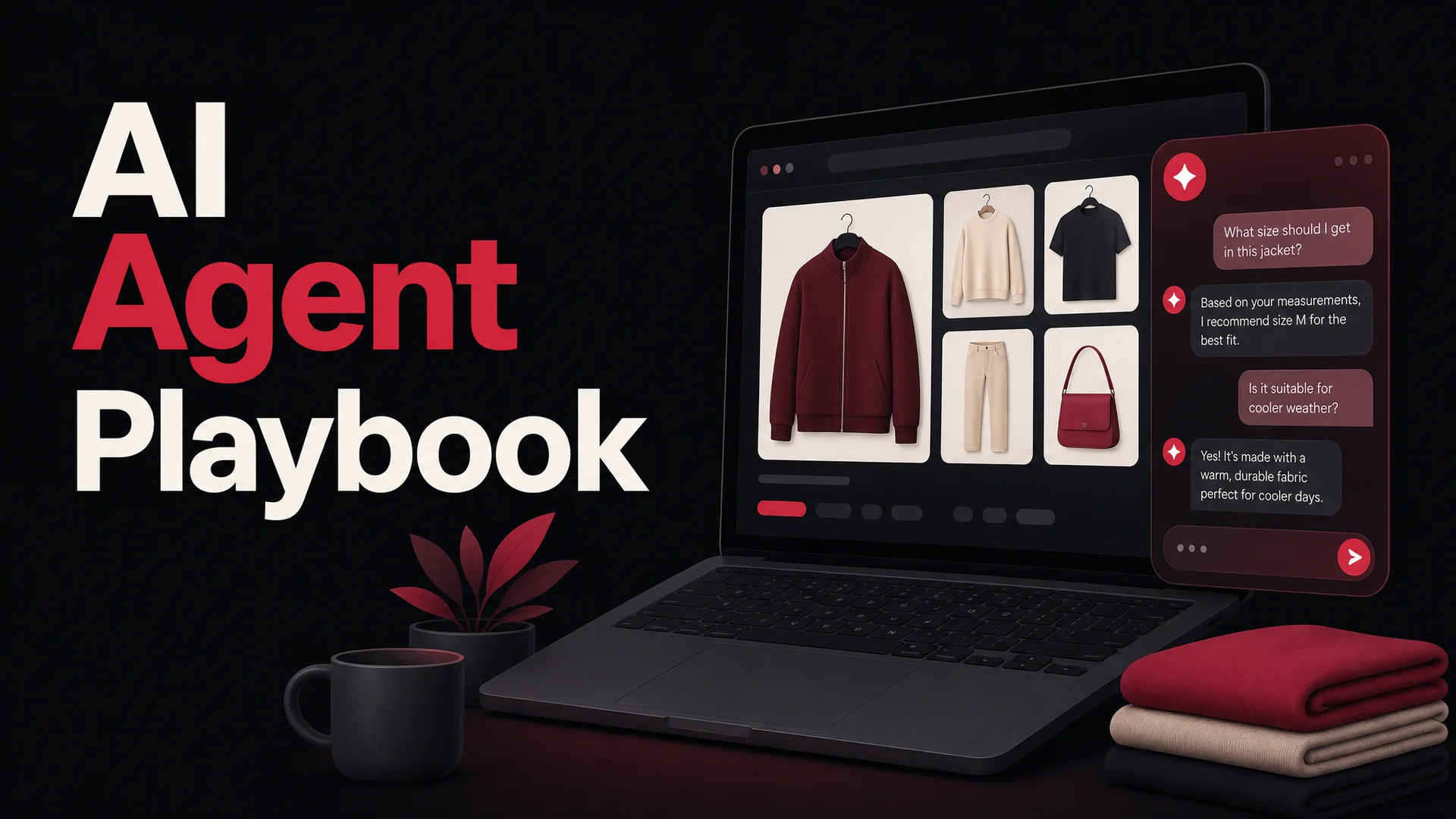
An ecommerce or retail AI agent is software that lives on your storefront and your messaging channels, talks to shoppers in their own language, and resolves their issues without a human in the loop. It answers product questions, recommends items, looks up orders, processes returns, recovers carts, books appointments where relevant, and escalates the messy edge cases to a human teammate with a full transcript and a summary attached. It sits across every place a customer can reach you - your storefront, your app, WhatsApp, Messenger, Instagram DMs, Slack channels for B2B accounts, and increasingly your in-store kiosks.
That description would have looked the same in 2021. What changed is the engine underneath it. The "chatbots" of five years ago were scripted decision trees: keyword in, canned response out. Phrase a question in an unexpected way and the bot collapsed into "I did not understand that, please rephrase." The scripted, intent-routed bots that defined the early wave have been displaced by reasoning-first models with million-token context windows and reliable tool use.
In 2026, the engine is a frontier large language model - and the frontier has moved a lot in the last twelve months. Anthropic's Claude Opus 4.7 leads SWE-bench Pro at 64.3% for complex tool use, and is the model most retailers we see pick for high-stakes flows like cancellations and chargebacks. OpenAI shipped GPT-5.5 and GPT-5.5 Pro with parallel reasoning - the difference between an agent that confidently hands a refund and one that hedges. Google's Gemini 3.1 Ultra runs natively across text, image, audio, and video with a 2M-token context window, which means a customer can send a photo of a damaged package and get a real answer in the same turn.
Just as importantly for storefront economics, the open-weight tier has caught up. DeepSeek V4 Flash sits at $0.14 per million input tokens and $0.28 per million output, with a 1M-token context. MiniMax M2.7, Moonshot's Kimi K2.6, Z.ai's GLM-5.1, Alibaba's Qwen 3.6 family, and Xiaomi's MiMo-V2-Pro all ship as open-weight, agentic-first models that are genuinely production grade. For a regulated retailer - pharmacies, healthcare-adjacent commerce, financial-services-tied loyalty programs - the MIT-licensed Chinese open-weights make on-prem and air-gapped deployment viable for the first time.
What this combination unlocks is concrete. An agent can hold your entire product catalog, your full policy library, and the shopper's previous conversation in context at once - RAG becomes a tuning lever, not a hard requirement. Routine "where is my order?" traffic can route to DeepSeek V4 Flash or MiniMax M2 at a fraction of a cent per resolution, while a complicated returns-and-refund chain gets handed to Claude Opus 4.7 or GPT-5.5 Pro. Tool use - the part that actually books, refunds, looks up, charges, schedules - has gone from demoware to dependable infrastructure.
A retail agent in 2026 is not a script wrapped around a model. It is a model wrapped around your catalog, your policies, your CRM, your fulfillment system, and your payment rails - with the licence to take actions on the customer's behalf when the situation calls for it.
The use cases that actually move revenue
The generic pitch for chatbots - "better customer experience" - is too vague to budget against. Here are the highest-leverage workflows where an AI agent earns its keep.
1. Personalized product discovery and guided selling
This is the single highest-ROI motion in ecommerce conversational AI. A "customers also bought" widget uses collaborative filtering - useful, but it has nothing to say about what you actually want. An AI agent parses intent in natural language. "I need a moisturizer for sensitive skin that does not feel greasy and is under $30, ideally fragrance-free." That sentence is unintelligible to a recommendation widget and trivial for a modern model. The agent narrows your 500-product catalog to three candidates, explains why each fits the constraints, surfaces the relevant ingredient or material details, and answers the inevitable follow-up about returns or shipping in the same breath.
The numbers back this up. About 31% of e-commerce shoppers add a product after an AI-driven recommendation, and personalized suggestions lift average order value by roughly 15%. The mechanic that made Amazon's recommendation engine responsible for around a third of its revenue is now available to a brand doing seven-figure annual revenue on Shopify.
In practice this looks like a shopper in the men's outerwear category getting wool-blend gloves and a beanie surfaced inside the same conversation that started with "do you have this in medium." It looks like a returning customer being shown the season's three pieces that match the cuts she has bought twice before. With a 1M-token context window on Claude Sonnet 4.6 or DeepSeek V4 Flash, the entire catalog plus the season's marketing copy plus the shopper's session history can sit in working memory for the model to draw from in real time.
2. Order tracking and proactive delivery updates
"Where is my order?" is the most common ecommerce ticket on the planet. Across the industry, status inquiries account for 30–40% of all support volume. Every one of those tickets is a repetitive, predictable task that an AI agent resolves in a single round trip by calling your order management system through an AI Action.
The shopper provides an order number or the email on file. The agent retrieves the carrier, the tracking link, the last scan, and the estimated delivery date. If there is a delay, it explains the cause - weather event, customs, carrier exception - and offers an option, whether that is a partial refund, a reship, or a courtesy credit.
The more interesting move is the proactive one. When the carrier flags a delay, the agent can reach out first - through WhatsApp or email - and offer a coupon or an updated ETA before the customer has to ask. A late delivery is normally a satisfaction killer; intercepted early and acknowledged honestly, it can be a loyalty builder.
3. Returns, refunds, and policy automation
Returns are where ecommerce support gets expensive in a hurry. A single return interaction can stretch across confirming the order, checking the eligibility window, explaining the policy, generating a label, refunding the card, and reassuring the customer about the timeline. That is a ten-minute call or a six-message email thread.
A modern agent handles the same flow in under two minutes. It confirms the SKU and purchase date, checks the return window against your policy, opens the RMA in your back-end, generates the prepaid label through your shipping integration, and sets the refund expectation accurately because it actually queried your payment processor for the timing. Tool-use reliability is the whole story here, and it is precisely where the agentic class of 2026 - Kimi K2.6, GLM-5.1, Claude Opus 4.7, Qwen3.6, MiMo-V2-Pro - has stopped being demo-quality.
4. Cart recovery and checkout rescue
With abandonment near 70%, this is the highest-leverage workflow you can automate. The agent intervenes in two modes.
The proactive mode triggers on signal: extended inactivity on the checkout page, an exit-intent gesture, a billing form abandoned mid-fill. Instead of a generic "10% off if you come back" popup, the agent opens with a targeted line - "I noticed you have items in your cart. Anything I can help with on sizing or shipping before you wrap up?" - and is then equipped to actually answer.
The reactive mode is the post-abandonment follow-up. The agent reaches the shopper through email, SMS, or WhatsApp with a message that references the actual items in the cart, addresses the most likely objection for that category and price point, and includes a one-click resume link. Brands running this pattern through Berrydesk see cart-abandonment drops in the 20–30% range and recovery-driven revenue lifts of 7–25% depending on category. Higher-AOV verticals - furniture, jewelry, premium electronics - sit at the top of that range because the conversation is where the trust gets built.
5. Cross-selling, upselling, and conversational bundling
A good salesperson reads the conversation and surfaces the obvious complement at the obvious moment. A coffee maker pairs with filters and a descaling kit. A laptop pairs with a sleeve, a mouse, and an extended warranty. A dress pairs with a clutch and a pair of earrings.
An AI agent does this across every conversation, on every channel, twenty-four hours a day, with perfect recall of your full SKU set. Done well, an upsell is not pressure - it is taste. With a million tokens of context, the agent can hold the full bundle logic, every active promotion, the customer's prior purchases, and the inventory state in working memory at once. There is no orchestration layer doing fragile lookups against a slow recommendation API; the model just answers from context. Conversational upsells generate around a 14% revenue lift on average, and that is for retailers running them well.
6. Virtual shopping assistants for fuzzy intent
Most shoppers are not in "buy this exact thing" mode. They are in "I have an event next Friday and I need an outfit" mode, or "my MacBook is three years old and I do not know what to replace it with" mode. A virtual shopping assistant translates fuzzy intent into a short list of real SKUs.
For a fashion brand this means asking about occasion, fit preference, palette, and budget, then producing five outfits the customer can actually picture wearing. For consumer electronics it means walking through use cases - gaming, video editing, travel - and matching specs to behavior. For beauty it means a short skin diagnostic and a regimen, not a list of bestsellers.
What changed in 2026 is that the agentic tool-use models can now reliably execute the back-half of this conversation. The agent does not just suggest the outfit. It checks size availability across warehouses, applies a first-time-buyer discount, books a fitting appointment if you offer one, and emails a wishlist if the shopper wants to think about it. That is the difference between a bot and an assistant.
7. Multilingual support without multilingual headcount
A non-trivial percentage of online shoppers expect a tailored experience, and the most fundamental form of personalization is language. A modern agent detects the customer's language from the first message and responds natively, with the same product knowledge and policy fluency in Japanese, German, Portuguese, or Arabic as in English. It can switch languages mid-conversation without reconfiguration. Gemini 3.1 Ultra and Claude Opus 4.7 are particularly strong in low-resource languages where older models tended to fall back to English mid-sentence.
A single Berrydesk agent can hold a fluent conversation in 80+ languages - including the long tail of languages where dedicated human support has historically been uneconomical to staff. The same agent ships to your website, WhatsApp, Instagram, Messenger, Slack, and Discord from a single dashboard.
8. Loyalty programs without the support load
Loyalty programs generate a steady drip of "how many points do I have," "how do I redeem these," "when do these expire" inquiries. Every one of those is an automatable conversation that, left to a human, costs more to resolve than the discount the customer is asking about.
A Berrydesk agent connected to your loyalty backend handles all of it inline - balance checks, redemption walkthroughs, expiry warnings, tier benefits explanations - and creates natural moments to surface a personalized offer. "You have 1,200 points expiring in three weeks; here are three ways to use them on items you've recently looked at." That is loyalty marketing that does not feel like marketing.
9. Conversational feedback that customers actually leave
Survey response rates are in long-term decline. Conversational feedback - asking a single, specific question at the end of a resolved chat - collects what a star-rating popup never will. Berrydesk agents can be configured to ask different questions for different conversation types: post-delivery satisfaction for fulfillment threads, fit feedback for fashion, install or setup smoothness for electronics. The data goes straight into your analytics layer, and the volume is two to five times what a traditional NPS email pulls in.
10. Proactive engagement, with restraint
Most storefronts are still passive. Visitors browse, hit a friction point, and leave silently. A proactive agent flips that, but it has to be done with restraint. Popping a chat window the second a visitor lands is the digital equivalent of a sales associate following you around a store; you will lose the customer faster than you would have lost them to indecision.
The version that works fires on signal. Thirty seconds on a single product page without scrolling is one. A third visit to the same category in a week is another. Landing from a high-intent paid search ad is a third. Engaged shoppers who hit one of these signals and get a relevant, on-brand opener convert noticeably better - proactive agents have lifted site-wide conversion by as much as 38% in case studies.
The benefits that show up on the P&L
Revenue. Across recommendations, recovery, upsell, and round-the-clock availability, the average retailer running a properly configured AI agent reports measurable top-line lift. The 58% figure that gets quoted in the analyst reports is the floor, not the ceiling - the brands at the top end are well into the double digits as a percentage of digital revenue. Shoppers who interact with an AI agent are roughly four times more likely to convert than those who browse alone.
Cost per resolution. A human-handled retail support interaction lands somewhere between $6 and $15 when you load in salary, tools, and overhead. An AI-handled interaction sits around $0.50–$0.70 at full retail model pricing - and falls into single-digit cents per conversation when you route routine traffic to DeepSeek V4 Flash or MiniMax M2. That is a 90%+ reduction on the inquiries that make up the bulk of your volume.
Always-on coverage. Your storefront does not close at five. About 26% of e-commerce traffic in most categories hits between 9 PM and 7 AM local time, and an agent that can handle that traffic captures revenue that would otherwise have leaked to a competitor open in another timezone.
Elastic capacity. Black Friday, Singles Day, a viral TikTok - none of them require you to scramble for seasonal staff. The agent absorbs a 50x traffic spike on the same infrastructure it serves a Tuesday afternoon.
Consistency. Every shopper gets the policy correct, the size chart correct, the return window correct, on-brand voice every time. The variance that comes with a thirty-person support team disappears.
Insight. Every conversation is a labeled dataset. What customers are asking, where they are stuck, what they are searching for that you do not stock, which product page generates the most pre-purchase questions - all of it surfaces in your analytics in near-real-time.
Human leverage. The 70–80% of inquiries that the agent absorbs frees your human team for the conversations that actually need them: complex returns, VIP relationships, complaints, retention saves, B2B accounts. Your agents stop being ticket processors and start being the part of the brand customers remember.
What good looks like: a composite deployment
Consider a composite of what a well-tuned Berrydesk agent looks like in the wild for a mid-market home and garden retailer with roughly 1,200 SKUs and a small in-house support team.
In the first month, the agent absorbs about two-thirds of incoming conversations end-to-end without a human ever touching the thread. Routine status checks - about 35% of inbound - get handled in a single round trip. Return initiations, which used to consume the morning of one full agent, drop to a queue of clarifying questions and exceptions. The team's average first response time falls from hours to seconds.
On the revenue side, the agent's guided-selling flow converts shoppers who would otherwise have bounced off a category page. The cross-sell engine adds a meaningful single-digit-to-low-double-digit lift to average order value. Cart recovery - proactive intervention on the checkout page plus reactive WhatsApp follow-ups - claws back a chunk of abandoned sessions that were previously simply lost.
The retailer reassigns one of two support agents from ticket triage to onboarding and outbound, because there is no longer enough reactive volume to occupy two full-time people. That headcount reallocation is, more often than not, the largest single line item in the ROI calculation.
These numbers are not unique to one industry. Apparel, beauty, electronics, specialty foods, hardware, B2B distribution - the workflows are different in detail and identical in shape: deflect repetitive questions, surface the right product at the right moment, intervene at the abandonment threshold, hand off cleanly when judgment is required.
How to deploy on Berrydesk, step by step
Standing up a production-grade ecommerce agent on Berrydesk does not require an engineer or a six-week timeline. The actual flow is four steps, with two more for the boring-but-essential operational hygiene.
Step 1: Pick your model - and your model mix. In Berrydesk, you select the underlying engine when you create the agent. Most stores benefit from a tiered configuration. Route routine traffic - order status, simple FAQs, sizing - to a fast, cheap workhorse like DeepSeek V4 Flash or MiniMax M2 at fractions of a cent per resolution. Route ambiguous, multi-step, or high-stakes interactions - refunds, complaints, custom orders - to a frontier model like Claude Opus 4.7, GPT-5.5 Pro, or Gemini 3.1 Ultra. The same agent, same training data; only the model behind the wheel changes by intent. For regulated or air-gapped deployments, the MIT-licensed Chinese open-weight models - GLM-5.1, Qwen3.6-27B, MiMo-V2-Pro - make on-prem genuinely viable.
Step 2: Train on your data. This is the step that decides whether your agent is useful or embarrassing. Feed it everything it would need to do the job: full product catalog with descriptions, specs, and prices; complete return, shipping, and warranty policies; sizing and care guides; the FAQ; anonymized past support transcripts; relevant Notion pages, Google Drive folders, or YouTube product videos. Berrydesk crawls and indexes the lot. The principle could not be simpler: more data, better answers. A 200-product catalog with full specs beats a 10-question FAQ every single time. If your agent sounds vague, the fix is almost always more training data, not more prompt engineering.
Step 3: Brand the widget and configure behavior. Set the agent's name, the brand colors, the welcome message, the tone of voice. Then write the operating instructions in plain language: "Be warm and concise. Recommend complementary products when relevant, never aggressively. If a shopper asks for a product we do not carry, suggest the closest in-stock alternative. Never invent shipping times - only quote what the order management system returns. Escalate to a human if the shopper asks twice or expresses frustration." This is a contract with the model, and modern frontier models follow it closely.
Step 4: Wire up AI Actions and channels. AI Actions are the part that turns the agent from a fancy FAQ into a real teammate. Connect Shopify or your custom backend for order data, Stripe for payment lookups and refunds, your help desk for ticket creation and escalation, your CRM for context, your booking tool if you sell installations or consultations. Then deploy the same agent to your website, WhatsApp, Instagram, Messenger, Slack, and Discord with the channel switches in the dashboard. One agent, one set of training data, every surface your customers actually use.
Step 5: Watch the missed-questions log. This is the operational habit that separates a good deployment from a mediocre one. Every week, open the missed-questions and low-confidence conversation log in Berrydesk. Each entry is a gap in your training data. Add the missing information - usually a paragraph in a policy doc or a product field - and the agent improves on the next interaction. Plan a monthly refresh as catalog, pricing, and policies drift.
Step 6: Plan for handoff. Configure the conditions that trigger a human takeover and the data that travels with the conversation: the full transcript, the customer's order history, what the agent already attempted. The handoff is not a failure of automation. It is the seam where automation earns trust.
Open-weight, closed frontier, or routed: the cost decision
The single most consequential architectural choice for a retail agent in 2026 is which model - or models - to run behind it. The honest answer is rarely a single model.
A pure closed-frontier approach - Claude Opus 4.7 or GPT-5.5 Pro on every conversation - gives you the highest ceiling on quality and the cleanest tool-use behavior. It is also the most expensive way to answer "where is my order?" eight thousand times a day.
A pure open-weight approach - DeepSeek V4 Flash, MiniMax M2, GLM-5.1 - gives you a much better unit economic profile, MIT and Apache licensing where on-prem matters, and genuinely strong agentic behavior. The ceiling on the hardest, most ambiguous conversations is a notch below the closed frontier on most days.
A routed approach - cheap, fast model on routine intents; frontier model on complex intents; open-weight model on regulated workloads - captures most of the benefit of both. It is also the configuration Berrydesk is built for. Most stores end up here within a quarter of going live. Closed-frontier picks: Claude Opus 4.7 for any flow that involves money or risk, GPT-5.5 Pro for multi-step orchestration, Gemini 3.1 Ultra when the conversation involves images, video, or audio.
RAG, long context, or both
The second architectural debate is whether to keep the classic retrieval-augmented-generation pipeline or to lean on the new million-token context windows.
The pre-2026 answer was obvious: RAG, always, because no model could hold a full catalog. The 2026 answer is more interesting. With Claude Opus 4.6 and Sonnet 4.6 shipping a 1M-token context at no surcharge, with DeepSeek V4 matching it, and with Gemini 3.1 Ultra at 2M, you can in principle drop your entire SKU sheet, your full policy library, and the active promotion calendar into the model's working memory and skip retrieval entirely.
The pragmatic answer is both. Use long context to hold the slow-moving spine of your business - policies, brand voice, top-200 products, the active campaign brief. Use RAG for the long tail and for anything that changes by the minute, like inventory levels and pricing. That combination is faster than pure RAG (no retrieval round-trip on the common path), more accurate than pure long-context (no needle-in-haystack drift), and cheaper than either taken to an extreme.
How to choose a platform - and what to avoid
Not every product on the market is built for ecommerce, and a lot of "AI chatbot" tools are still rule-based decision trees in a chat interface. They follow scripted paths: if the shopper says X, respond with Y. The moment a question lands outside the script, the bot fails. For ecommerce, where product questions are infinitely varied and context matters enormously, a rule-based bot creates more friction than it removes. Honest evaluation criteria look like this.
Training on your data, not templates. The platform should let you upload your own catalog, your own policies, your own transcripts - and learn from them. Templates cannot tell a shopper whether your specific jacket runs large.
Real-time data through Actions. The agent needs to read live order status, current inventory, and CRM context. A bot that cannot answer "did my order ship?" with the actual answer is window dressing.
Multi-channel deployment from one place. Your shoppers are on the website, WhatsApp, Instagram, Messenger, and sometimes Slack or Discord. The agent should ship to every channel from a single config and keep one unified conversation history.
Model choice and tiering. The cost story for an ecommerce agent in 2026 is the model you run, not the platform fee. A platform that locks you into one frontier model is leaving money on the table compared to one that lets you route by intent across GPT-5.5, Claude Opus 4.7, Gemini 3.1, DeepSeek V4, Kimi K2.6, GLM-5.1, Qwen 3.6, and MiniMax M2.
Clean human escalation with full context. When the agent hands off, it should hand off the transcript, the customer record, the order context, and a one-line summary of what was attempted.
Analytics that map to revenue. Total chat volume is a vanity metric. Deflection rate, revenue per chat session, AOV change for chat-assisted orders, and cart-recovery contribution are the metrics that decide whether the deployment pays for itself.
Native ecommerce integrations. Shopify, WooCommerce, Magento, Stripe, Zendesk, and your CRM should be one-click, not a custom webhook project.
The gap between approaches is large. A rule-based bot handles maybe 20% of real shopper queries acceptably. An AI agent trained on your data handles 60–80% on day one and creeps past 90 with a few weeks of refinement.
Mistakes that kill ecommerce AI agent deployments
Most failed deployments are not technology failures. They are operational ones.
Training on a 10-question FAQ
The single most common deployment failure is an agent trained on a thin FAQ page. The model has nothing to work with, so when a shopper asks something outside the ten covered topics, the agent either hallucinates or punts with a non-answer. Both outcomes erode trust quickly. Upload everything: the full catalog with descriptions and specs, the complete policy library, sizing and warranty docs, anonymized past transcripts.
No human escalation path
In 2024, an airline's customer support bot fabricated a bereavement-fare refund policy that did not exist. A customer relied on the bot's answer, bought a ticket, and was refused the refund. A Canadian tribunal ruled the airline liable for what the bot had said. The lesson is not that AI is dangerous. The lesson is that an AI without a clean human escalation path manufactures liability. Customers accept AI assistance. They do not accept being trapped in a loop with no way to reach a person, especially when the answer they got was wrong.
Set it and forget it
An ecommerce agent is a living system, not a one-time install. Products change. Prices shift. Promotions launch and expire. Return windows tighten and loosen. Without a weekly review of the missed-questions log and a monthly training refresh, the agent's quality drifts down within a quarter. The operational cadence is small - about an hour a week - and the compounding return is significant.
Generic responses across every price tier
A shopper asking about a $15 t-shirt has different expectations than a shopper asking about a $2,000 appliance. Configure the agent to adjust response depth and consultative tone by category and price band. The cheap purchase wants speed. The expensive purchase wants confidence.
Ignoring mobile
Most ecommerce traffic is mobile. If your widget loads slowly, blocks product imagery, or feels cramped on a small screen, you are degrading the experience for the majority of your customers. Test on real devices, not just the dashboard preview. The bar is "would I talk to this on the train."
Skipping the brand voice
A luxury retailer's agent and a streetwear brand's agent should not sound the same. If yours does, the agent reads as a generic vendor bot, and the conversion lift will be smaller. Spend a real afternoon writing the voice prompt, and revisit it quarterly.
Treating the agent as a wall, not a door
The point of an ecommerce agent is not to keep the customer away from your team. It is to filter so that your team spends its time where judgment matters. Configure handoff aggressively for high-value carts, complaint patterns, and emotionally loaded messages. The agent should make your support team more effective, not unreachable.
The metrics worth tracking
Most chatbot dashboards drown you in vanity statistics. The metrics that actually predict whether the deployment is paying for itself are short.
- Conversion rate, before and after. Measure store-wide conversion for thirty days before deployment and thirty days after. This is the primary signal.
- Average order value for chat-assisted orders versus unassisted. This isolates the lift from cross-sell and guided selling.
- Cart abandonment on the checkout page specifically. Checkout-page abandonment is where purchase intent was already real, which is where intervention has the highest ROI.
- Ticket deflection rate. A well-trained agent should deflect 50–70% in month one and grow from there.
- First response time. The before/after delta should be measured in orders of magnitude.
- Chat satisfaction. Thumbs up and thumbs down by week. Watch the trend, not the absolute number.
- Revenue per chat session. The most undertracked metric, and often the most decisive one. Total chat-attributed revenue divided by chat sessions in the same period.
What to mostly ignore: total chat volume on its own, and "accuracy" without a business outcome attached. A bot can be 95% "accurate" and still cost you money if it never recommends a product, never recovers a cart, and never handles a return.
Why 2026 is the year this stops being optional
The reason this guide is different from one written 18 months ago is that the underlying capability has moved. SWE-bench Pro, the benchmark for genuinely complex multi-step engineering tasks, has frontier models - Claude Opus 4.7 at 64.3%, Kimi K2.6 at 58.6%, GLM-5.1 at 58.4%, MiniMax M2.7 at 56.22% - solving more than half of problems that were unsolvable to commercial models a year ago. That same step change shows up in ecommerce agents as reliable AI Actions: refunds that complete cleanly, bookings that don't double-book, payments that route to the right rail, returns that file with the correct reason code.
Token economics have moved in parallel. DeepSeek V4 Flash at $0.14 per million input tokens makes routing routine traffic to a frontier-grade open-weight model a rounding error in your COGS. MiniMax M2 runs at roughly 8% the price of Claude Sonnet at twice the speed for the workloads it is good at. The cost of "have an agent answer this" has fallen by roughly an order of magnitude since 2024, and the floor on quality has risen at the same time.
The practical consequence for an operator is that an ecommerce AI agent has crossed the line from optional differentiator to default infrastructure. The stores that deploy one in 2026 are not going to win because their bot is magical. They are going to win because the stores that do not deploy one will look, by comparison, slow.
Frequently asked questions
What is an ecommerce AI agent? Software that lives on your storefront and your messaging channels and handles customer interactions automatically. It answers product questions, looks up orders, processes returns, recommends items, recovers carts, and escalates the cases that require human judgment with the full transcript attached. Modern agents run on frontier large language models trained or grounded on your specific catalog, policies, and order data.
How much does it cost? Costs range from a free tier for small stores to a few hundred dollars a month for higher-volume operations. With Berrydesk's model routing, you can put routine traffic on open-weight models like DeepSeek V4 Flash or MiniMax M2 for fractions of a cent per resolution, and reserve frontier models for the harder conversations. Most stores see positive ROI inside the first month.
Can it actually move sales? Yes, and the pattern is consistent across categories. Documented deployments show conversion lifts in the tens of percent, AOV gains from cross-sell and bundling in the high single to low double digits, and cart-recovery contributions in the same range.
Do I need engineering help to deploy one? No. Berrydesk is fully no-code. Pick a model, upload your catalog and policies, configure tone in plain language, brand the widget, wire up AI Actions to Shopify or Stripe with one-click integrations, and embed the widget with a single snippet. An afternoon for most stores.
Which platforms does it integrate with? Berrydesk connects to Shopify, WooCommerce, Magento, and custom storefronts; payment processors including Stripe; help desks like Zendesk; CRMs; and messaging surfaces including WhatsApp, Messenger, Instagram, Slack, and Discord. The same agent ships to all of them at once.
How is this different from live chat? Live chat needs a person on the other end. An AI agent is on 24 hours a day, handles thousands of simultaneous conversations, and only escalates when human judgment is genuinely required. Most stores run both - the agent on the front line, humans on the long tail.
Which model should I pick? For most ecommerce deployments, the right answer is a tiered configuration: a fast, cheap open-weight model for routine traffic (DeepSeek V4 Flash or MiniMax M2), a frontier model for complex conversations (Claude Opus 4.7, GPT-5.5 Pro, or Gemini 3.1 Ultra), and an MIT-licensed model for any regulated or air-gapped workloads (GLM-5.1, Qwen3.6-27B, or MiMo-V2-Pro). Berrydesk lets you pick a primary model and route by intent without writing code.
What is a realistic ROI? For a $50,000-per-month store, even a 10% conversion lift and a 50% ticket deflection rate is north of $8,000 a month in combined revenue and savings. The numbers scale roughly linearly with traffic. The decisive variable is training data quality.
If you want to see what this looks like for your store, Berrydesk lets you spin up a branded AI support agent - pick your model, train it on your catalog and policies, brand the widget, and ship it to your website and messaging channels - without writing a line of code. Start at berrydesk.com and have your first agent live before the next abandoned cart.
 Berrydesk
Launch your ecommerce AI agent in minutes
- Trained on your full catalog, policies, and order data - not a 10-question FAQ
- Routes routine traffic to cheap open-weight models, escalates to GPT-5.5 or Claude Opus 4.7 only when it should
Set up in minutes

Chirag Asarpota is the founder of Strawberry Labs, the team behind Berrydesk - the AI agent platform that helps businesses deploy intelligent customer support, sales and operations agents across web, WhatsApp, Slack, Instagram, Discord and more. Chirag writes about agentic AI, frontier model selection, retrieval and 1M-token context strategy, AI Actions, and the engineering it takes to ship production-grade conversational AI that customers actually trust.