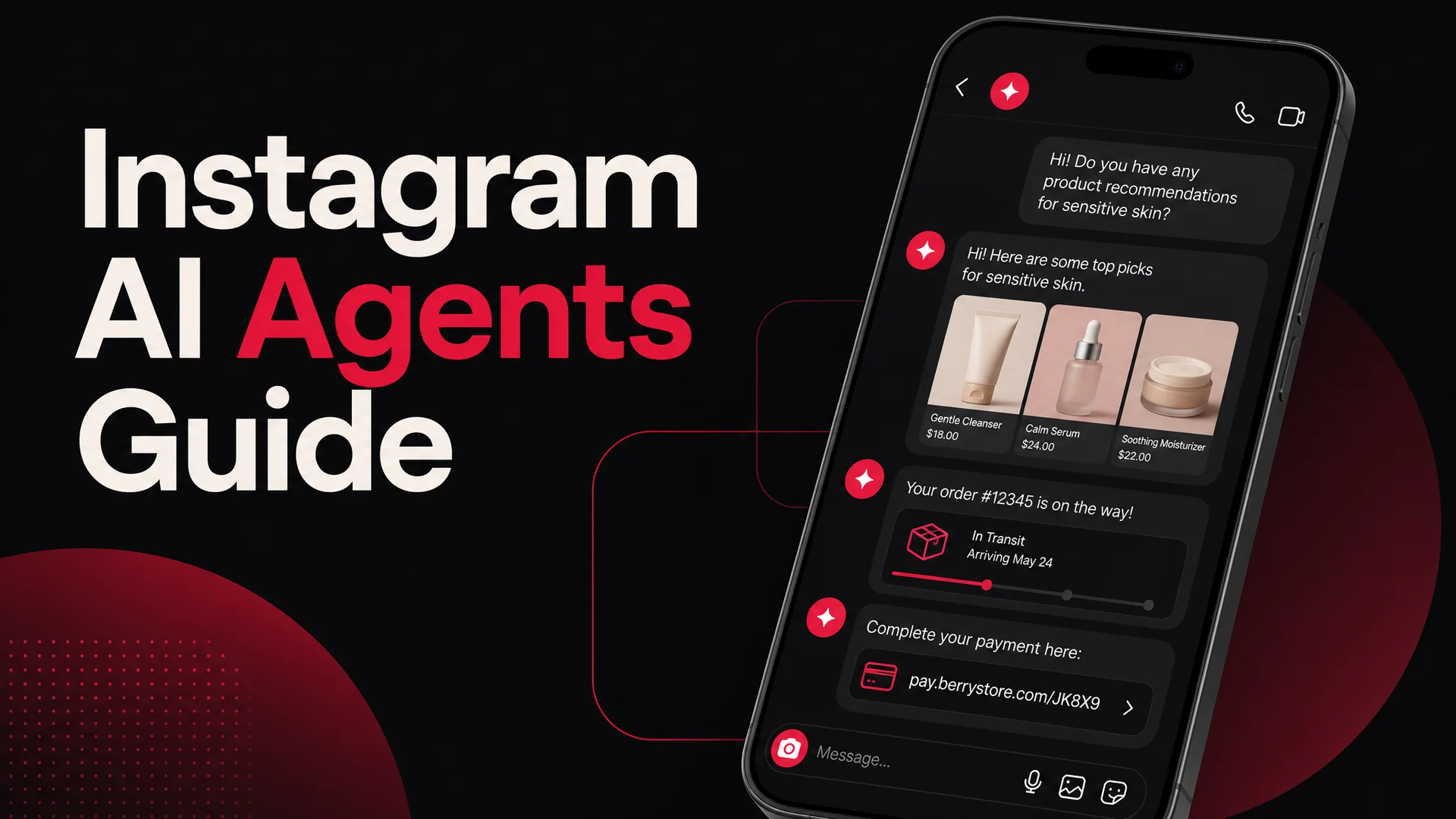
It's a Tuesday evening. A shopper lands on your product page, scrolls through the gallery, pinches into a fabric close-up, taps through to the reviews, and lingers near "Add to cart" for the better part of ten minutes.
Then the tab closes. No purchase. No email. No abandoned-cart trigger that explains what actually happened.
Almost always, what happened is the same thing: there was one small question they couldn't answer fast enough. A sizing nuance. The cutoff for next-day delivery. Whether a return is free or just possible. Whether the warranty covers the thing they're actually worried about. They had a 30-second decision in front of them, and your store didn't give them a 30-second answer.
This is the quiet leak in nearly every direct-to-consumer business: friction that no one ever files a ticket about. The shopper just leaves and buys somewhere else, and your analytics record it as a routine bounce.
The brands winning in 2026 aren't winning on price or even on product alone - those gaps close quickly. They're winning on service that meets shoppers in the moment, in the channel, and in the language they're already using. Service that feels like a smart store associate, not a phone tree.
What e-commerce customer service actually is
E-commerce customer service is the entire arc of help your store provides around a purchase: pre-sale guidance that reduces hesitation, in-checkout reassurance that protects conversion, and post-purchase support that protects the relationship.
That includes obvious things - sizing, shipping windows, payment failures, returns, warranty claims, order tracking - and a long tail of smaller asks that often matter more: "does this ship to a P.O. box?", "can I add a gift note?", "is this restock genuine or a pre-order?", "will my discount stack on a sale item?". Every one of those is a tiny moment where the customer either trusts you and continues or doesn't and leaves.
Modern support runs across email, live chat, WhatsApp, Instagram and TikTok DMs, SMS, Discord servers for community-driven brands, and increasingly an AI agent embedded directly in the storefront. The surface area has grown, but the underlying job has not. Help people quickly. Be specific. Be honest. Solve the problem the first time.
What good service actually buys you
It is tempting to treat support as a cost line - a function whose only job is to be cheaper. The teams that grow fastest treat it as a revenue channel. Here is what well-run support actually returns.
Retention you don't have to re-buy
Acquiring a new customer in most consumer categories now costs many multiples of keeping an existing one. When a buyer trusts that your store will resolve a sizing exchange or a damaged-in-transit claim without a fight, they stop comparison shopping. They come back, and they bring the friends who watched the issue get handled.
Larger second and third orders
A smooth first interaction sets the ceiling for the second basket. The customer who needed a different size in their first order, got it overnight, and felt taken care of is the customer whose next order is two pieces instead of one. The math compounds across the year.
Reviews and word of mouth that actually convert
Every well-handled support thread is a candidate for a five-star review, an unprompted Instagram story, or a screenshot posted to a community subreddit. That kind of social proof outperforms paid media on conversion because it shows the part of your operation that prospects actually worry about: what happens when something goes wrong.
Fewer chargebacks and disputes
A meaningful share of chargebacks aren't fraud - they're frustration. The customer couldn't reach you, assumed the worst, and let their bank handle it. A two-minute reply about a delayed shipment will routinely save a transaction that would otherwise become a dispute, a refund, and a lost product.
Higher checkout conversion
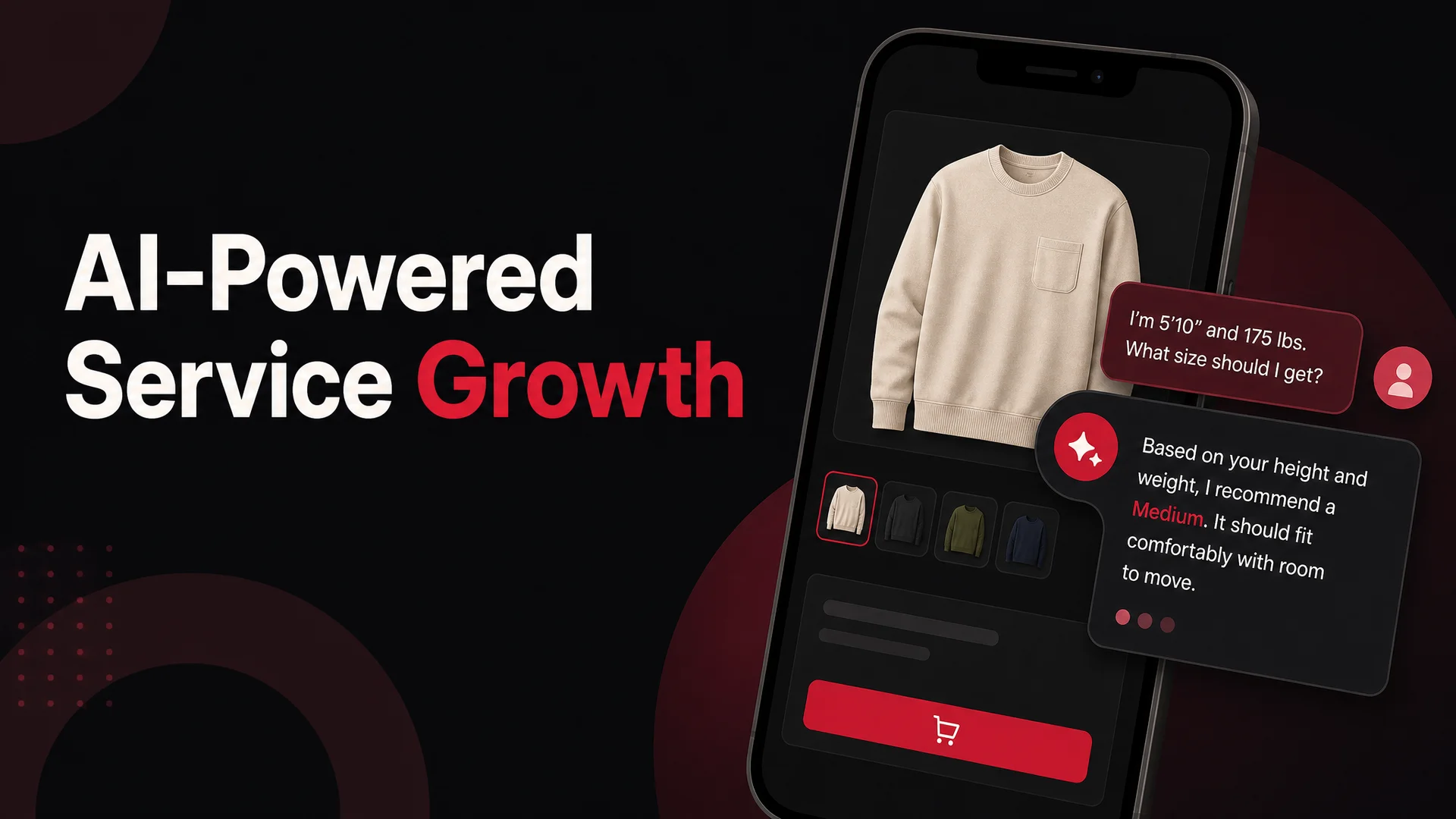
Pre-purchase questions are pre-purchase doubts in disguise. When a shopper can ask "will this fit a size 9 wide foot?" inside the product page and get an answer in seconds, the doubt collapses and the order completes. This single pattern is one of the highest-leverage uses of AI in commerce today.
A constant feed of product and operations insight
Support conversations are the most honest research instrument you own. The repeated question is a packaging problem. The recurring complaint is a sizing chart problem. The confusion at checkout is a UX problem. If support data isn't flowing back to merchandising, ops, and product, you are throwing away the most useful signal in your business.
The 2026 model landscape - and what it means for support
The reason support is suddenly a place where AI actually earns its keep, rather than a punchline, is that the underlying models have changed shape in the last year.
Anthropic's Claude Opus 4.7 leads SWE-bench Pro at 64.3% for complex coding and is exceptional at the kind of structured reasoning a support agent needs to handle a multi-step return. Claude Opus 4.6 and Sonnet 4.6 both ship with a 1M-token context window at no surcharge - enough room to hold an entire help center, the customer's full order history, and your current promo policy in a single prompt. OpenAI's GPT-5.5 and GPT-5.5 Pro brought parallel reasoning into the default stack in April 2026. Google's Gemini 3.1 Ultra carries a 2M-token context and is natively multimodal across text, image, audio, and video - which matters the moment a customer drops in a photo of a damaged item.
The bigger shift, especially for cost-sensitive support volume, is the open-weight frontier. DeepSeek V4 Flash is priced at $0.14 per million input tokens and $0.28 per million output, with a 1M context. MiniMax M2 and M2.7 run at roughly 8% the price of Claude Sonnet at twice the speed. Z.ai's GLM-5.1, Moonshot's Kimi K2.6, Alibaba's Qwen 3.6 family, and Xiaomi's MiMo-V2-Pro round out a set of agentic, tool-use-native models with MIT or Apache licenses - meaning on-prem, air-gapped, and regulated deployments are now genuinely viable.
The practical implication for an online store is straightforward. You no longer pick a single model and live with the trade-offs. A well-built support stack routes the routine 80% of conversations - order tracking, return windows, shipping ETAs, restock questions - to a fast, cheap model like DeepSeek V4 Flash or MiniMax M2, and reserves Claude Opus 4.7, GPT-5.5 Pro, or Gemini 3.1 Ultra for the complex escalations that justify the price. Berrydesk lets you set this routing as a deployment config, not a research project.
How to build a support operation that actually works
Good service does not arrive by accident. It is the output of a few decisions made deliberately.
Meet customers where they already are
Your shoppers do not all live in your inbox. Some prefer the chat widget on the site. Some only ever DM Instagram. Some want a WhatsApp thread with a real human. Some live in a Discord. Pick two or three high-traffic channels to start - typically the on-site widget, email, and one social platform - and unify the inbox so that the same conversation looks the same regardless of where it began. Berrydesk deploys a single agent across web, Slack, Discord, WhatsApp, and more so the experience and knowledge stay consistent.
Set response-time targets, then publish them
Customers do not need miracles, but they do need a floor. A reasonable starting point in 2026:
- Live chat or AI agent: instant for FAQs, under two minutes when a human takes over
- Email: under six hours during business windows, under twelve hours overnight
- Social DMs: under two hours
Even an honest "we've got this and you'll hear back by 4pm" message beats silence, which is interpreted as indifference.
Use templates without sounding like a template
Macros and snippets save real time on shipping delays, return requests, address corrections, and sizing questions. The trick is to treat them as scaffolding, not the final answer. Lead with the customer's name and the specific detail they raised, then drop the standard middle, then close with a personal sentence. Modern AI support agents do this automatically: they pull from your saved replies, but rewrite the wrapper around the customer's actual question.
Train the team - or train the agent
If you have human agents, they should know your catalog, your return policy, your shipping carriers, and your top ten edge cases by heart. If you are running solo or with a thin team, your AI agent is your operating manual. Train it on your help center, your product pages, your refund and warranty policies, your Notion ops docs, your Google Drive of supplier sheets, and any internal recordings you have. Berrydesk trains on docs, websites, Notion, Google Drive, and YouTube in the same flow, so your agent walks in with the same context a senior support hire would have on day 30.
Maintain a real knowledge base
A meaningful share of inbound support is, frankly, the same six questions. "Where's my order?" "How do returns work?" "What's the warranty?" "Do you ship to my country?" "Can I change the address?" "How do I cancel?" Put those answers in a clean, searchable help center. Two things happen: deflection rises, and your AI agent has a higher-quality source to ground on, which raises accuracy on the questions that do come through.
Close the loop with feedback
Every ticket is a data point. Tag them. Watch the categories. The week your "where is my order" volume spikes is the week your carrier is slipping. The month "fit runs small" appears in the top five tags is the month merchandising should reconsider the size chart. Without this loop, support is a treadmill. With it, support is a steering wheel.
What to watch out for
A few honest pitfalls worth flagging before you over-invest.
Don't deploy an AI agent on top of a broken knowledge base. The agent will faithfully repeat whatever stale, contradictory, or incomplete information it finds. Spend a week pruning the help center before you spend a day on the bot.
Don't hide the human escalation path. Customers tolerate AI when it works and resent it when it doesn't. A visible, frictionless "talk to a person" handoff turns the agent from a wall into a useful first line of triage.
Don't pick one model and call it strategy. A single-model stack overpays for routine resolutions and underperforms on hard ones. Routing is the unlock.
Don't outsource judgment on policy edge cases. AI is excellent at applying a clear policy. It is worse at deciding when to break one. Keep humans in the loop for refunds outside the standard window, goodwill credits, and anything involving a regulator.
Don't ignore tone. Brand voice is not optional. The agent that resolves the ticket but sounds like a different company is a regression.
Open-weight vs closed frontier - and where AI Actions fit
A common question right now is whether to standardize on the closed frontier (GPT-5.5, Claude Opus 4.7, Gemini 3.1 Ultra) or lean on the open-weight wave (DeepSeek V4, GLM-5.1, Qwen 3.6, MiniMax M2, MiMo-V2). The honest answer is "both, by traffic shape."
Closed frontier models still set the ceiling on hard, ambiguous, multi-step reasoning - the messy refund, the unusual warranty case, the angry escalation that needs a delicate response. Open-weight models, with their dramatic price and latency advantages, are now strong enough to own the long tail of routine resolution. Agentic tool-use behavior - calling your order system, your shipping API, your payment processor - is reliably production-ready in Kimi K2.6, GLM-5.1, Claude Opus 4.7, Qwen 3.6, and MiMo-V2-Pro, which is what makes "AI Actions" - bookings, refunds, order lookups, address changes, payment captures - work as live transactions rather than demos.
Berrydesk's AI Actions sit on top of this. Your agent doesn't just describe how to update a shipping address; it actually updates it, in your order management system, with the customer watching.
Getting started
If you want a fast, low-risk path to better service, the simplest move is to put a branded AI support agent on the site, train it on your existing help center and product catalog, wire up the three or four AI Actions that absorb the most repetitive ticket volume, and watch what changes in your conversion and CSAT numbers over a month.
That's the playbook Berrydesk is built for. Pick your model - GPT-5.5, Claude Opus 4.7, Gemini 3.1, DeepSeek V4, Kimi K2.6, GLM-5.1, Qwen 3.6, MiniMax M2, or others - train it on your docs, websites, Notion, Google Drive, or YouTube content, brand the widget, add the AI Actions that match your operations, and deploy it across your storefront, Slack, Discord, and WhatsApp in the same afternoon. No engineering team required.
Ready to turn support into the part of your store that quietly compounds? Start at berrydesk.com and have your agent live before your next campaign drops.
 Berrydesk
Turn shopper questions into closed sales
- Launch a branded support agent trained on your catalog, FAQs, and policies in minutes
- Resolve order, sizing, and returns questions 24/7 across your site, WhatsApp, and Instagram
Set up in minutes

Chirag Asarpota is the founder of Strawberry Labs, the team behind Berrydesk - the AI agent platform that helps businesses deploy intelligent customer support, sales and operations agents across web, WhatsApp, Slack, Instagram, Discord and more. Chirag writes about agentic AI, frontier model selection, retrieval and 1M-token context strategy, AI Actions, and the engineering it takes to ship production-grade conversational AI that customers actually trust.