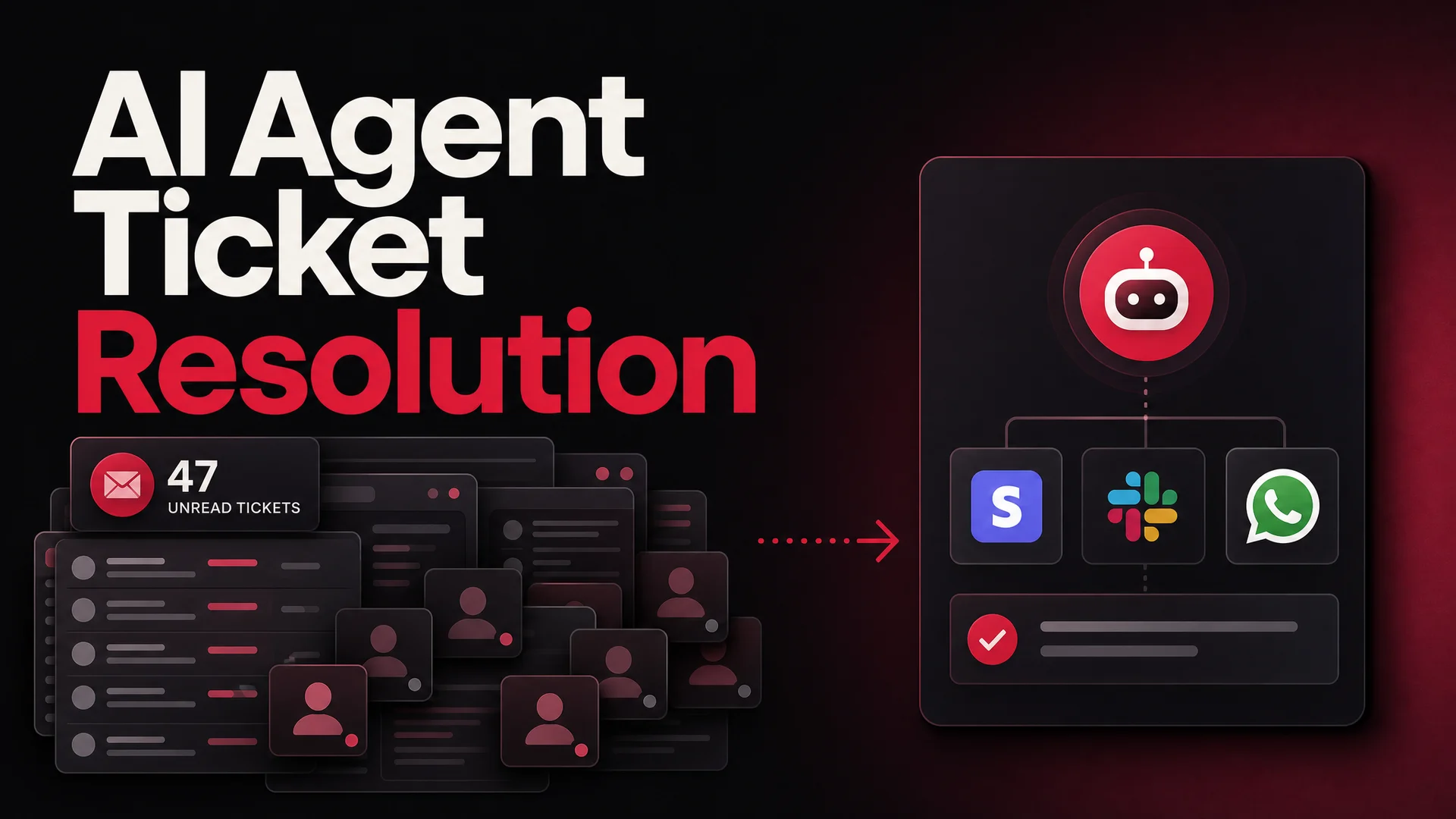
You opened Intercom's pricing page, did the math on $39 per seat plus $0.99 per AI resolution, and closed the tab faster than your support queue refreshes. That reaction is not a fluke. It is what a generation of operators are doing every week as they look at their own inbox - 47 unanswered conversations, most of them asking the same three questions - and conclude that the platform they grew up using is no longer priced like a tool, it is priced like a partner you cannot afford.
The questions in that queue are usually some flavor of "can I switch to annual?", "where is my refund?", "my card just expired, can you update it?" - the kind of thing that does not need a human signing into Stripe at midnight. It needs a system that can read the policy, look up the customer, and execute the action. That distinction - answering versus acting - is the whole story of what changed between the inbox era and the AI-agent era.
Intercom was designed in 2011. It is a beautifully built customer-conversation platform with AI features bolted on top after the fact. A new category of tooling has emerged on the other side: AI agents built from the model up, where the human inbox is the fallback rather than the foundation. Berrydesk sits squarely in that newer category. It is not an inbox with a chatbot. It is a branded AI agent you train in four steps, point at your support traffic, and let it resolve real tickets - including the ones that involve booking, payments, and account changes - by talking to your existing systems directly.
If Intercom's question is "how do we make our human team faster?", Berrydesk's question is "why is a human in this loop at all?"
Why operators are walking away from Intercom in 2026
There is a reason the alternative-shopping conversation has gotten louder over the last twelve months. Three forces have stacked on top of each other: pricing that punishes the outcomes you actually want, a platform that has accumulated more surface area than most teams need, and an AI layer that has fallen behind the open frontier. None of these are fatal individually. Together they are why founders are quietly migrating.
1. The pricing model that taxes your wins
Intercom's commercial design pre-dates the world we are operating in. When seats were the unit of work, charging per seat was reasonable. When AI was a deflection toy, charging per resolution made sense as a way to monetize a side feature. In 2026 those two pricing levers cut against each other in a way that founders feel every month.
- The success tax. You pay roughly $0.99 every time the AI actually solves a ticket. The better your bot performs - the more aggressively you train it, the more tools you wire up, the more cleanly it deflects routine traffic - the larger your invoice. The pricing model is structurally pointed away from the goal. Worse, "resolution" is defined by the vendor, not by you, so you are paying a per-unit fee on a metric you cannot fully audit.
- Add-ons for things that should be standard. WhatsApp is not a fringe channel anymore; in many markets it is the default. Charging an extra ~$99/month for it, on top of seat fees and resolution fees, is the sort of pricing that made sense when WhatsApp was novel. It is not novel.
- Seat sprawl for read-only roles. Managers, QA reviewers, finance staff who occasionally check a refund - they all need a seat to see anything. Costs scale with headcount, including headcount whose contribution to the queue is zero. Every new hire is a billing event.
The honest version of this pricing page reads: "the more value our AI delivers, the more we charge you, and the more humans you employ to oversee it, the more we charge you again." You can build a business on that model. It is harder to be a customer of one.
2. A platform built for an org chart you don't have
Intercom's surface area is enormous. Help center, product tours, ticketing workflows, multi-brand routing, outbound campaigns, in-app messages, surveys, NPS, knowledge management, AI co-pilot, AI agent - all of it integrated, all of it priced together. For a 400-person support org with five product lines, that breadth is genuinely useful. For most of the teams shopping for an alternative, it is overhead.
- Features you do not use, paid for monthly. SMBs and growth-stage SaaS teams routinely end up paying for advanced ticketing automations, multi-brand help centers, and proactive product tour builders they will never configure. The platform is sized for an enterprise support org and billed accordingly.
- Setup cycles measured in weeks. A full Intercom rollout - inbox configuration, macros, routing rules, help center migration, AI training, role mapping - typically takes two to four weeks before anyone sees real volume hit it. Modern AI-first tools can be live in an afternoon, trained on your existing site, docs, and a Notion export. You are paying not just for the platform but for the implementation tax.
- Change cost. Once you have built a hundred macros, a routing tree, and a custom help center on Intercom's primitives, it gets harder each quarter to consider leaving. The bloat is also a moat.
The honest question to ask before another renewal: of the 80 features I am paying for, how many fired in the last 30 days? For most teams the answer makes them quietly start a vendor-comparison spreadsheet.
3. The AI is a generation behind the frontier
This is the part that has shifted the most in the last twelve months and is the easiest to underrate. Intercom's AI is genuinely competent at what it was designed for - answering known questions inside Intercom's data graph. But the frontier has moved, and it has moved in two directions that matter for support.
The first is the closed frontier. As of May 2026, Claude Opus 4.7 leads SWE-Bench Pro at 64.3%, GPT-5.5 Pro ships parallel reasoning that meaningfully changes how an agent plans multi-step tool calls, and Gemini 3.1 Ultra carries a 2M-token context window that can hold an entire help center, a year of conversation history, and your refund policy in-context simultaneously. A modern AI support agent can be trusted with chains of action that would have been demoware on last year's models.
The second, and more disruptive for support pricing, is the open-weight frontier. DeepSeek V4 Flash (April 2026) is a 284B-parameter MoE with 13B active and a 1M-token context, priced at $0.14 / $0.28 per million input/output tokens - fractions of a cent per typical resolution. Moonshot's Kimi K2.6 (April 2026) is built specifically for agentic work, with native video input, swarms of up to 300 sub-agents, and 12-hour autonomous coding sessions. Z.ai's GLM-5.1 (April 2026), MIT-licensed, scores 58.4 on SWE-Bench Pro - beating GPT-5.4 and Claude Opus 4.6 on that benchmark - and was trained entirely on Huawei Ascend chips. MiniMax M2.7 runs at roughly 8% of Claude Sonnet's price at twice the speed. Alibaba's Qwen3.6-27B is Apache-2.0 and beats much larger MoE rivals on agentic coding. Xiaomi's MiMo-V2-Pro ships open weights with a 1M context.
What that means in practice for a support team is something Intercom's pricing page is not designed to reward: you can route the boring 80% of traffic to a low-cost open model that costs a fraction of a cent per resolution, and reserve the frontier models for the hard cases. That is the blended-cost model Berrydesk is built around. Intercom's per-resolution pricing flattens this distinction - every resolution costs the same dollar regardless of what it took to produce. That made sense when there was one model. It makes no sense now.
The other gap is what the AI can train on and what it can do. Intercom's AI is most comfortable inside Intercom's content graph. A modern AI agent should be able to ingest your website, your docs, your Notion, your Google Drive, your YouTube tutorials, and your help center, and then call out to your other systems - Stripe, your booking tool, your order management, your CRM - to actually finish the job. That is the difference between deflecting a ticket and resolving the underlying problem.
Berrydesk vs Intercom: the actual comparison
Strip away the marketing. The two products are answering different questions.
Berrydesk is an AI agent builder. It assumes the agent is the primary worker. It is built to be trained quickly, branded fully, wired to your business systems, and deployed across web, Slack, Discord, WhatsApp, and other channels in a single configuration. Humans handle escalations, not the baseline.
Intercom is a customer service platform. It assumes humans are the primary workers. It is built to give those humans an inbox, a help center, a ticketing system, and an AI co-pilot to make them faster. The AI works for the team.
A useful mental model: Berrydesk gives you a competent, branded employee that works 24/7, never asks for a raise, and can execute on its own. Intercom gives you an office for your support team, with an AI assistant in the corner.
1. Primary job
- Berrydesk: automate resolution and execute actions. The agent answers questions from your trained content, and where the question requires a real-world change - refund, subscription downgrade, booking confirmation, address update - it calls the relevant API and does it. The human queue is what is left over.
- Intercom: unify customer conversations for a human team. The inbox is the center of gravity. AI sits in front of it as a deflection layer.
2. Architectural assumption
- Intercom is human-first. The product's DNA is a shared inbox. Every workflow eventually surfaces to a human seat. The AI was added on top of an architecture designed around people.
- Berrydesk is AI-first. The agent, its model selection, its tool integrations, and its branded widget are the product. Human escalation is supported but not central.
This shows up in everything from data model to UX. Intercom thinks in tickets and assignees. Berrydesk thinks in conversations, tools, and outcomes.
3. Model choice
This is where the gap is widest and getting wider every month.
- Berrydesk lets you pick the underlying model - GPT, Claude, Gemini, DeepSeek, Kimi, GLM, Qwen, MiniMax, and others - and route traffic across them. You can ship a deployment that uses DeepSeek V4 Flash or MiniMax M2 for the routine 80%, Claude Opus 4.7 for complex policy interpretation, and Gemini 3.1 Ultra when you genuinely need a 2M-token window to reason over an entire conversation history. Cost per resolution for routine traffic ends up an order of magnitude below what a per-resolution platform charges.
- Intercom runs on Intercom's chosen stack. You do not pick the model, you do not see what is running underneath, and you cannot route differently for different traffic classes. The pricing absorbs the model choice into a single per-resolution fee.
For regulated industries the model question goes further. GLM-5.1 (MIT-licensed), Qwen3.6-27B (Apache 2.0), and MiMo-V2 (MIT) make on-prem and air-gapped deployments viable. If your compliance posture rules out sending support transcripts to a US frontier vendor, the open-weight Chinese models give you a credible local option. Berrydesk's architecture is friendly to that choice. Closed platforms generally are not.
4. Pricing model
- Intercom: seat-based plus usage. You pay per human agent, plus roughly $0.99 every time the AI resolves a ticket, plus surcharges for channels like WhatsApp. Costs grow with both your headcount and your AI's effectiveness - a structurally awkward incentive.
- Berrydesk: message-based usage pricing. You pay for the work your agent actually does. Adding a manager who needs to spot-check conversations is not a billing event. Resolving a ticket cleanly is rewarded, not taxed.
The forecasting difference matters more than it sounds. Per-resolution pricing on top of seat fees produces a bill that moves with two independent variables, both of which trend up if you are succeeding. Usage-based pricing produces a bill that moves with one variable - volume - that you can model from your traffic.
5. Time to live
- Berrydesk: the four-step setup - pick a model, train on your sources, brand the widget, wire AI Actions - gets a real agent live in an afternoon. Training sources include docs, websites, Notion, Google Drive, and YouTube transcripts, so most teams can stand up a starting agent without a content migration project.
- Intercom: full rollout typically runs two to four weeks before the platform is meaningfully configured. That is implementation time you are paying for in seat fees while you wait.
6. Action surface
- Berrydesk: AI Actions cover bookings, payments, refunds, account changes, order lookups, and any other API your team exposes. The agentic capabilities of frontier and open models - Kimi K2.6's multi-agent swarms, Claude Opus 4.7's tool reliability, Qwen3.6's local-deploy agents - make these flows production-ready, not demoware.
- Intercom: Fin can hand off, surface articles, and increasingly take some actions, but the architecture is still tilted toward deflection-then-handoff.
When Intercom is still the right call
The honest version of this comparison includes the cases where you should not switch. Berrydesk is not trying to be a 1:1 inbox replacement, and there are real teams for whom that is what matters most.
Stick with Intercom if:
- You run a large, mature support org where the inbox is the workplace. Forty agents collaborating across complex tickets need the kind of routing, assignment, and macro infrastructure Intercom has spent fourteen years building. An AI-first agent platform is not the right primitive for that team's daily workflow.
- Your support is consultative. If your typical ticket is a 45-minute multi-stakeholder thread that resolves a six-figure deal, the unit you are optimizing is the human conversation, not deflection. Intercom's tooling is well-shaped for that.
- You want one vendor for everything. Help center, product tours, outbound campaigns, NPS surveys, in-app messages, ticketing, and AI under one roof has real value if you can absorb the cost. The integration is genuine.
- Budget is not the constraint. If the seat-plus-resolution math does not bother you, and you have the staff to operate the breadth of the platform, the maturity of the product is real.
Switch to Berrydesk if:
- Your goal is to compress support volume, not just route it faster. You are trying to resolve, not triage.
- Most of your tickets are repetitive. Billing, password resets, plan changes, order lookups, refund eligibility, scheduling - anything an agent with the right tool calls can finish without a human.
- You need actions, not answers. The hard requirement is that the agent talks to Stripe, your booking system, your order DB, your CRM, and finishes the job.
- You need predictable, blended-model economics. You want to route routine traffic to cheap open models and reserve frontier models for hard cases, and you want a bill that scales with usage rather than with headcount.
- You want to be live this week, not this quarter.
Common pitfalls when evaluating an alternative
A few traps to flag if you are running this evaluation seriously.
Trap 1: comparing per-resolution pricing only at the headline number. $0.99 per resolution sounds bounded until you do the math at volume. A team handling 8,000 routine resolutions a month is paying nearly $8,000 in resolution fees alone, on top of seats. The comparison metric you actually want is blended cost per resolved conversation, including model cost, platform cost, and human time saved. Berrydesk's routing-to-open-models approach typically wins that metric by a wide margin, especially as DeepSeek V4 Flash and MiniMax M2 prices keep falling.
Trap 2: treating "context window" as a spec sheet item. A 1M-token context (DeepSeek V4, Claude Opus/Sonnet 4.6) or 2M-token context (Gemini 3.1 Ultra) is not a vanity number. It changes what RAG has to do. With enough context room to hold your entire knowledge base plus the full conversation history, retrieval becomes a tuning lever rather than a hard architectural requirement. That simplifies your pipeline and reduces the failure modes where the right document just was not retrieved.
Trap 3: underestimating the agentic gap. Old-generation chatbots, including the ones inside legacy support platforms, were built when "the AI does an action" meant "the AI fills in a form for a human to confirm." Models like Kimi K2.6 (4,000-step coordinated agents), GLM-5.1 (8-hour autonomous plan-execute-test-fix loops), Claude Opus 4.7, and Qwen3.6 are reliable enough at multi-step tool use that production refunds, bookings, and policy-bound account changes are now genuinely safe to automate. If your evaluation does not test multi-step actions, you are evaluating a generation-old capability.
Trap 4: assuming "AI-first" means "no humans." It does not. It means the default flow is automated and the human is the escalation. Berrydesk supports human handoff, internal collaboration, and review. The architectural difference is which side is the default.
How a Berrydesk deployment actually comes together
Concretely, here is how teams move from "we are evaluating an Intercom alternative" to "the agent is handling 70% of our queue" in a few days, not a few weeks.
Step one - pick a model, or a routing strategy. Most teams start with a single frontier model (Claude Opus 4.7 or GPT-5.5 for nuanced policy reasoning, Gemini 3.1 Pro for long-context retrieval over a large knowledge base). After two weeks of traffic, you split the routing: cheap open models like DeepSeek V4 Flash or MiniMax M2 for high-volume routine intent, frontier models for ambiguous or high-stakes cases. The blended cost per resolution often lands an order of magnitude below per-resolution pricing.
Step two - train on the sources you already have. Point Berrydesk at your website, public docs, internal Notion workspace, Google Drive folders, and YouTube tutorials. The agent ingests them, indexes them, and is ready to answer. You do not migrate a help center.
Step three - brand the widget. Colors, tone, name, avatar, and language. The agent should feel like your product, not a generic chatbot pasted into a corner.
Step four - wire AI Actions. This is where the resolution math changes. Connect Stripe so the agent can issue refunds and update subscriptions inside your eligibility rules. Connect your booking system so it can confirm appointments. Connect your order DB so it can look up shipments. Each Action is a tool call the agent picks up automatically when the conversation needs it.
Step five - deploy across channels. Web widget, Slack, Discord, WhatsApp, and more from the same configuration. You do not pay extra to add WhatsApp.
The thing that surprises operators the first time is how much of the queue this absorbs. The 47 unanswered tickets your team wakes up to each morning are not 47 hard problems; they are usually 38 routine ones the agent could have closed at 3 a.m. and 9 real ones that benefit from a human.
The shift in one line
Intercom is a great answer to a question from 2014: how do we help our support team handle more conversations? Berrydesk is a serviceable answer to a question from 2026: given the models that exist now, why is a human in this conversation at all?
Both questions are legitimate. Most teams will find that the second question fits more of their queue than they expected.
If you want to see what the four-step setup looks like on your own content - your docs, your site, your Stripe - you can build a Berrydesk agent for free at berrydesk.com and have it answering real traffic by the end of the day. No seat fees, no per-resolution surcharge, and no two-week implementation cycle to get there.
 Berrydesk
Stop paying per seat to manage tickets
- Launch a branded AI support agent in four steps, trained on your docs, site, and Notion.
- Route routine tickets to low-cost open models and reserve frontier models for hard escalations.
Set up in minutes

Chirag Asarpota is the founder of Strawberry Labs, the team behind Berrydesk - the AI agent platform that helps businesses deploy intelligent customer support, sales and operations agents across web, WhatsApp, Slack, Instagram, Discord and more. Chirag writes about agentic AI, frontier model selection, retrieval and 1M-token context strategy, AI Actions, and the engineering it takes to ship production-grade conversational AI that customers actually trust.