A plain language model can summarize a paragraph or draft an email, but ask it to look up an order, refund a customer, or schedule a callback and it stalls. It has no memory beyond the current turn, no hands to reach into your systems, and no internal sense of what step comes next. LLM agent frameworks exist to close those gaps - they wrap a model in planning, memory, and tool use so it can actually finish a job instead of describing how the job might go.
The agent framework conversation in 2026 looks nothing like it did even a year ago. Frontier closed models have leapt forward - GPT-5.5 Pro brought parallel reasoning, Claude Opus 4.7 leads SWE-Bench Pro at 64.3%, and Gemini 3.1 Ultra carries a 2M-token context window. At the same time, open-weight Chinese models from DeepSeek, Moonshot, Z.ai, Alibaba, MiniMax, and Xiaomi have collapsed inference costs and put MIT/Apache-licensed frontier weights in the hands of anyone with a GPU budget.
The framework you build on top of those models is what decides whether they actually solve customer problems or just impress in demos. This guide walks through what an LLM agent really is in 2026, the components inside any framework, the six dimensions that matter when evaluating one, how the major options compare, and where a no-code platform like Berrydesk fits when the goal is a production support agent rather than a research project.
What an LLM agent really is
An LLM agent is a model wired into a loop. Instead of producing one response and stopping, it observes the situation, decides what to do, takes an action - calling an API, querying a knowledge base, running a tool - and observes the result. Then it loops again, refining its plan until the goal is met or it hands off.
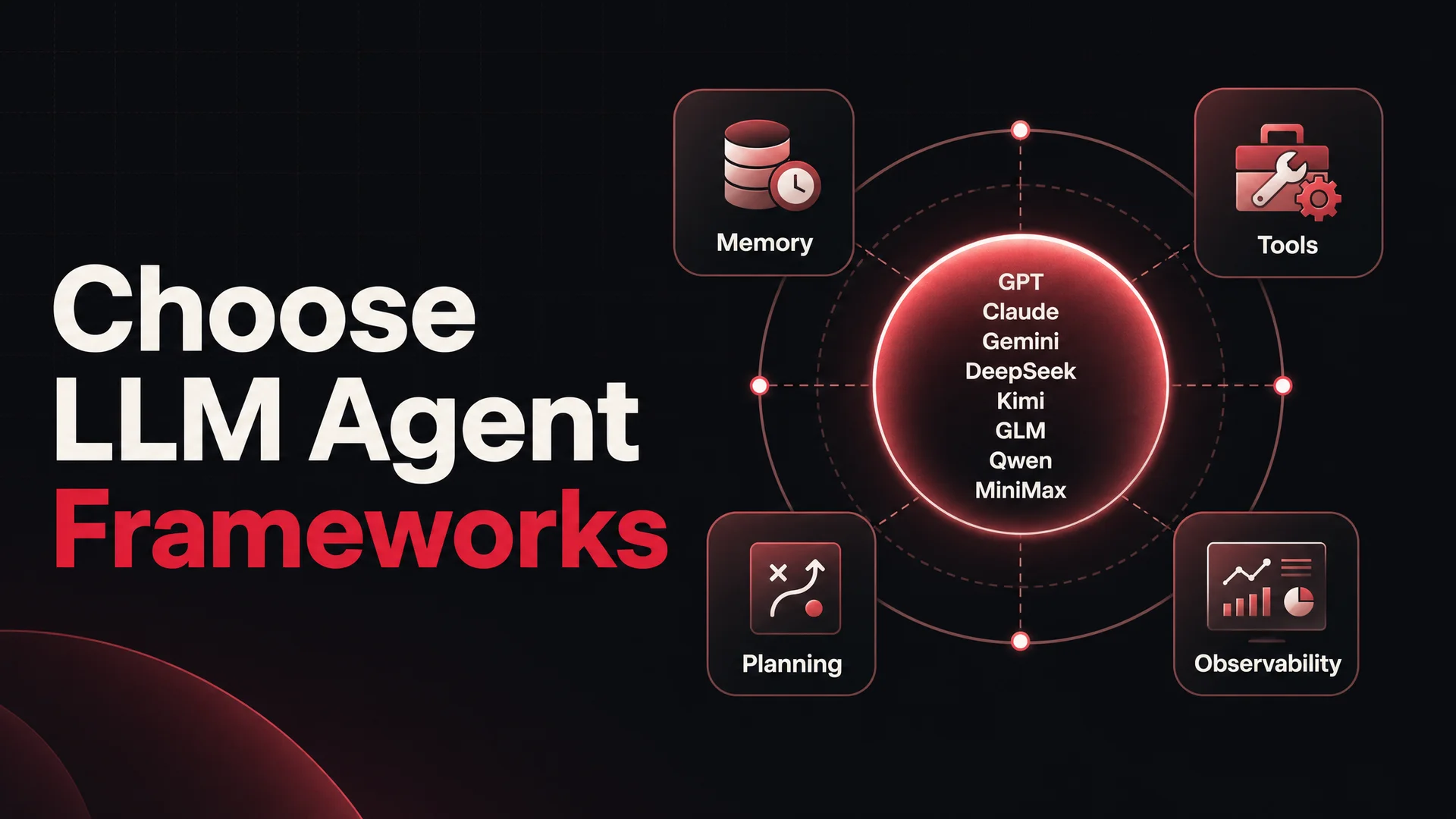
The interesting part is the wiring, not the model. A modern LLM agent is not a chatbot with a better autocomplete. The four ingredients that turn a model into an agent - reasoning, memory, tools, and planning - have all matured at the same time, which is what makes the current crop of frameworks meaningfully different from the wrapper layers of 2023 and 2024.
Reasoning is the LLM itself. The shortlist for production support is now wider than it has ever been. On the closed side, GPT-5.5, GPT-5.5 Pro, Claude Opus 4.7, Claude Sonnet 4.6, and Gemini 3.1 Pro and Ultra each bring different strengths - parallel reasoning paths, agentic tool fluency, or genuinely native multimodality. On the open-weight side, DeepSeek V4 Pro and V4 Flash, Moonshot Kimi K2.6, Z.ai GLM-5.1, Alibaba's Qwen 3.6 family, MiniMax M2.7, and Xiaomi MiMo-V2-Pro give you frontier-class reasoning at a fraction of the per-token cost.
Memory has stopped being a single buffer. A real agent keeps short-term conversational state, mid-term session summaries, long-term vector stores, and structured memory in places like a CRM, an order database, or a Notion workspace. The 1M-token context windows in Claude Opus 4.6, Sonnet 4.6, and the DeepSeek V4 line - and Gemini 3.1 Ultra's 2M - change the calculus here. An entire help center, the last 90 days of conversations with a customer, and your refund policy can sit in-context. RAG is now a tuning lever for relevance and cost, not a hard requirement.
Tools are the bridge between the model and the rest of the company. Agentic models like Kimi K2.6, GLM-5.1, Claude Opus 4.7, Qwen 3.6, and MiMo-V2-Pro have made multi-step tool use reliable enough to actually run refunds, schedule appointments, take payments, and update CRM records in production.
Planning is the thin layer that turns "answer the user" into "decompose the problem, pick a path, execute, watch for failure, escalate." Kimi K2.6 can run autonomous coding sessions for twelve hours and coordinate up to 300 sub-agents across thousands of steps. GLM-5.1 ships with an eight-hour plan-execute-test-fix cycle baked in. Claude Opus 4.7 leads SWE-bench Pro at 64.3%, with GLM-5.1, MiniMax M2.7, and Kimi K2.6 close behind. The capability is no longer the bottleneck. The wiring is.
Why frameworks exist
If you want to glue all of this together yourself, you are signing up to build a small operating system. You need a way to format prompts, parse model outputs, route tool calls, retry failures, manage token budgets, persist memory, version prompts, log traces, and evaluate quality across versions. Every team that does this from scratch ends up rebuilding the same primitives.
Agent frameworks try to give you those primitives once. The pitch is:
- A standard structure for the agent loop, so you are not reinventing it per project.
- Adapters for popular models and APIs, so swapping GPT-5.5 for Claude Opus 4.7 or DeepSeek V4 Flash is a config change.
- Out-of-the-box memory, retrieval, and tool integrations.
- Hooks for logging and evaluation.
- Patterns for orchestrating multiple agents working together.
Done well, this turns a six-week prototype into a six-day one. Done badly, it adds a dependency that you spend more time fighting than using.
The core components inside any framework
Strip back the marketing and almost every framework is built from the same five pieces:
- Model interface. A consistent way to call a frontier model - increasingly across both closed providers (OpenAI, Anthropic, Google) and the open-weight wave. With 1M-token context windows now standard on Claude Sonnet 4.6, DeepSeek V4, and the MiMo line, and 2M on Gemini 3.1 Ultra, the interface needs to handle long-context calls without choking.
- Planning. A way to decompose a task into ordered steps. ReAct-style prompting is the workhorse, but newer agents lean on the model's native reasoning traces.
- Memory. Short-term scratchpads for the current task and longer-term stores - vector databases, summarization buffers, episodic memory - for things the agent should remember across sessions.
- Tools. Structured definitions of what the agent can call. Modern frameworks use JSON schemas so the model can generate valid arguments without hallucination.
- Execution. The runtime that actually invokes tools, captures errors, feeds results back, and decides whether to keep looping.
The cycle, in shorthand: input → plan → action → execute → observe → update memory → repeat.
How to pick a framework: six dimensions that actually matter
Surface features blur together quickly when every vendor's landing page looks the same. The six dimensions below are the ones that hold up after you put a framework into production and start measuring.
1. Cognitive depth
The question is not whether the agent can reply. It is whether it can hold context, reason across it, and keep itself honest.
Context window strategy. If your support conversations stretch across ten or twenty turns, span attached PDFs, or need to reason over a 600-page policy manual, you need a model with at least 128K tokens of headroom - and ideally one of the 1M-token tier (Claude Opus 4.6 / Sonnet 4.6, DeepSeek V4 Pro and Flash, MiMo-V2-Pro) or Gemini 3.1 Ultra's 2M. Just as important, the framework needs to manage that window: trimming, summarizing, and re-injecting the right slices instead of dumping everything every turn.
Multimodality. Voice intake, screenshot triage, product photos, video walkthroughs - multimodal input shows up in real support far more often than teams expect. Gemini 3.1 Ultra is natively multimodal across text, image, audio, and video; Kimi K2.6 added native video input. Pick a framework that exposes multimodal endpoints cleanly, not one that bolts a transcription service on the side.
Reasoning style. A pure FAQ bot needs almost no reasoning. A bot that quotes refund eligibility from policy, checks order state, and decides whether to comp shipping needs a model that can plan and a framework that can hold the plan in working memory across tool calls. GPT-5.5 Pro's parallel reasoning, Claude Opus 4.7's tool-use track record, and the open-weight agentic leaders all matter here for different reasons.
Hallucination control. This is where most enterprise pilots die. The framework should provide retrieval grounding with citations, calibrated uncertainty (the agent should be willing to say "I do not know"), output validation against schemas or known facts, and ideally a second-model judge for high-stakes responses. Chain-of-thought visibility helps debugging but is not a hallucination defense by itself.
2. Enterprise readiness
The framework either makes compliance and operations easy or it makes them your problem.
Regulatory fit. SOC 2, GDPR, HIPAA, regional residency rules - the framework has to support them, not just claim to. Look for documented data flows, encryption posture, access controls, audit logs, and the ability to choose where data physically lives. The MIT-licensed open-weight wave (GLM-5.1, Qwen 3.6-27B, MiMo) makes air-gapped deployments genuinely viable for the first time, which is the unlock for finance, healthcare, and government.
Deployment surface. SaaS is fastest, private cloud gives you control, on-prem gives you maximum sovereignty, and hybrid lets you split sensitive workloads from public ones. A framework worth choosing supports more than one of these without forcing a rebuild.
Audit and replay. Every agent decision - input, retrieved chunks, model called, tools invoked, output - should be replayable. This is non-negotiable for debugging, for compliance, and for the inevitable "why did the bot say that?" investigation. Frameworks that offer turn-level traces with full prompt and tool payloads are in a different league from those that hand you a chat log.
Operational risk. Ask the vendor what their failure modes are, not just their happy paths. What happens when a model provider has an outage? What is the fallback chain? Can the agent gracefully escalate to a human when confidence drops?
3. Development velocity
Time-to-first-deployment and time-to-iteration are what separate platforms that get used from those that get shelved.
No-code, low-code, full-code. A no-code builder lets a support manager ship a working agent in an afternoon. Low-code adds escape hatches for custom logic. Full-code SDKs are what your platform team eventually wants once the agent matters enough to put behind staged rollouts. The strongest frameworks span all three - pick the right entry point per team, and let teams graduate.
Templates and starters. Pre-built flows for common verticals - ecommerce returns, SaaS onboarding, billing triage, appointment booking - turn weeks of work into days. The point is not the template itself; it is the embedded knowledge of which prompts, tools, and guardrails actually work for that pattern.
Iteration loop. Look for live conversation replay, prompt version diffs, A/B testing across model and prompt variants, regression suites built from real traffic, and one-click rollback. Building an agent is a feedback loop, not a one-shot deployment, and the framework either makes the loop tight or makes it painful.
4. Operational cost
Running agents at scale is where the open-weight wave changes the spreadsheet most.
Per-resolution cost. The right unit is not tokens - it is cost per resolved conversation. A support agent that routes routine traffic to DeepSeek V4 Flash at $0.14 / $0.28 per million input/output tokens, or to MiniMax M2.7 at roughly 8% of Claude Sonnet's price at twice the speed, can resolve common tickets for fractions of a cent. Reserving Claude Opus 4.7, GPT-5.5 Pro, or Gemini 3.1 Ultra for the small slice of hard escalations keeps the total bill predictable. A framework that supports model routing per intent or per confidence band is doing real work for your margin.
Scaling behavior. Traffic spikes are the norm in support - product launches, outages, holiday surges. The framework should auto-scale model calls, tool calls, and vector queries without manual intervention. Cold-start latency on the first message after an idle period is a real user experience tax; check it before signing.
Cost variance. Per-token billing creates a long tail. A handful of pathological conversations can blow a monthly budget. Look for built-in token caps per session, retry budgets, and cost dashboards segmented by intent and channel.
5. Ecosystem integration
An agent that cannot reach into the rest of your stack is a fancy autocomplete.
Knowledge sources. Help center exports, public docs, Notion, Google Drive, Confluence, sitemaps, YouTube transcripts, internal wikis. The framework should ingest all of them, refresh them on a schedule, and re-embed only what changed.
Business systems. Native or first-class connectors for Shopify, Stripe, HubSpot, Salesforce, Zendesk, Intercom, and the long tail of internal APIs. AI Actions - the ability for the agent to take a step rather than just describe one - depend entirely on this layer.
Channels. A modern support agent lives on a website widget, in Slack and Discord, on WhatsApp, inside email, and increasingly in voice. Berrydesk, for example, treats every channel as a first-class deployment target with a single underlying agent definition and consistent AI Actions.
Observability. Metrics in Prometheus or Datadog, logs in your existing stack, traces in OpenTelemetry. If the framework is a black box to your monitoring, it will be a black box during your next incident.
CI/CD. Agent definitions belong in version control. Look for declarative configuration, scriptable deploys, environment promotion (staging to prod), and feature flags for new tools or prompts.
6. Adaptability over time
The model layer changes every six weeks. The framework you choose has to absorb that without forcing a rewrite.
Model portability. When DeepSeek V5 ships, or Claude Opus 4.8 lands, you should be able to swap it in for a subset of traffic in minutes. Frameworks that hard-code a single provider are a strategic liability.
Fine-tuning and adaptation. For tone, vocabulary, and edge-case patterns specific to your business, fine-tuning still beats prompting. The framework should support adapter-based fine-tunes on the open-weight families (Qwen, DeepSeek, GLM, MiMo) and managed tuning on the closed ones where the provider offers it.
Continuous learning loops. Thumbs-up/down feedback, escalation reasons, post-resolution surveys - all of this should flow back into evaluation suites and prompt iteration automatically.
Languages. If you serve customers outside one geography, multilingual quality matters per market, not just on average. Test the actual languages you care about; do not trust the headline number.
What changed in 2026
A few shifts are worth calling out, because they affect how you should build:
- Long context blunts the RAG bottleneck. With 1M-token windows on Claude Sonnet 4.6, DeepSeek V4, and Kimi K2.6, and 2M on Gemini 3.1 Ultra, you can keep an entire knowledge base, conversation history, and policy bundle in-context. RAG is now a tuning lever, not a hard requirement.
- Open-weight frontier models collapse cost. DeepSeek V4 Flash runs at $0.14 per million input tokens and $0.28 per million output. MiniMax M2 lands at roughly 8% the cost of Claude Sonnet at twice the speed. For routine support traffic, the economics are no longer close - open-weight models win, and you reserve Claude Opus 4.7 or GPT-5.5 Pro for the hard escalations.
- Tool use is finally reliable. Agentic-first models - Kimi K2.6, GLM-5.1, Claude Opus 4.7, Qwen 3.6, MiMo-V2-Pro - make AI Actions like bookings, refunds, and order lookups production-grade rather than demoware.
- Evaluation moved from afterthought to default. Frameworks now ship with eval harnesses out of the box, because the failure mode of agents is silent regressions, not crashes.
- Air-gapped deploys are real. MIT/Apache-licensed open weights from GLM-5.1, Qwen 3.6-27B, and the MiMo family make on-prem and air-gapped support agents viable for regulated industries.
The 2026 framework landscape
The framework ecosystem has matured but not consolidated. The names worth knowing:
LangChain and LangGraph
Still the broadest toolkit, with adapters for almost every model and vector store on the market. LangGraph, the stateful workflow layer on top, is where most production teams now build because it makes the agent loop explicit and inspectable. The cost is a steep learning curve and a sprawling abstraction surface - if you take a week off, the public API has probably shifted. The component library is unrivaled, the model coverage is comprehensive. The trade-off is everything around the core: you build the security model, the audit trail, the deployment infrastructure, the observability stack, and the iteration tooling yourself.
For a research team or a platform group with dedicated ML engineers, that's the point. For a support team trying to ship a production agent in weeks rather than quarters, the assembly cost shows up as schedule risk and a perpetual maintenance backlog.
A minimal LangChain-style agent in Python looks like this:
from langchain_anthropic import ChatAnthropic
from langchain.agents import tool, AgentExecutor, create_react_agent
from langchain_core.prompts import PromptTemplate

@tool
def get_word_length(word: str) -> int:
    """Return the number of letters in a word."""
    return len(word)

llm = ChatAnthropic(model="claude-opus-4-7", temperature=0)
tools = [get_word_length]
prompt = PromptTemplate.from_template(
    "Answer the question using the available tools.\n\nQuestion: {input}"
)
agent = create_react_agent(llm, tools, prompt)
executor = AgentExecutor(agent=agent, tools=tools, verbose=True)

print(executor.invoke({"input": "How many letters are in 'serendipity'?"})["output"])
That is the cheerful version. Real production code adds tracing, retries, prompt versioning, schema validation, eval harnesses, and hours of plumbing.
CrewAI
Built around the idea of small teams of specialized agents - a researcher, a writer, an editor - passing work between them. The mental model is clean and onboarding is faster than LangChain. Best for content workflows and structured multi-step jobs where you can name the roles up front.
Microsoft AutoGen
The Azure-first choice. AutoGen treats every actor - agents, humans, tools - as a chat participant and lets you compose them into conversations. Its strength is multi-agent orchestration patterns and tight Azure integration. If your data already lives in Azure, your identity is in Entra, and your existing automation is in Power Platform, AutoGen reduces friction at the integration layer. The cost is portability - moving to a non-Azure model lineup is heavier than it is in a model-agnostic framework - and a slightly slower cadence on adopting the latest open-weight model releases.
LlamaIndex
Started as a retrieval library and grew into an agent framework with strong RAG defaults. If your agent's job is mostly "answer questions over a corpus," LlamaIndex gets you there with the least ceremony.
MetaGPT, Google ADK, Botpress
Honorable mentions. MetaGPT models multi-agent teams as a software company. Google ADK is the cleanest path if you are already on Vertex. Botpress sits between code and no-code, aimed at conversational flows.
DIY on open weights
A growing number of teams are running GLM-5.1, Qwen 3.6-27B, or MiMo-V2-Flash on their own GPUs and writing the agent loop themselves. For a regulated industry with hard data residency requirements, that path is increasingly attractive. The honest accounting is that you take on the model serving, the tool runtime, the evaluation harness, and the operational burden - all of which a framework would otherwise carry. Worth it for a few specific shops, expensive for most.
Multi-agent systems
CrewAI and AutoGen lean into this explicitly, but every major framework now supports patterns where a planner agent delegates to specialists. Kimi K2.6 has pushed the ceiling here - its swarm mode coordinates hundreds of sub-agents across thousands of steps - but the harder problem in support is usually fewer, more reliable agents rather than more of them.
The honest cost of code-based frameworks
Frameworks are powerful, but the bill of materials is rarely advertised:
- Engineering headcount. Python or TypeScript, comfortable with async, comfortable reading framework source when the docs lie.
- Setup. Vector store, model accounts, secrets, tool integrations, observability. A working starter takes days, not minutes.
- Debugging. Agents fail in long, hard-to-reproduce traces. Without a tracing tool you are reading thousands of tokens of logs.
- Maintenance. The frameworks evolve fast; APIs break. Models deprecate. Your agent that worked beautifully in November stops working in February.
- Evaluation. You need a test set, a way to run it, and the discipline to use it before shipping changes.
For a research team or a platform startup, this is fine - the work is the product. For a support team that needs an agent on the website by next quarter, it is the wrong shape of investment.
When to skip the framework
A framework is the right answer when your agent does something genuinely novel: orchestrating a tool that does not exist yet, coordinating a multi-team workflow, or running long-horizon autonomous tasks where you need full control over every step.
For the most common use case - a customer-facing support agent that answers from your docs, hands off to a human when needed, and takes a small set of actions on behalf of the user - you do not need a framework. You need a platform that has already made the boring decisions correctly.
Berrydesk: the no-code path to a production agent
Berrydesk is built for teams who want a production support agent live this week, not next quarter. Under the hood it uses the same primitives a framework would assemble - a model core, retrieval over your knowledge, conversation memory, structured tools - but you compose it through a UI in four steps.
- Pick a model. Choose from GPT-5.5 and GPT-5.5 Pro, Claude Opus 4.7 and Sonnet 4.6, Gemini 3.1 Ultra and Pro, DeepSeek V4, Kimi K2.6, GLM-5.1, Qwen 3.6, MiniMax M2.7, and others. Route routine traffic to a low-cost open-weight model and reserve the frontier for escalations.
- Train it. Point it at docs, websites, Notion workspaces, Google Drive folders, or YouTube videos. Long-context models keep most of that in working memory; for very large corpora, retrieval handles the rest.
- Brand the widget. Match your colors, copy, and tone. The agent looks like part of your product, not a third-party add-on.
- Add AI Actions and deploy. Bookings, refunds, order lookups, payment flows - wired up without writing tool schemas by hand. Then ship to your website, Slack, Discord, WhatsApp, or wherever your customers already are.
The model-agnostic stance is the differentiator. Routine deflection can run on DeepSeek V4 Flash or MiniMax M2.7 at near-zero cost. Hard escalations route to Claude Opus 4.7 or GPT-5.5 Pro. Multimodal tickets - screenshots, product photos, voice - go to Gemini 3.1 Ultra. The team picks the trade-off; the framework executes it.
Built-in retrieval grounding with citations, audit-grade conversation traces, and AI Actions that have moved from demoware to production-ready cover the dimensions most teams actually care about. The no-code builder lets a support lead ship in an afternoon, with full-code escape hatches when the agent grows up.
The trade-off is straightforward. A code-based framework gives you total control and unlimited surface area; Berrydesk gives you ninety percent of the agent capability and zero of the framework maintenance. For a support team, that ratio almost always favors the platform.
Common pitfalls worth naming
A handful of failure patterns show up across pilots regardless of which framework gets picked.
Over-indexing on benchmarks. SWE-Bench Pro and GPQA Diamond are useful signals, but they do not predict how a model handles your specific tone, your product names, or your edge cases. Run a held-out set of real conversations through any candidate model before committing.
Treating the agent as a one-shot deploy. Production agents need a weekly review of escalation reasons, low-confidence answers, and thumbs-down feedback. The framework should make that review cheap; if it doesn't, the agent silently drifts.
Locking into a single model. Six weeks from now there will be a better, cheaper option for at least one of your traffic bands. Routing by intent and confidence is a better long-term posture than picking a forever-model.
Underestimating tool reliability. AI Actions only work in production when retries, idempotency, and error recovery are first-class. A refund issued twice is worse than no refund at all.
Treating the model as the product. The model is the cheapest, most-replaceable part of the system. Your knowledge base, your tool definitions, and your evals are the moat.
Skipping evaluation. If you cannot measure quality, every change is a guess. Build a small test set early and run it on every prompt change.
Over-orchestrating. Multi-agent setups look impressive in demos and add latency and failure modes in production. Start with one agent and one tool, add complexity only when forced.
Ignoring routing. Sending every query to your most expensive model is how you discover that 80% of support traffic is answerable by DeepSeek V4 Flash at a hundredth of the cost.
FAQ
How much do LLM agent frameworks cost to run? Most frameworks are open source, so the line item is the model API. With DeepSeek V4 Flash at $0.14 / $0.28 per million tokens and MiniMax M2 priced around 8% of Claude Sonnet, routine support volume is now genuinely cheap. The real cost is engineering time. No-code platforms like Berrydesk bundle inference and infrastructure into a flat plan.
Are LLM agents production-ready for enterprise use? For narrow, well-scoped tasks - answering from a knowledge base, executing a fixed set of actions, routing to humans - yes. The 2026 generation of agentic models pushed reliability across a real threshold. For long-horizon autonomous work with no human in the loop, treat it as cutting edge and evaluate carefully.
Which framework is best for someone just starting out? If you are not a developer, do not start with a framework. Start with a no-code platform like Berrydesk and learn what your agent actually needs to do. If you are a Python developer, LangGraph has the most documentation and community. If your job is multi-agent collaboration specifically, CrewAI is the gentlest on-ramp.
Do I need GPUs to run an agent? Almost never. Agents call cloud APIs. You only need GPUs if you are self-hosting open-weight models for compliance reasons - and even then, MIT-licensed models like GLM-5.1 and Qwen 3.6-27B run on commodity hardware, not specialized clusters.
The bottom line
For most organizations standing up an AI support agent in 2026, the right framework is the one that lets the team ship quickly, swap models as the landscape shifts, audit every decision, and integrate cleanly with the channels and systems they already have. Berrydesk is built around exactly that philosophy: model-agnostic, channel-agnostic, with AI Actions that take steps rather than just describe them.
The agent layer of AI is here, and it works. The question for most teams is no longer whether to use one, but how to ship it without spending a quarter wiring frameworks together. If your goal is a branded support agent that handles real conversations and real actions, start with Berrydesk - pick the model, point it at your knowledge sources, and you can have a branded agent live before the end of the day.
 Berrydesk
Skip the framework. Ship a support agent today.
- Pick from GPT-5.5, Claude Opus 4.7, Gemini 3.1, DeepSeek V4, Kimi K2.6 and more - no code required.
- Mix and match frontier and open-weight models per ticket type, with AI Actions for refunds, bookings, and lookups.
Set up in minutes

Chirag Asarpota is the founder of Strawberry Labs, the team behind Berrydesk - the AI agent platform that helps businesses deploy intelligent customer support, sales and operations agents across web, WhatsApp, Slack, Instagram, Discord and more. Chirag writes about agentic AI, frontier model selection, retrieval and 1M-token context strategy, AI Actions, and the engineering it takes to ship production-grade conversational AI that customers actually trust.