Vector embeddings are one of those AI ideas that sound abstract until you realize they are quietly running almost every modern customer-support agent, search bar, and recommendation feed you touch. They are the bridge between human language - messy, ambiguous, full of synonyms and slang - and the strict numerical world that machine learning models operate in.
Put simply: an embedding is a way of describing a piece of data - a word, a sentence, a help article, an image, a 30-minute support call - as a list of numbers that captures what that data means. Once you have that list of numbers, you can do math on meaning. You can ask "which of these 50,000 articles is closest to this customer's question?" and get an answer in milliseconds. You can cluster every refund ticket from the last quarter and surface the patterns. You can route a Spanish question about shipping to the same answer as the English version, even if not a single word overlaps.
This guide walks through what embeddings actually are, how they work under the hood, where they fit in the 2026 AI stack - including how the rise of 1M- and 2M-token context windows has changed when you should and should not bother with them - and how to put them to work on the kind of problem most readers of this blog actually have, which is building a support agent that understands the company it works for.
What a Vector Embedding Really Is
Imagine you had to describe every concept you know using exactly 768 numbers. The first number might roughly correspond to "how concrete or abstract is this thing." The 17th might capture "is this related to money." The 412th might track "is this a verb describing motion." Most dimensions will not have such tidy human-readable interpretations - they are learned automatically - but the principle holds: each number is a coordinate along some axis of meaning.
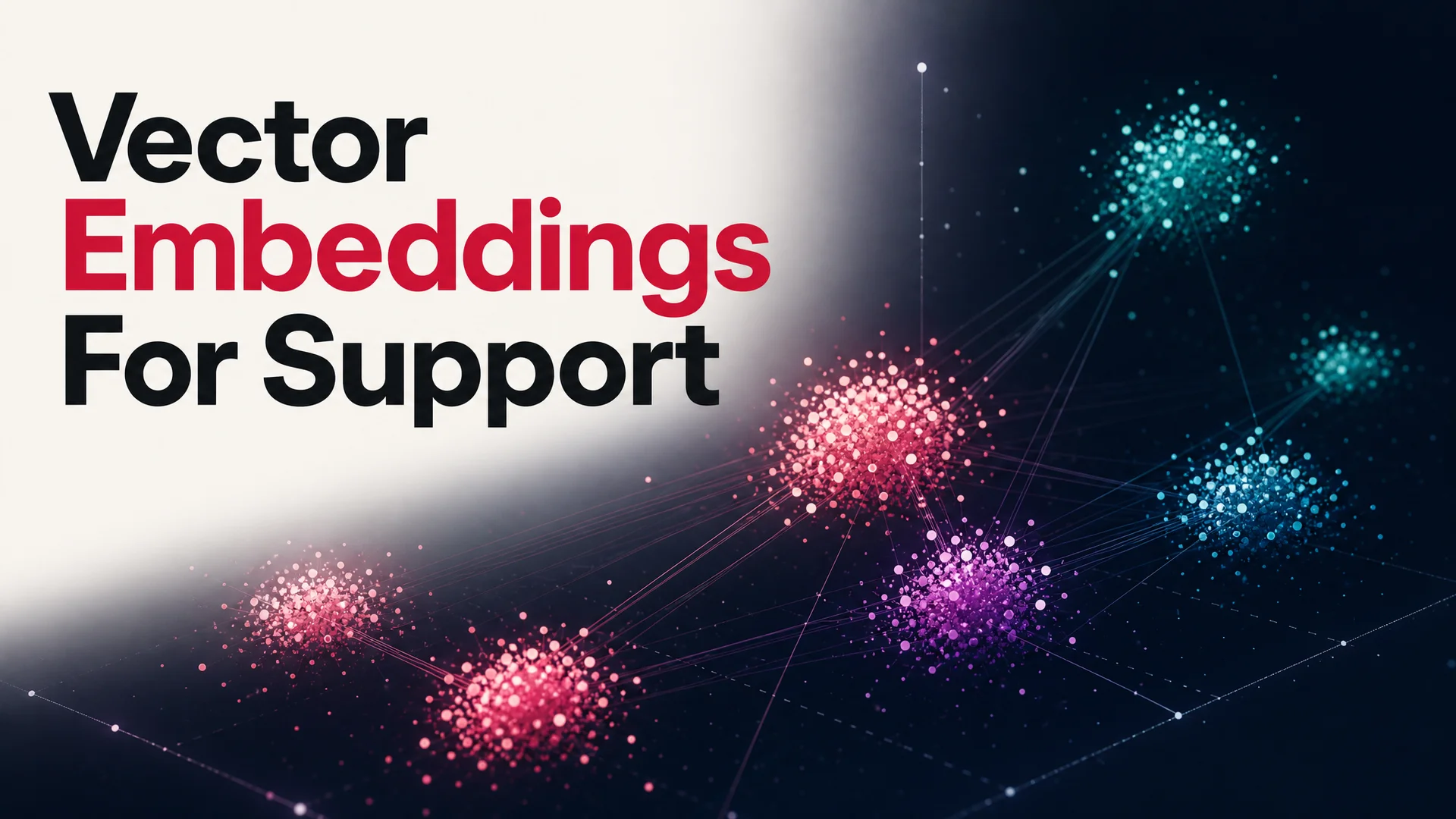
A vector embedding is exactly that: a fixed-length list of numbers (a vector) that locates a piece of content as a single point in a high-dimensional space. The space might have 384, 768, 1,536, or even 4,096 dimensions depending on the model. The crucial property is that things with similar meaning end up near each other in that space, while things with different meaning end up far apart.
That single property is what unlocks everything else. Once meaning is geometry, every problem that involves understanding becomes a problem of measuring distance.
How Embeddings Are Created
Embeddings come out of neural networks. The network's job, during training, is to organize a chaotic pile of raw inputs - text, pixels, audio waveforms - into a layout where semantic neighbors really are spatial neighbors.
The training loop looks roughly like this. The network sees an example, makes a prediction (for instance: "given this sentence with one word hidden, what is the missing word?" or "are these two sentences a question-and-answer pair or a random pairing?"), checks how wrong it was, and nudges its internal parameters to be slightly less wrong next time. Repeat that loop on hundreds of billions of examples and the network gradually settles on a representation where the geometry of the embedding space mirrors the structure of the underlying data. This whole process is called representation learning, and the loop's adjustment step is called backpropagation.
A good analogy: imagine reorganizing a chaotic library shelf-by-shelf. Day one you place books at random. As you read more of them, you start moving titles around - adventure novels migrate together, cookbooks form their own neighborhood, technical manuals end up across the room. The shelves did not change shape, but the positions on them now encode meaning. After enough re-shelving, you can find any new book's right home almost on instinct. A trained embedding model has done a higher-dimensional version of that, with a few billion books, in a 768-dimensional library.
Modern embedding models for English text - OpenAI's text-embedding-3-large, Cohere's embed-v4, Voyage's voyage-3, BGE-M3, the latest sentence-transformers checkpoints - are all variants of this same recipe, just scaled up and tuned for different tradeoffs of dimensionality, multilingual coverage, and retrieval quality.
How Embeddings Behave in Vector Space
Once content is embedded, the geometry does the work.
The Space Itself
Picture a map. Cities that share a region of the world cluster together; cities on opposite sides of the planet are far apart. A vector space is the same idea with more dimensions and a different notion of distance - instead of geography, the axes encode aspects of meaning. Two product descriptions that talk about wireless headphones land near each other. A recipe for sourdough lands far away. A help article about "resetting your password" and a customer message that says "I can't log in anymore" land closer than either of them does to a marketing page about pricing tiers.
Measuring Distance
How do you actually compute "near" and "far" in 768-dimensional space? Two metrics dominate.
Cosine similarity measures the angle between two vectors. If they point in the same direction, the cosine is 1; if they are orthogonal, it is 0; if they point in opposite directions, it is -1. Magnitude does not matter - only direction. This is the default for most text retrieval workloads because the style of the embedding matters more than its raw length.
Euclidean distance is the straight-line distance between two points, exactly as you would measure on a map. Some image and audio embedding models prefer it, and some vector databases optimize one or the other under the hood.
There are others - dot product, Manhattan distance, Hamming distance for binary embeddings - but in practice, a support-team engineer working with a managed platform will rarely choose. The system picks the right metric for the embedding model in use.
Capturing Meaning, Not Just Words
The reason embeddings beat keyword search is that they encode relationships you never explicitly told them about. A few classic illustrations:
- "King" and "queen" land near each other because they share royalty and humanity, even though the letters in the words have nothing in common.
- The vector arithmetic king − man + woman lands near queen, because the model has learned that gender and royalty live on roughly orthogonal axes.
- "Cat" and "dog" cluster as animals; "car" sits in a different neighborhood entirely; "jaguar" sits awkwardly between cat and car and is disambiguated by surrounding context.
For a support agent, the practical version is this: a customer who types "my widget won't turn on after the update" gets matched to a help article titled "Troubleshooting boot loops following firmware v3.2" even though the two share zero exact tokens. That is the whole game.
A Concrete Mini-Example
Suppose you embed three product descriptions into a tiny 2-dimensional space (real models use hundreds of dimensions, but two is easier to visualize):
- Laptop → [1.5, 0.8]
- Tablet → [1.4, 0.9]
- Refrigerator → [0.2, -1.3]
The laptop and tablet are nearly on top of each other; the refrigerator is in a different quadrant. A retrieval system asked "find me products like this tablet" returns the laptop first and ignores the refrigerator, without anyone hand-coding a rule that says electronics ≠ appliances.
Where Embeddings Live in the 2026 AI Stack
Embeddings are not the whole story anymore. The frontier model landscape has shifted underneath them in the last twelve months, and the right design today is different from the right design two years ago.
Long-Context Models Have Changed the Calculus
In 2026, several frontier models ship with context windows that would have sounded absurd in 2023:
- Claude Opus 4.6 and Sonnet 4.6 include a 1M-token context window at no surcharge, alongside Claude Opus 4.7 leading SWE-bench Pro at 64.3%.
- Gemini 3.1 Ultra carries a 2M-token context, natively multimodal across text, image, audio, and video.
- DeepSeek V4 Flash offers 1M context at $0.14 per million input tokens - essentially commodity pricing for what used to be a premium capability.
- Xiaomi MiMo-V2-Pro packs >1T total params, 42B active, with a 1M context window and open MIT-licensed weights.
That means for many small to mid-sized knowledge bases - say, a SaaS company with 200 help articles, a policy doc, and a refund FAQ - you can simply paste the entire knowledge base into the prompt, and skip building a retrieval pipeline at all. This is sometimes called "long-context RAG" or "context-stuffing."
So why bother with embeddings at all? Three reasons:
- Scale. A retailer with 50,000 SKUs and a million product reviews still cannot fit everything in 1M tokens, and the marginal cost of doing so on every turn is wasteful. Retrieval cuts the working set down.
- Latency and cost. Even at DeepSeek V4 Flash prices, sending a million tokens per request adds up. Sending the top-5 most relevant chunks - say 4,000 tokens - is dramatically cheaper and faster, and on consumer-facing support widgets the latency difference is felt.
- Freshness and access control. Embeddings let you index a constantly-updating data source incrementally, attach metadata for permission filtering, and route different users to different slices of the corpus. Long-context prompting flattens that structure.
The 2026 best practice for support has shifted from "always RAG" to "retrieve when you need to, stuff context when you can, and use long-context as a forgiving fallback when retrieval misses."
Agentic Models Need Embeddings Too
The other big shift is that the latest models are agentic - they call tools, run multi-step plans, and take real actions. Kimi K2.6 runs autonomous coding sessions up to 12 hours and coordinates swarms of up to 300 sub-agents. GLM-5.1 runs an 8-hour plan-execute-test-fix loop. Claude Opus 4.7, Qwen3.6, and MiMo-V2-Pro are all built for tool use.
Agentic support means the AI does not just answer - it looks up the order, processes the refund, books the appointment, escalates to a human. Embeddings power the lookup step inside that loop. When the agent decides "I need to find the policy doc that covers expedited shipping in EU regions," it searches a vector index of the relevant docs, reads the top result, and uses it to ground its next action.
In other words, embeddings did not get less important - they got pushed deeper into the stack. They are now the memory and recall layer underneath an agent loop, instead of the final answer in a single-turn chatbot.
Where Vector Embeddings Show Up in Real Products
A short tour of what embeddings actually power:
- Semantic search. A user types "undo last payment" and gets a help article titled "Refund policy for recent transactions" - different words, same meaning.
- AI support agents. A Berrydesk-style agent embeds your help center and conversation history so that when a customer asks anything, the model is grounded in your company's actual answers instead of generic web knowledge.
- Recommendations. A streaming service embeds songs by genre, mood, and tempo. Your "for you" mix is the nearest neighbors of what you have listened to lately.
- Deduplication and clustering. A support team can cluster every ticket from the last week and instantly see the three biggest pain points without reading 4,000 tickets.
- Anomaly detection. Anything whose embedding falls far from the established clusters is, by definition, unusual - useful for fraud, content moderation, and surfacing rare bug reports.
- Cross-modal retrieval. With multimodal models like Gemini 3.1, you can embed an image and a caption into the same space and search one with the other.
Building Your First Embedding Pipeline: A Walkthrough
Theory is one thing, code is another. Let us build a small, runnable example: a tiny semantic search over four song-lyric snippets. You can lift this template into any text-similarity problem - FAQ matching, ticket clustering, content tagging.
We will use Hugging Face's Inference API and the sentence-transformers/all-MiniLM-L6-v2 model. It is small (384 dimensions), fast, and perfectly adequate for demos. For production you would reach for a stronger model - BAAI/bge-m3, voyage-3, or text-embedding-3-large - but the shape of the code stays identical.
Step 1: Set Up the Model and API Token
Create a Hugging Face access token in your account settings and plug it in:
import requests

model_id = "sentence-transformers/all-MiniLM-L6-v2"
hf_token = "your_token_here"

api_url = f"https://api-inference.huggingface.co/pipeline/feature-extraction/{model_id}"
headers = {"Authorization": f"Bearer {hf_token}"}
Step 2: Define Your Corpus
Four song lyrics, deliberately chosen so that two of them ("sunny morning" pair) should land close, while the other two go their own directions:
texts = [
    "Here comes the sun, shining bright on a brand-new day. The clouds have rolled away, and the skies are clear. Birds are singing sweet melodies, and I feel a warm embrace. It's a beautiful day, and everything seems alright.",
    "We're on a road to nowhere, driving through the open plains. The wind is in our hair, and the horizon seems endless. Every mile we go, the world feels wide and free. Join me on this journey, let's see where it leads.",
    "I can see clearly now, the rain has finally stopped. The sun is casting golden rays, painting everything with light. The streets are sparkling clean, and the sky is a brilliant blue. It's a perfect day to start anew, with hope and joy ahead.",
    "Is this the real life, or just a dream that's passing by? We're floating through the clouds, lost in a world of wonder. Reality and fantasy are intertwined in this magical moment. Let's savor the illusion while it lasts, and embrace the mystery."
]
Step 3: Generate the Embeddings
A single function call to the inference endpoint:
def embed(texts):
    response = requests.post(
        api_url,
        headers=headers,
        json={"inputs": texts, "options": {"wait_for_model": True}}
    )
    return response.json()

embeddings = embed(texts)
The response is a list of lists. Each inner list is a 384-dimensional vector. The first few values of one will look something like:
[0.051, -0.123, 0.321, -0.045, 0.056, -0.234, 0.098, 0.221, ...]
Those numbers are not meaningful in isolation. They only become meaningful in relation to other vectors.
Step 4: Store the Vectors
For a four-row demo, a Pandas DataFrame is fine. For real workloads, you would push these into a dedicated vector database - Pinecone, Weaviate, Qdrant, pgvector, Turbopuffer - that handles approximate nearest-neighbor search at scale.
import pandas as pd

embeddings_df = pd.DataFrame(embeddings)
embeddings_df.to_csv("embeddings.csv", index=False)
Step 5: Embed a Query and Compare
Now the payoff. We embed a new sentence - "A sunny day with clear skies and cheerful birds" - and find which of the four lyrics is most similar:
from sklearn.metrics.pairwise import cosine_similarity
import numpy as np

query = ["A sunny day with clear skies and cheerful birds."]
query_embedding = embed(query)[0]

stored = np.array(embeddings)
similarities = cosine_similarity([query_embedding], stored)
best = int(np.argmax(similarities))

print(f"Most similar lyric (index {best}):")
print(texts[best])
You should get back Song A or Song C - both "sunny morning" lyrics - and not the road-trip or dream-state ones. That single ranking is the building block for every retrieval system you will ever build. Add 49,996 more rows to your corpus, swap the CSV for a real vector database, swap the demo model for a production-grade one, and you have a real semantic search engine.
Common Pitfalls When Working with Embeddings
A short list of footguns that catch teams the first time they put embeddings into production:
- Mixing models. Embeddings from different models live in different spaces. You cannot index half your docs with one model and query with another. Pick one, version it, and re-embed when you upgrade.
- Chunking too coarsely. Embedding an entire 20-page PDF as one vector loses all internal structure. Chunk into ~200–800 token windows with some overlap, and index each chunk separately.
- Chunking too finely. Embedding individual sentences strips context. A sentence saying "this is not allowed" is meaningless without the surrounding paragraph.
- Ignoring metadata filters. Pure vector similarity does not know that the German customer should not see English-only docs, or that the trial-tier user should not see enterprise-only policies. Combine vector search with metadata filtering at query time.
- Forgetting reranking. Embeddings are great at recall but mediocre at precision. A second-stage cross-encoder reranker on the top-50 candidates dramatically improves the top-3 you actually feed the LLM.
- Stale indexes. If your help center updates daily and your vector index updates monthly, your agent will confidently quote retired policies. Build incremental re-embedding into your data pipeline.
Open vs Closed: Choosing the Embedding and Generation Stack
The embedding model is one decision; the LLM that consumes the retrieved chunks is another. In 2026, support teams have a much more interesting menu than they did a year ago.
For routine high-volume traffic - order status, password resets, return windows - the open-weight frontier is cheaper than ever. DeepSeek V4 Flash at $0.14 / $0.28 per million input/output tokens, MiniMax M2 at roughly 8% the cost of Claude Sonnet at 2x the speed, and Qwen3.6-27B running locally on Apache 2.0 weights all give you fractions of a cent per resolution.
For hard escalations - angry refund disputes, policy-edge cases, multilingual nuance - you reach for the heavy hitters: Claude Opus 4.7 for reasoning quality, GPT-5.5 Pro for parallel-reasoning depth, Gemini 3.1 Ultra for genuinely multimodal cases (a customer pasting a screenshot, recording a video of a broken device).
For regulated industries that need on-prem or air-gapped deployment - healthcare, finance, government - the MIT-licensed Chinese open weights (GLM-5.1, Qwen3.6-27B, MiMo-V2-Pro) are now genuinely viable production options. GLM-5.1 was trained entirely on Huawei Ascend chips with no Nvidia in the loop, which has its own supply-chain implications worth knowing about.
The right design routes traffic across this menu. Embeddings sit underneath all of it, indexing your knowledge base once and serving whichever model the router has chosen for that turn.
Where Berrydesk Fits
Building all of this from scratch - picking an embedding model, chunking your docs, running a vector database, wiring it to a generation model, monitoring drift, re-embedding on updates, attaching metadata filters, layering a reranker - is a real engineering project. For a support team, it is also a project that does not directly differentiate the company. Customers do not care whether your retrieval pipeline uses BGE-M3 or text-embedding-3-large. They care that the agent answered them correctly.
Berrydesk handles the embedding stack so you can focus on the answers. You upload your docs, sites, Notion workspace, Google Drive folders, or YouTube videos, and Berrydesk takes care of chunking, embedding, indexing, retrieval, reranking, and grounding. You pick the generation model - GPT-5.5, Claude Opus 4.7, Gemini 3.1, DeepSeek V4, Kimi K2.6, GLM-5.1, Qwen3.6, MiniMax M2, and others - and route different traffic tiers to different models to balance cost and quality. You add AI Actions for bookings, refunds, and order lookups. You brand the widget and deploy to your website, Slack, Discord, WhatsApp, and more.
The four-step setup - pick a model, train it on your knowledge, brand it, deploy it - gives you a production-grade support agent in minutes, with the embedding pipeline already done.
If you would rather ship answers than maintain vector indexes, start building your agent on Berrydesk.
 Berrydesk
Skip the embedding pipeline. Ship a support agent that already knows.
- Upload docs, sites, Notion, Drive, or YouTube - Berrydesk handles the embeddings, retrieval, and routing for you.
- Pick from GPT-5.5, Claude Opus 4.7, Gemini 3.1, DeepSeek V4, Kimi K2.6, GLM-5.1, Qwen3.6, MiniMax M2 - match cost to task.
Set up in minutes

Chirag Asarpota is the founder of Strawberry Labs, the team behind Berrydesk - the AI agent platform that helps businesses deploy intelligent customer support, sales and operations agents across web, WhatsApp, Slack, Instagram, Discord and more. Chirag writes about agentic AI, frontier model selection, retrieval and 1M-token context strategy, AI Actions, and the engineering it takes to ship production-grade conversational AI that customers actually trust.