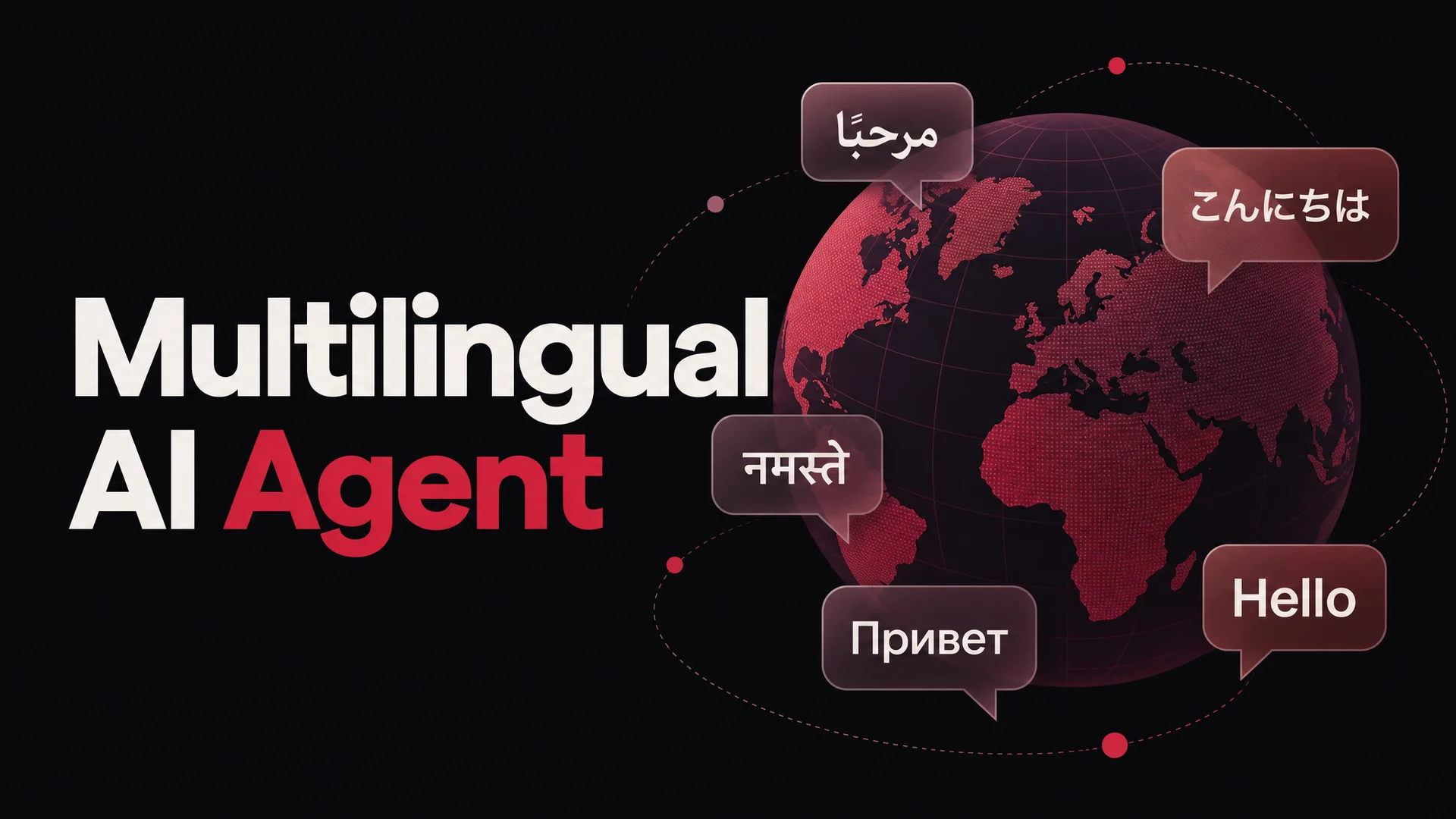
If you run customer support for a global product, the language question gets very practical, very fast. A user types in Brazilian Portuguese at 2 a.m. Another opens a ticket in Vietnamese with three product names mixed in English. A reseller in Riyadh wants Arabic in formal register, not chatty. Whatever AI agent sits in front of those conversations needs to actually handle them - not just translate badly and hope.
The good news: in 2026, the frontier models behind tools like Berrydesk are dramatically better at this than the GPT-3.5 / GPT-4 era systems most "ChatGPT supports X languages" articles were written about. The harder question is no longer "can the model produce Vietnamese?" - it's which model, in which configuration, for which slice of your traffic.
This post walks through what today's models actually cover, where the cracks still show up, and how to set up a multilingual support agent that doesn't embarrass you in front of half your customer base.
How many languages do modern AI models really cover?
OpenAI historically listed 58 officially supported languages for ChatGPT, but in practice the underlying models - GPT-5.5, Claude Opus 4.7, Gemini 3.1 Ultra, and the leading open-weight families - show usable proficiency in 95+ natural languages, plus most major programming languages. Coverage is no longer the headline; depth is.
A few things have shifted since the older guides on this topic were written:
Context windows changed the game. Claude Opus 4.6 and Sonnet 4.6 now ship with a 1M-token context window at no surcharge. Gemini 3.1 Ultra goes to 2M tokens, natively multimodal across text, image, audio, and video. DeepSeek V4 - both the 1.6T-param V4 Pro and the 284B V4 Flash - also supports 1M context. For multilingual support, this matters because you can fit your full glossary, brand voice guide, localized policy docs, and the entire conversation history into one prompt. Translation quality jumps when the model can see how you actually use a term in context.
Open-weight models from China closed the gap on non-English performance. Alibaba's Qwen 3.6 family, Z.ai's GLM-5.1 (MIT-licensed, 754B-param MoE), Moonshot's Kimi K2.6, MiniMax M2/M2.7, and Xiaomi's MiMo-V2 family were trained on substantially more Chinese, Japanese, Korean, Arabic, Indic, and Southeast Asian text than older Western models. For support traffic in those regions, the practical answer is often to route to Qwen 3.6 or DeepSeek V4 Flash rather than default everything to GPT.
Cost stopped being a reason to skimp on quality. DeepSeek V4 Flash is priced at roughly $0.14 per million input tokens and $0.28 per million output tokens. MiniMax M2 lands at roughly 8% the cost of Claude Sonnet at twice the speed. A multilingual support agent handling tens of thousands of resolutions a month no longer has to choose between "good in English, bad everywhere else" and a budget that scares the CFO.
So when you read that an AI "supports 95+ languages," the relevant follow-up is: with what quality, on what model, and what's it costing you per resolution?
Languages where today's frontier and open-weight models perform well
The list below reflects languages where modern AI agents - built on GPT-5.5, Claude Opus 4.7, Gemini 3.1, DeepSeek V4, Qwen 3.6, Kimi K2.6, GLM-5.1, MiniMax M2, or MiMo-V2 - show solid usable proficiency for customer-support-style workloads. As always, "well represented" is a sliding scale: Spanish and Mandarin are not in the same league as, say, Faroese.
- Albanian
- Arabic
- Armenian
- Awadhi
- Azerbaijani
- Bashkir
- Basque
- Belarusian
- Bengali
- Bhojpuri
- Bosnian
- Brazilian Portuguese
- Bulgarian
- Cantonese (Yue)
- Catalan
- Chhattisgarhi
- Chinese (Simplified and Traditional)
- Croatian
- Czech
- Danish
- Dogri
- Dutch
- English
- Estonian
- Faroese
- Finnish
- French
- Galician
- Georgian
- German
- Greek
- Gujarati
- Haryanvi
- Hindi
- Hungarian
- Icelandic
- Indonesian
- Irish
- Italian
- Japanese
- Javanese
- Kannada
- Kashmiri
- Kazakh
- Konkani
- Korean
- Kyrgyz
- Latvian
- Lithuanian
- Macedonian
- Maithili
- Malay
- Maltese
- Mandarin Chinese
- Marathi
- Marwari
- Min Nan
- Moldovan
- Mongolian
- Montenegrin
- Nepali
- Norwegian
- Oriya
- Pashto
- Persian (Farsi)
- Polish
- Portuguese (European)
- Punjabi
- Rajasthani
- Romanian
- Russian
- Sanskrit
- Santali
- Serbian
- Sindhi
- Sinhala
- Slovak
- Slovene
- Slovenian
- Spanish
- Swahili
- Swedish
- Tagalog
- Tajik
- Tamil
- Tatar
- Telugu
- Thai
- Turkish
- Turkmen
- Ukrainian
- Urdu
- Uzbek
- Vietnamese
- Welsh
- Wu
Coverage isn't the same as performance, though. English, Mandarin, Spanish, French, German, Portuguese, Japanese, Korean, Hindi, Arabic, and Russian are the languages where you can comfortably ship without humans in the loop on routine tickets. The long tail - Faroese, Sanskrit, Chhattisgarhi, regional South Asian languages, smaller African and Central Asian languages - works for first-line triage and translation, but expects more nuance loss than your French speakers will tolerate.
Programming languages your agent can read and write
Multilingual isn't just about natural languages. Modern coding-tuned models - Claude Opus 4.7 leading SWE-bench Pro at 64.3%, Kimi K2.6 at 58.6, GLM-5.1 at 58.4 (which beats Claude Opus 4.6 and GPT-5.4 on the same benchmark), MiniMax M2.7 at 56.22, and Qwen3.6-27B punching well above its weight in the dense-model class - handle code as a first-class citizen.
For developer-tooling and API support agents, that means the same Berrydesk deployment can reason about user code in:
- Python
- JavaScript and TypeScript
- C, C++, and C#
- Java and Kotlin
- Go
- Rust
- Ruby and PHP
- Swift and Objective-C
- SQL (across PostgreSQL, MySQL, SQLite, BigQuery dialects)
- Bash, Zsh, PowerShell
- HTML, CSS, and modern frameworks
- YAML, JSON, TOML, and infrastructure DSLs (Terraform, Helm)
- Solidity, R, MATLAB, and Julia for niche stacks
If you support a developer audience, this matters more than the natural-language list. Users will paste a stack trace in Japanese surrounding code, and the model needs to read both halves of that message correctly.
How to deploy multilingual support with Berrydesk
Berrydesk is built so the multilingual story is a configuration, not a project. The four steps:
Pick a model - or several. Choose from GPT-5.5, GPT-5.5 Pro, Claude Opus 4.7, Claude Sonnet 4.6, Gemini 3.1 Ultra and Pro, DeepSeek V4 Pro and Flash, Kimi K2.6, GLM-5.1, Qwen 3.6, MiniMax M2 / M2.7, and others. You can run different models for different languages or different ticket types - more on that below.
Train it on your real content. Connect your knowledge base, your help center, your Notion workspace, your Google Drive folders, your YouTube product walkthroughs, and your public website. The agent learns your brand voice, your product names, and the specific terminology your team has already localized - which is the single biggest accuracy lever for non-English support.
Brand the chat widget. Colors, logo, opening message, language fallback rules. Users get a UI that matches your product, in their language.
Add AI Actions and deploy. Plug in bookings, refunds, order lookups, and payment flows. Push the agent to your website, Slack, Discord, WhatsApp, or wherever your customers actually talk to you. Modern agentic tool-use models - Claude Opus 4.7, Kimi K2.6, GLM-5.1, Qwen 3.6, MiMo-V2-Pro - make these flows reliably production-grade rather than demoware.
Users can simply type in their language and the agent detects and responds. You can also pin a default language per channel (e.g., Brazilian Portuguese on a São Paulo regional widget) or expose a language switcher.
Choosing the right model for your language mix
This is where the 2026 landscape genuinely changes the answer. Three patterns we see Berrydesk customers use:
Single model, frontier-quality everywhere. If your traffic skews English plus a handful of major European and Asian languages, picking Claude Opus 4.7 or GPT-5.5 as a single workhorse is the simplest configuration. You pay frontier prices, but you get consistently strong responses everywhere and don't have to think about routing. Good for B2B SaaS with global but not-yet-massive volume.
Routed: cheap default, frontier escalation. Route routine tickets - password resets, order-status questions, plan changes - to DeepSeek V4 Flash or MiniMax M2 at fractions of a cent per resolution. Reserve Claude Opus 4.7 or GPT-5.5 Pro for the genuinely hard ones: angry customers, ambiguous refund requests, multi-step debugging. The cost curve gets dramatically better without quality regressions where it matters.
Region-specific routing. Run Qwen 3.6 or DeepSeek V4 for Chinese, Japanese, Korean, Indic, and Southeast Asian traffic, and a Western frontier model for English / Spanish / French / German. The Chinese open-weight families were trained on much more text in those languages and tend to nail register, idiom, and proper-noun handling better. Combined with your localized knowledge base, the quality bump is noticeable.
On-prem and air-gapped deploys. For regulated industries - health, finance, government - MIT- and Apache-licensed open weights (GLM-5.1, Qwen3.6-27B, MiMo-V2 family) make running the whole stack inside your own VPC viable. GLM-5.1 was trained entirely on Huawei Ascend 910B chips, no Nvidia, which has compliance implications worth knowing if you're operating in markets with hardware-origin requirements.
Limitations and pitfalls to watch for
Even in 2026, multilingual AI is not a solved problem. The mistakes we see most often:
Treating "can produce the language" as "speaks the language well." A model that produces grammatical Vietnamese can still get formality registers wrong, or misuse honorifics in Korean and Japanese in ways that feel rude. Pre-launch, have a native speaker review responses to your top 30 ticket intents in each language you ship.
Trusting auto-detection on short messages. "OK", "merci", and product names are notoriously hard to language-detect on. Pin language explicitly when you know it from the channel or user profile; don't make the model guess from a three-word message.
Mixing knowledge bases. If your English help center has been updated and your German one hasn't, the agent will silently prefer the English source and translate on the fly - sometimes contradicting your published German policy. Either keep localized docs in sync or train the agent to flag the divergence.
Skipping a glossary. Brand names, product names, plan names, and any jargon you've intentionally left untranslated should live in a glossary the agent always sees. With 1M-token context windows, there is no excuse for shipping without one.
Overestimating long-tail accuracy. For low-resource languages - Faroese, smaller Indic languages, regional African languages - quality is good for triage and translation, but you should not run fully autonomous resolution. Route to a human, or to a translation pair (e.g., user writes in Wolof, agent works in French internally and translates the final reply).
Where multilingual AI support is heading
The honest direction of travel: long-context plus high-quality open-weight models is going to make multilingual support cheaper, faster, and more accurate every six months. You are no longer choosing between "great in English" and "tolerable elsewhere" - you're choosing between several genuinely good options, each with a different cost and licensing profile.
For support teams, the practical work is shifting away from "can our AI handle Spanish?" and toward governance: what does your localized knowledge base look like, who reviews accuracy in each language, where does the agent escalate, and which models do you trust to operate autonomously vs. with a human in the loop. The model layer is no longer the bottleneck.
If you're ready to put a multilingual agent in front of your customers - branded, trained on your real content, and deployed wherever your users already are - you can spin one up at berrydesk.com without a credit card.
 Berrydesk
Launch a multilingual support agent in minutes
- Pick from GPT-5.5, Claude Opus 4.7, Gemini 3.1, DeepSeek V4, Qwen 3.6, and more.
- Train on your docs, sites, and Notion - branded chat live on web, Slack, or WhatsApp.
Set up in minutes

Chirag Asarpota is the founder of Strawberry Labs, the team behind Berrydesk - the AI agent platform that helps businesses deploy intelligent customer support, sales and operations agents across web, WhatsApp, Slack, Instagram, Discord and more. Chirag writes about agentic AI, frontier model selection, retrieval and 1M-token context strategy, AI Actions, and the engineering it takes to ship production-grade conversational AI that customers actually trust.