Machine learning has stopped being a science-project line item and is now baked into how serious companies forecast demand, screen transactions, route support tickets, price products, and decide where to invest the next dollar of marketing spend. Over the past eighteen months the model layer underneath every one of those workflows has changed dramatically, and the cost of running ML in production has fallen by roughly an order of magnitude.
This guide is for operators who have to make decisions about that shift. It is not a textbook. It is a practical map of where machine learning earns its keep in 2026, what the new model landscape unlocks, and how to deploy ML solutions without setting fire to your budget or your customer trust.
We will cover:
- What machine learning actually means inside a business, stripped of buzzwords
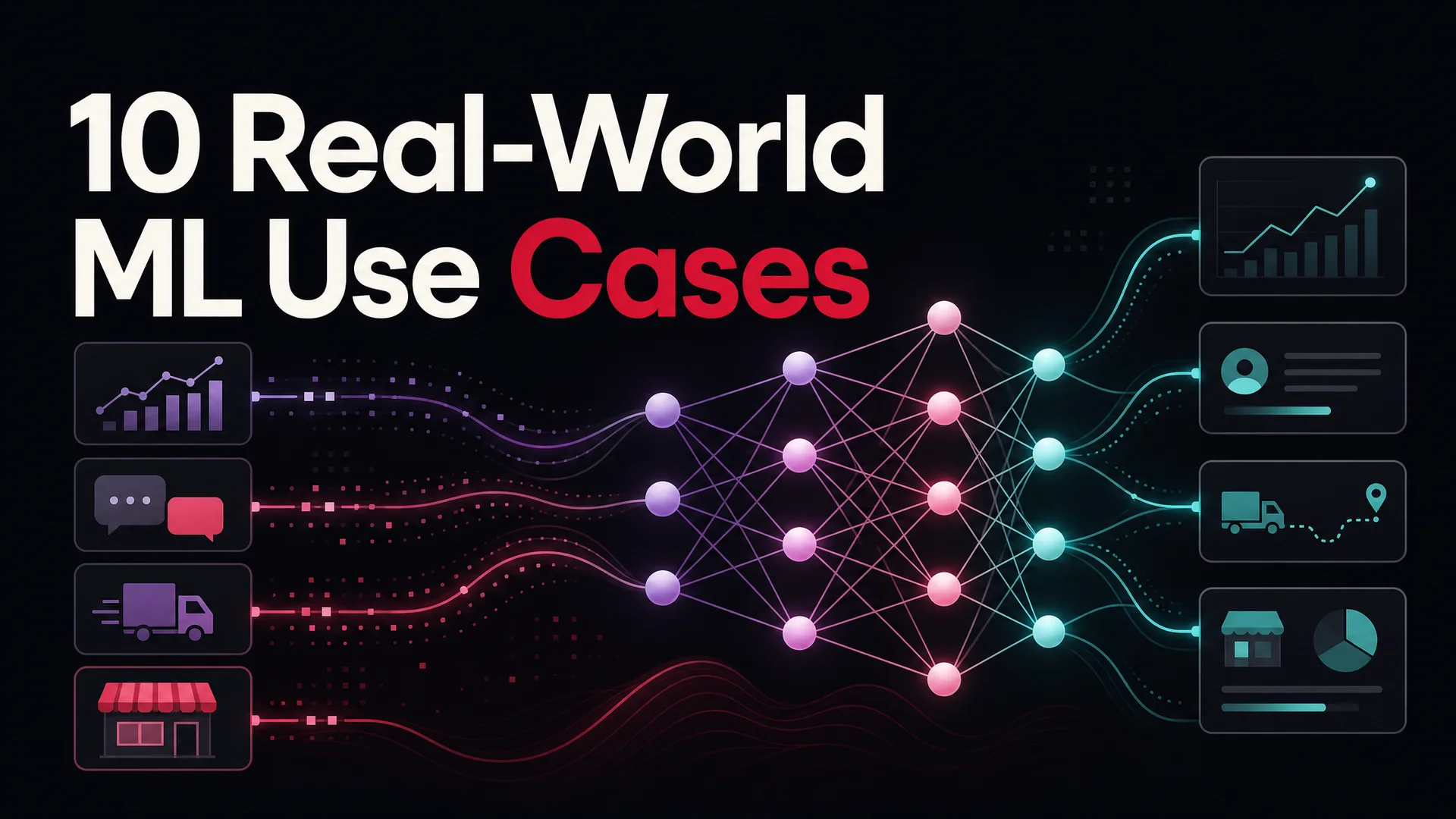
- Ten use cases that are reliably producing returns in 2026, with how to think about each
- How the open-weight model wave is collapsing per-resolution costs
- A concrete implementation playbook, including pitfalls
- What to plan for over the next eighteen months
By the end you should have enough scaffolding to walk into a leadership meeting and argue confidently for or against a specific ML investment, with the trade-offs visible.
What Machine Learning Means Inside a Business
Machine learning is the practice of giving a computer system enough examples - and the right algorithm - to learn a behavior without writing the rules out by hand. Instead of "if order value > $500 and country = X, flag," you show the model thousands of past flagged and unflagged transactions and let it discover the relationships that matter. The model's quality is bounded by the quality and breadth of the data you feed it.
Surveys put adoption north of half of all mid-market and enterprise companies, but the spread is wide. Some teams have a single recommendation model in production. Others have ML embedded across forecasting, fraud, support, and pricing, with a real platform layer underneath. The gap between those two postures is widening, not narrowing.
There are four working parts to know:
- Algorithms - the mathematical recipes that turn data into a model.
- Training data - historical records, ideally labeled, that show the model what good and bad outcomes look like.
- Features - the specific signals you give the model. Often the most important lever in the whole pipeline.
- Models - the trained artifact that takes new inputs and emits a prediction, classification, or decision.
The Three Learning Styles
Almost everything you will encounter falls into one of three buckets.
Supervised learning trains on examples where the answer is already known. Spam vs. not spam. Will churn vs. won't churn. Loan default vs. repaid. This is the workhorse for most business ML - classification when the output is categorical, regression when it is a number.
Unsupervised learning finds structure in unlabeled data. The classic example is customer segmentation: you do not tell the model what segments exist, you let it surface natural clusters. Dimensionality reduction also lives here - collapsing thousands of features into a handful of meaningful ones for downstream models.
Reinforcement learning lets an agent learn by interacting with an environment and receiving rewards. It powers game-playing systems, robotics, and increasingly the agentic AI models that handle multi-step tool use. With the rise of Moonshot's Kimi K2.6, Z.ai's GLM-5.1, and Xiaomi's MiMo-V2-Pro, reinforcement learning is no longer a research curiosity - it is what makes a support agent capable of running a refund workflow end to end.
Algorithms You Will Hear About Most
A handful of algorithms dominate practical work:
- Linear regression for continuous predictions where the relationships are roughly straight lines.
- Logistic regression for binary outcomes - the entry point to most fraud and churn models.
- Decision trees for interpretable, rule-like models.
- Random forests and gradient-boosted trees (XGBoost, LightGBM) for the strongest performance on most tabular business data. If you only learn one family, learn this one.
- Support vector machines for high-dimensional classification problems.
- K-means and hierarchical clustering for segmentation.
- Neural networks - the foundation of everything language- and vision-related, including the frontier large language models that now run most modern customer-facing AI.
How a Project Actually Flows
The textbook ML workflow has six steps. They are obvious in retrospect and surprisingly easy to skip in practice.
- Collect and prepare the data. Most of the work, most of the time. Modern tooling automates a chunk of cleaning and feature extraction, but no amount of automation rescues a sparse or biased dataset.
- Engineer features. Decide which signals you give the model. Domain expertise dominates here.
- Pick an algorithm. Match the technique to the problem and the data shape.
- Train the model. Tune parameters, validate, and iterate.
- Evaluate on held-out data. This is where overconfidence dies. A model that scores beautifully on training data and terribly on new data has memorized rather than learned.
- Deploy and monitor. Production performance drifts as the world changes. Continuous monitoring is part of the job, not an afterthought.
Why It Differs From Traditional Code
Classic software is deterministic - you write the rules, the program follows them. ML inverts that. The rules emerge from the data. Models can adapt as they see more examples, generalize to inputs nobody anticipated, and find patterns in high-dimensional data that no human could enumerate by hand. The price you pay is interpretability and a need for serious data hygiene. With those caveats understood, the practical use cases get interesting.
Ten Machine Learning Use Cases Producing Real Business Value in 2026
For each application below we will lay out the problem it solves, how ML addresses it, the techniques in play, what to watch out for, and how the May 2026 model landscape changes the calculus.
1. Customer Segmentation and Personalization
The problem. Treating every customer the same wastes spend at the top of the funnel and erodes loyalty at the bottom. The companies pulling ahead are those that can describe their audience as a few hundred meaningful micro-segments rather than three demographic buckets.
The ML approach. Clustering algorithms ingest behavioral, demographic, and transactional data and surface segments the marketing team would never find by hand. Once segments exist, recommender systems and uplift models personalize content, offers, and product placement at the individual level.
What changed in 2026. Long-context language models - Gemini 3.1 Ultra at 2M tokens, Claude Sonnet 4.6 and DeepSeek V4 at 1M - let teams build personalization that incorporates a customer's full interaction history without aggressive truncation. A support agent built on Berrydesk can now hold every prior conversation, every order, and the full product catalog in context, and respond as if it remembers.
Techniques in play.
- K-means and hierarchical clustering for segmentation
- Collaborative filtering and matrix factorization for recommendations
- Deep embedding models for representing customers and content in a shared space
- Long-context LLMs for conversational personalization
Watch out for. GDPR, CCPA, and the growing list of regional successors. Filter bubbles that narrow rather than expand the customer's world. Models that overfit to the last quarter and miss emerging behaviors. Models that quietly inherit and amplify bias from the training set.
When this works, churn drops, conversion lifts, and the marketing team stops blasting generic emails to people who have already bought the product.
2. Predictive Maintenance
The problem. Industrial downtime is brutally expensive. A jet engine pulled from service unexpectedly, a packaging line down for four hours, a chiller failing on a hot Saturday - these are revenue events, not maintenance events.
The ML approach. Time-series models trained on sensor telemetry, maintenance logs, and operating conditions predict the probability of failure within a given window. Maintenance shifts from calendar-based to condition-based, and from reactive to anticipatory.
Techniques in play.
- Time-series forecasting with ARIMA-family models, Prophet, and LSTM/Transformer architectures
- Anomaly detection on streaming sensor data
- Random forests for feature importance, to tell engineers which signals actually matter
- Ensemble approaches that combine physics-based simulation with learned models
Watch out for. Failures are rare events, and rare events are hard to label well. False alarms train operators to ignore the system. Real-time integration with industrial control systems is a nontrivial engineering task. Treat the ML model as one input to a maintenance decision, not the decision itself.
A well-instrumented predictive maintenance program tied into downtime tracking software does more than predict failures - it gives reliability engineers a feedback loop that improves the schedule itself over time.
3. Fraud Detection and Prevention
The problem. Online payments fraud is an arms race. Rules-based systems catch yesterday's tactics. By the time analysts write a new rule, the attackers have moved on.
The ML approach. Real-time scoring models look at hundreds of features per transaction - device fingerprint, behavioral biometrics, IP reputation, transaction graph context - and emit a risk score in milliseconds. Models retrain frequently to chase shifting attack patterns.
Techniques in play.
- Gradient-boosted trees and random forests for tabular risk features
- Graph neural networks for detecting coordinated fraud rings
- Anomaly detection for previously unseen attack types
- Ensembles that fuse model scores with rules and human-reviewed cases
Watch out for. Class imbalance - fraud is a tiny fraction of traffic, and naive accuracy metrics are useless. False positives that frustrate legitimate customers can cost more than the fraud itself. Adversaries actively probe and adapt to your model. Regulated industries demand explainability for adverse actions.
The best programs combine ML with a small team of skilled analysts who feed labeled cases back into training. Fully automated fraud systems exist; the ones that work in the long run keep humans in the loop.
4. Supply Chain Optimization
The problem. Global supply chains are complex enough that small forecasting errors compound into large stockouts or overstocks. The pandemic, the 2022 shipping disruptions, and the 2024 Red Sea reroute reminded everyone that resilience matters as much as efficiency.
The ML approach. Demand forecasting models combine historical sales with external signals - weather, macro indicators, web search trends, even satellite imagery of port traffic. Reinforcement learning optimizes routing and inventory placement under uncertainty. NLP models scan supplier news and filings for risk signals.
Techniques in play.
- Hierarchical time-series forecasting across SKU, store, and region
- Reinforcement learning for inventory and routing decisions
- LLM-driven document analysis for supplier risk assessment
- Optimization solvers wrapped around learned demand models
Watch out for. Models trained on pre-disruption data fail when the world shifts. Build in mechanisms to detect distribution drift. Multi-objective optimization - cost vs. speed vs. carbon vs. resilience - has no single right answer. Make the trade-offs explicit, do not hide them inside the model.
5. Conversational AI and Agentic Customer Support
The problem. Support volumes keep growing, customer expectations keep rising, and hiring linearly to keep up no longer pencils. Self-service alone leaves money on the table when it cannot resolve issues.
The ML approach. Modern LLM-powered support agents understand intent, retrieve the right knowledge, take actions, and escalate cleanly when they should. They are no longer the intent-tree chatbots of five years ago.
What changed in 2026. This is the use case the model wave has reshaped most aggressively.
- Frontier closed models - GPT-5.5 and GPT-5.5 Pro, Claude Opus 4.7 leading SWE-Bench Pro at 64.3%, Gemini 3.1 Pro at 94.3% on GPQA Diamond - handle the hardest reasoning and escalations.
- Open-weight frontier models - DeepSeek V4 Flash at $0.14 / $0.28 per million input/output tokens, MiniMax M2 at roughly 8% the price of Claude Sonnet at twice the speed, Qwen3.6-27B running comfortably on a single GPU - handle the high-volume routine traffic at fractions of a cent per resolution.
- Agentic models - Kimi K2.6 with 12-hour autonomous coding sessions and swarms of up to 300 sub-agents, GLM-5.1 with an 8-hour plan-execute-test-fix loop, Claude Opus 4.7, Qwen3.6, MiMo-V2-Pro - make AI Actions like booking, refunds, order lookups, and payment flows reliable instead of demoware.
- MIT and Apache-licensed Chinese open weights - GLM-5.1, Qwen3.6-27B, MiMo - make on-prem and air-gapped deployments viable for regulated industries that could not adopt closed-API models at all.
A typical Berrydesk deployment routes routine traffic to DeepSeek V4 Flash or MiniMax M2 and reserves Claude Opus 4.7, GPT-5.5 Pro, or Gemini 3.1 Ultra for the escalations that need them. The unit economics that emerge are genuinely different from a year ago.
Techniques in play.
- LLM-based intent and entity understanding
- Retrieval-augmented generation, increasingly used as a tuning lever rather than a hard requirement now that 1M-2M token windows are common
- Tool-use frameworks for agentic actions
- Reinforcement learning from human feedback to improve tone, accuracy, and refusal behavior
Watch out for. Hallucinations on questions outside the knowledge base. Bad escalation paths that trap users with the bot. Tone mismatches with brand. Privacy gaps when handling sensitive customer data. The fix for most of these is disciplined evaluation, clear scope, and a real fallback to humans.
When set up well, conversational AI handles the bulk of repetitive load, gives human agents better context for the rest, and stays online at 3am on a holiday.
6. Predictive Analytics for Sales and Marketing
The problem. Sales teams spend roughly two-thirds of their time on accounts that will not close. Marketing teams over-invest in channels that look great in last-touch attribution and underinvest in the ones doing real work.
The ML approach. Lead-scoring models rank prospects by conversion probability. Customer lifetime value models help marketing decide how much to spend acquiring a given segment. Multi-touch attribution models assign credit across the channels a buyer actually touched. Forecasting models give finance a defensible pipeline number.
Techniques in play.
- Classification for lead scoring
- Survival analysis for customer lifetime value and churn
- Multi-touch attribution using Markov chains or Shapley values
- Causal inference methods to estimate true incremental lift, not just correlation
Watch out for. Historical data captures yesterday's market. Qualitative factors - brand, narrative, competitive moves - do not show up cleanly in the data and still matter. Lead-scoring models can ossify bias by always favoring customers who look like past customers. Periodically force the team to take risks the model would not.
7. Image and Video Analysis
The problem. Visual data is everywhere - store cameras, product photos, shipping inspections, social media - and almost none of it has historically been searchable or analyzable at scale.
The ML approach. Convolutional networks and increasingly transformer-based vision models classify, detect, segment, and caption images and video. Native multimodal models like Gemini 3.1 Ultra and Kimi K2.6 (with native video input) collapse what used to be three pipeline steps into one.
Techniques in play.
- Object detection (YOLO-family, DETR variants)
- Segmentation models for fine-grained analysis
- Multimodal LLMs for caption-and-reason workflows
- Transfer learning from large pretrained backbones
Watch out for. Compute cost at scale. Bias in training data leading to unfair outcomes, particularly in any application touching faces or people. Privacy and regulatory exposure for surveillance-adjacent use cases. Set guardrails before the technology runs ahead of the policy.
8. Sentiment Analysis and Social Listening
The problem. Public perception moves faster than internal reporting cycles. By the time a crisis shows up in a weekly dashboard, the window to respond has often closed.
The ML approach. NLP models scan social platforms, reviews, and support transcripts in near real time, classify sentiment, surface emerging topics, and flag anomalies. Modern LLMs handle context-dependent sentiment - sarcasm, comparative phrasing, mixed feelings - far better than the bag-of-words classifiers of a few years ago.
Techniques in play.
- Aspect-based sentiment analysis to separate what customers love from what they hate within the same review
- Topic modeling and clustering for trend discovery
- Named entity recognition to track mentions of products, competitors, executives
- LLM-based zero-shot classification when labeled data is scarce
Watch out for. Volume and velocity are real engineering problems. Slang and meme-speak evolve faster than annotation cycles. Sentiment scores without context can mislead. Pair the dashboard with a human who actually reads the conversations.
9. Dynamic Pricing and Revenue Management
The problem. Static prices leave revenue on the table during demand peaks and depress volume during troughs. But aggressive dynamic pricing can corrode trust quickly.
The ML approach. Demand forecasting models combine with elasticity estimates and competitor signals to set prices that maximize a chosen objective - revenue, margin, market share - within constraints.
Techniques in play.
- Time-series forecasting for demand
- Regression and causal modeling for price elasticity
- Multi-armed bandit algorithms for online price testing
- Reinforcement learning for sequential pricing decisions
Watch out for. Customers notice when prices change too often. Regulated industries - insurance, energy, healthcare - face hard constraints on pricing logic. Isolating the impact of a price change from everything else moving in the market requires real experimental design.
10. People Analytics and Talent Management
The problem. Hiring is expensive and noisy. Retention is a leading indicator of culture problems. Learning and development programs often fail to land because they are built for the average employee rather than the actual one.
The ML approach. NLP-driven resume and interview analysis. Survival models for predicting attrition risk. Recommender systems for personalized learning paths. Optimization for workforce scheduling.
Techniques in play.
- LLM-based resume parsing and skill extraction
- Survival analysis for tenure and turnover
- Recommendation systems for learning content
- Constrained optimization for shift planning
Watch out for. This is the application area where ethical risk is highest. Models that quietly encode bias from past hiring decisions perpetuate that bias at scale. Run regular fairness audits, document model decisions, and keep humans in the loop on consequential calls. Treat ML in HR as decision support, never decision automation.
Choosing Between Closed Frontier and Open-Weight Models
Most of the use cases above can be powered by either a closed frontier model or an open-weight one, and the right answer depends on three questions.
How sensitive is the data? If customer PII or regulated data flows through the model, on-prem or VPC-isolated deployments matter, and the MIT-licensed open weights - GLM-5.1, Qwen3.6-27B, MiMo - become not just cheaper but the only viable option.
What is the volume? At ten thousand resolutions a day, the marginal cost of using a frontier closed model is fine. At ten million, the difference between $0.14 per million input tokens (DeepSeek V4 Flash) and a frontier closed model adds up to seven figures a year. Most production deployments end up routing the long tail to a cheap open-weight model and reserving the frontier for hard cases.
How agentic is the workflow? If the model needs to call tools, navigate multi-step processes, and recover from errors, look hard at the agentic-first models - Kimi K2.6, GLM-5.1, Claude Opus 4.7, Qwen3.6, MiMo-V2-Pro. A model that scores brilliantly on a static benchmark can still flounder in a 12-step refund workflow.
The pattern that wins for most teams in 2026 is a routed deployment: a router model classifies the request, sends it to the cheapest model that can handle it competently, and falls back to a frontier model only when needed. Berrydesk supports this pattern out of the box, letting you mix GPT, Claude, Gemini, DeepSeek, Kimi, GLM, Qwen, MiniMax, and others within a single agent.
How to Implement Machine Learning Without Setting Money on Fire
The technology is the easy part. The organizational shift around it is what most projects underestimate.
Assess Readiness Honestly
Before you pick a use case, take a hard look at four things.
Data infrastructure. Can you reliably extract clean training data from your systems within a reasonable time? If the answer is no, fix that before anything else.
Technical capability. Do you have a data scientist or ML engineer on staff, or a partner you trust? AutoML tools have closed some of the gap, but they have not eliminated the need for someone who understands the math.
Business alignment. Pick use cases tied to a measurable outcome a leader cares about. Solving an interesting problem that nobody owns is the fastest path to a shelved project.
Cultural readiness. ML works best in organizations that already make decisions based on data. If yours runs on instinct and politics, the model output will be ignored regardless of accuracy.
Build the Right Team
Successful ML programs need a mix of roles:
- Data scientists to design and train models
- ML engineers to deploy, monitor, and maintain them in production
- Data engineers to keep the data pipelines reliable
- Domain experts to validate that the model is solving the right problem
- Project managers to keep work moving across team boundaries
Hybrid in-house plus external partner is a common pattern for mid-market teams. Pure in-house is the right call once volume and strategic importance justify the headcount.
Pick the Right Tools
The ecosystem is mature and crowded. A reasonable default stack:
- Open-source libraries like PyTorch, scikit-learn, and XGBoost for custom modeling
- Cloud ML platforms - AWS SageMaker, Vertex AI, Azure ML - for managed infrastructure
- AutoML tools when the data science team is small
- Specialized vertical platforms like Berrydesk for AI customer support, where the heavy lifting around grounding, routing, and tool use is already solved
The right choice is the one your team can actually operate. A best-in-class platform that nobody on staff knows how to use is worse than a second-best one that everyone knows.
Get the Data Right
Most ML failures are data failures dressed up as model failures. Identify your sources, build robust collection pipelines, clean aggressively, and invest in feature engineering. The single biggest accuracy lever in most projects is not the algorithm - it is how the inputs are constructed.
Develop Models the Boring Way
Start simple. A logistic regression baseline is faster to deploy and easier to debug than a neural network, and it tells you whether the signal exists in the data at all. Use cross-validation. Tune hyperparameters systematically rather than by intuition. Ensemble multiple models if accuracy matters more than latency. Document every decision for the next person on the team.
Deploy Carefully
Production ML deployment looks more like operations than data science.
- Build an evaluation framework that runs against new model versions automatically
- Roll out gradually with A/B testing or shadow deployments
- Monitor accuracy, latency, drift, and downstream business metrics
- Plan for retraining cadence from day one
- Comply with the regulations that apply - GDPR, CCPA, the EU AI Act, sector-specific rules
Take the Ethics Seriously
Every consequential ML system needs answers to five questions before launch.
- Fairness. Does the model treat protected groups equitably?
- Transparency. Can you explain a decision when challenged?
- Privacy. Is data being used the way customers were told it would be?
- Accountability. Who owns the model and its outcomes?
- Societal impact. Are there second-order effects you have not thought through?
These are not box-checking exercises. They protect the company from regulatory action and the customer from harm.
What to Watch Over the Next 18 Months
A handful of trends are shaping the next phase of business ML.
AutoML continues to mature. The gap between an experienced ML engineer and a competent operator using a modern AutoML platform narrows every quarter. This is good news for teams without a deep bench.
Explainable AI is a regulatory requirement, not a nice-to-have. The EU AI Act and its analogs in other jurisdictions are pushing interpretability from optional to mandatory in high-risk applications. Plan accordingly.
Edge AI is real now. Models small enough to run on a phone or industrial gateway have caught up to where cloud models were two years ago. Latency-sensitive and privacy-sensitive use cases get easier.
Federated learning is moving out of research. Training across decentralized data without centralizing it is now practical for healthcare, finance, and any setting where data cannot move.
Quantum machine learning stays speculative for most companies but is worth tracking. Specific narrow problems may see early advantage in the next two to three years.
Agentic AI eats more workflows. The agent-first models - Kimi K2.6, GLM-5.1, Claude Opus 4.7 - make it realistic to give an AI a multi-step business process and have it complete the process, not just discuss it. Customer support, IT operations, and back-office workflows are where this lands first.
What This Means for Customer-Facing AI
Conversational AI in particular is moving fast. Natural language understanding is essentially solved at the level most businesses need. Multimodal interactions - text, voice, image, video - are now table stakes for new deployments. Emotion-aware response is on the cusp. Personalization at scale is no longer a research problem; it is a deployment problem. And integrations are pushing AI agents out of the support silo and into sales, success, ops, and internal IT.
Berrydesk lets businesses launch a branded support agent in four steps: pick a model, train it on your docs and sites and Notion and Drive and YouTube, brand the chat widget, plug in AI Actions for bookings and payments, and deploy to your website, Slack, Discord, WhatsApp, and beyond. The platform layer handles routing across GPT, Claude, Gemini, DeepSeek, Kimi, GLM, Qwen, MiniMax, and others, so you can put cheap fast models on the easy work and frontier models on the hard work without rewriting the agent.
The Short Version
Machine learning is no longer the differentiator - having a real ML practice is the baseline. The differentiator now is whether you have built the data infrastructure, organizational muscle, and routing intelligence to deploy ML cheaply at scale across the use cases that matter for your business.
Take with you:
- Pick high-impact use cases tied to measurable outcomes, not interesting problems with no owner
- Invest in data quality before you invest in model sophistication
- Build a multidisciplinary team and a culture that listens to model output
- Match the model to the workload - open-weight for volume, frontier for the hard tail
- Roll out gradually, monitor honestly, and retrain on a schedule
- Treat ethics, fairness, and explainability as engineering requirements, not afterthoughts
The teams that internalize all of this in 2026 will compound their advantage every year that follows. The ones that wait will spend the rest of the decade catching up.
If you are ready to start with the customer-facing slice - the place where ML pays for itself fastest in 2026 - try Berrydesk and have a working AI support agent live in an afternoon.
 Berrydesk
Launch your AI agent in minutes
- Train on your docs, sites, Notion, Drive, and YouTube
- Pick from GPT-5.5, Claude Opus 4.7, Gemini 3.1, DeepSeek V4, Kimi K2.6, and more
Set up in minutes

Chirag Asarpota is the founder of Strawberry Labs, the team behind Berrydesk - the AI agent platform that helps businesses deploy intelligent customer support, sales and operations agents across web, WhatsApp, Slack, Instagram, Discord and more. Chirag writes about agentic AI, frontier model selection, retrieval and 1M-token context strategy, AI Actions, and the engineering it takes to ship production-grade conversational AI that customers actually trust.