Tidio has been a familiar name in small-business customer messaging for over a decade. It does the basics well: a live chat widget, a few canned bot flows, and a tidy inbox for email and Messenger. For a single-product DTC store with low ticket volume, that combination still gets the job done.
The problem is that "the basics" have moved. In 2026, customers do not write to a support team to be greeted by a decision-tree bot that asks them to pick from four buttons. They expect an agent that has read every help article, knows their last three orders, can change a delivery address without a handoff, and answers in their language at two in the morning. The gap between what a 2013-era live chat tool can do and what a modern AI agent can do has become a chasm - and Tidio sits closer to the live-chat side of it than the agent side.
There are also the usual operational frustrations that come up in Tidio reviews: a builder that gets fiddly once flows branch more than two layers deep, navigation that buries useful settings, and a pricing curve where the features you actually want - automation triggers, advanced analytics, AI add-ons - sit behind the upper plans. None of this makes Tidio bad. It makes it worth checking what else is on the table before you renew.
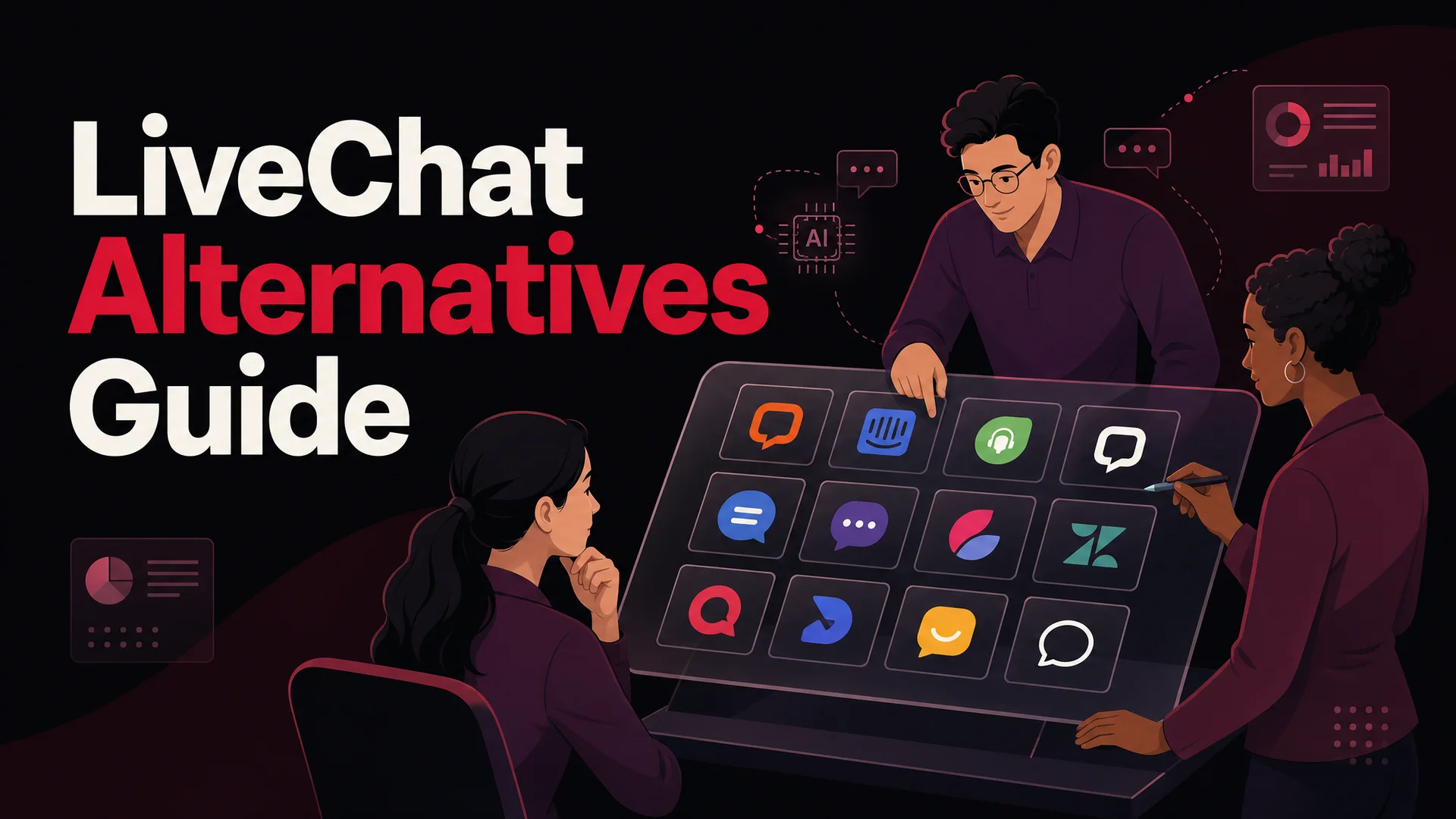
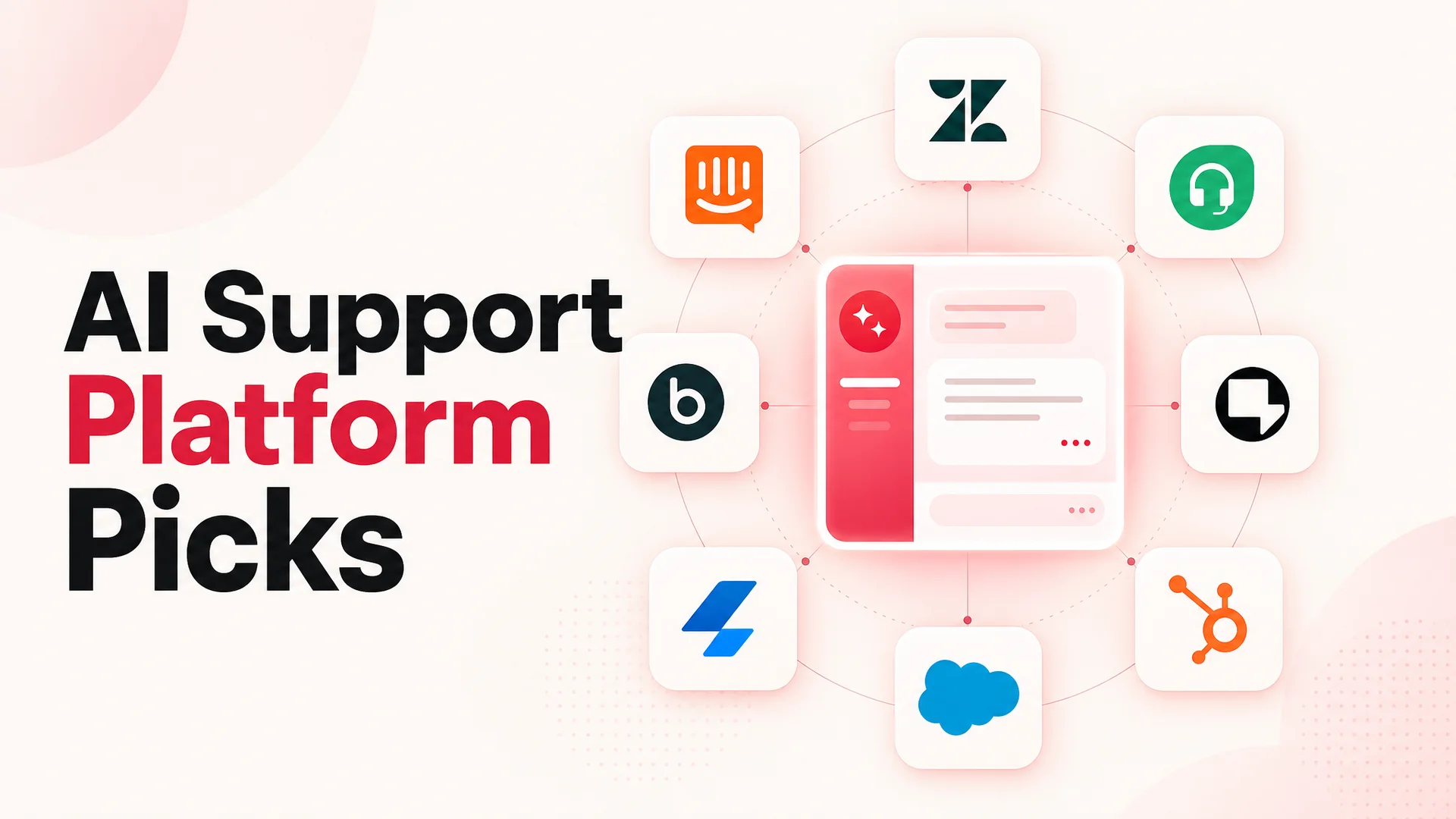
Below are eight alternatives that overlap with what Tidio does, ordered roughly from "AI-agent native" to "traditional helpdesk with AI bolted on." Each section covers what the tool actually is, where it fits, and what trade-off you are buying into.
1. Berrydesk
Berrydesk takes the opposite stance from Tidio: instead of starting with a chat window and adding bot logic later, it starts with the AI agent and treats the chat surface as one of many places that agent can show up. You connect a knowledge source, pick a model, and you have an agent that handles real questions in minutes - not a flow chart you have to maintain.
The setup is four steps. Pick a model from a list that now includes GPT-5.5 and GPT-5.5 Pro, Claude Opus 4.7 and Sonnet 4.6, Gemini 3.1 Ultra and Pro, DeepSeek V4, Moonshot Kimi K2.6, Z.ai's GLM-5.1, Alibaba's Qwen3.6, MiniMax M2, and others. Train it on your docs, your live website, Notion, Google Drive, YouTube, or any combination. Brand the widget. Add AI Actions for things like booking a meeting, processing a refund, looking up an order, or charging a card. Then deploy to your website, Slack, Discord, WhatsApp, or all of them at once.
What makes this practical in 2026 - and not just demoware, like a lot of "AI chatbot" pitches were two years ago - is that the underlying models can finally hold an entire support context in their head. Claude Opus 4.6 and Sonnet 4.6 ship with a 1M-token context window at no surcharge. Gemini 3.1 Ultra goes to 2M. DeepSeek V4 Flash hits the same 1M number for $0.14 per million input tokens. That means a Berrydesk deployment can keep your full help center, the customer's conversation history, and the policy document for a given action all in working memory, without the brittle retrieval pipelines that used to break support bots.
The tool-use story has caught up too. Models like Kimi K2.6, GLM-5.1, Claude Opus 4.7, and Qwen3.6 are built for multi-step agentic work - running an action, checking the result, recovering from a mistake, asking the customer the right follow-up. That is what makes AI Actions on Berrydesk a real automation layer rather than a "the bot can call an API if everything goes perfectly" promise.
Berrydesk is a strong fit if you want one operating system for support that you can grow with: small teams use it as a smart FAQ widget, larger teams use it as the first line for thousands of tickets a week and route the hard cases to humans. Get started at berrydesk.com.
2. Salesforce Service Cloud
Salesforce sits at the opposite end of the spectrum from Tidio. It is a CRM-first platform where service is one pillar among many - sales pipelines, marketing automation, analytics, and the rest. Einstein, its AI layer, plugs language models into ticket triage, reply drafting, and case summarization across all of those surfaces.
The case management itself is genuinely deep. Tickets can be routed across phone, email, chat, and social channels, with rules-based assignment, SLA enforcement, and escalation paths that a large organization actually needs. Customization is famously broad: every object, field, and workflow can be reshaped, and the AppExchange marketplace adds another layer of integrations and add-ons.
The trade-off is exactly what you would expect from that scope. Salesforce is expensive, the implementation is rarely a weekend project, and you will likely need an admin or a partner for any serious customization. If your support strategy is one moving part of a much larger enterprise customer engine - sales, marketing, success, billing, all stitched together - Salesforce is a reasonable destination. If you just want a smart agent on your website by Friday, it is overkill.
3. Crisp
Crisp is Tidio's closest spiritual sibling. It started life as a multi-channel inbox: live chat, email, Messenger, WhatsApp, Twitter DMs, SMS, and Instagram all funnel into one shared view. Bot building is done through a visual flow editor that is genuinely cleaner than Tidio's once your flows get past two or three branches.
There are a few things Crisp does that Tidio does not. Co-browsing lets an agent see the customer's screen and walk them through a problem in real time, which is a quiet but powerful feature for software companies and complex purchases. Visitor tracking shows you who is on the site, what they are reading, and how long they have been stuck on the pricing page - useful for proactive outreach. Integrations with Slack, Shopify, WordPress, HubSpot, and Zapier are deep enough that Crisp can sit in the middle of a typical SaaS or e-commerce stack without becoming an island.
Where Crisp falls short of an AI-agent platform is in the agent layer itself. Its bots are flow-based first and language-model-augmented second. If your goal is a true conversational agent that can resolve novel questions on its own - not just route them - you will outgrow Crisp's automation faster than you outgrow its inbox.
4. Chatfuel
Chatfuel is purpose-built for messaging-app commerce, with Facebook Messenger, Instagram, and WhatsApp as the primary surfaces. If a meaningful share of your traffic comes from social ads that drop people into a DM thread, Chatfuel's specialization shows: it has the visual flow builder, the audience segmentation, the broadcast tools, and the meta-platform-specific compliance that a site-first tool like Tidio handles only loosely.
The AI side has improved a lot. Modern Chatfuel bots can pass natural-language inputs to a language model rather than insisting on keyword matches, which means conversations feel less like filling out a form. For the use cases Chatfuel targets - abandoned-cart recovery on Instagram, lead capture from a Facebook ad, order status in WhatsApp - that is often enough.
What Chatfuel is not is a website-first support agent. If most of your help interactions happen on your dashboard or your docs site, you will end up bolting another tool on top, which defeats the point of consolidating. The other consideration is platform risk: a tool built around Meta's messaging APIs is, by construction, exposed to whatever those APIs and their pricing do next.
5. Freshdesk
Freshdesk is a classic help-desk product with an AI layer that has matured a lot in the past two years. Its core remains the ticketing system: every email, chat, call, or social-media interaction becomes a ticket with a status, an assignee, and an SLA. Routing rules, ticket prioritization, and team inboxes mean a support org of fifty people can avoid the standard "who is taking this one?" thrash.
The self-service side is the part Tidio has nothing like. Freshdesk's knowledge-base module lets you publish help articles, organize them into categories, and surface them inside the chat widget so customers can answer their own questions before opening a ticket. With Freddy, the AI layer, those articles also act as grounding for AI-suggested replies and bot responses, which closes the loop between published content and live answers.
Where Freshdesk shows its origins is in the ergonomics of the AI itself. The agent capability is mostly an "answer suggestion" plus a "summarize this thread" pattern grafted onto a ticketing UI, rather than a first-class agent that resolves issues end-to-end. For teams that already think in tickets and want better automation around that workflow, Freshdesk is a strong fit. For teams that want to skip the ticket queue entirely on the most common questions, you will want a tool with a deeper agent layer.
6. Zendesk
Zendesk is the other anchor name in helpdesk software. The shape of the product is similar to Freshdesk's - tickets, multi-channel intake, automation rules, knowledge base, community forum - but the company has gone harder on AI in the last cycle. Zendesk AI now includes intent detection on incoming messages, suggested macros for agents, autonomous resolution for a defined set of intents, and reply drafting tuned to your brand voice.
The self-service side, like Freshdesk's, can be surprisingly impactful. A well-tended Zendesk help center plus a competent AI deflection layer can resolve a meaningful chunk of contacts without an agent ever being involved. The community forum module - where customers help each other and your team monitors - is the kind of thing a small team rarely builds well, and Zendesk packages it cleanly.
The standard caveat applies. Zendesk is priced for organizations with real support headcount and real ticket volume; if you are a five-person company looking for something to drop on your marketing site, the per-seat math will not feel friendly. There is also the perception, fair or not, that Zendesk's footprint is large and its UI dense - not a tool you onboard in an afternoon.
7. Zoho Desk
Zoho Desk is part of the broader Zoho suite, which is its main strength and its main complication. If you already use Zoho CRM, Zoho Books, or Zoho Projects, Desk plugs in cleanly: tickets see customer records, deals, invoices, and project context without separate integrations. Zia, the AI layer, handles intent detection, sentiment scoring, anomaly detection on ticket trends, and reply suggestions.
The interface is more approachable than Salesforce, and the price point is lower than Zendesk for similar feature surface. Templates and a low-code customization layer mean you can adjust ticket forms, automation rules, and dashboards without a specialist. That makes Zoho a sensible default for businesses that want a competent helpdesk without committing to a top-tier vendor.
The pattern of complaint that comes up consistently is around support quality from Zoho itself - slow responses, generic answers, occasional regressions after updates. Worth knowing if your business depends on the tool being responsive when something breaks.
8. LiveAgent
LiveAgent leans into the universal-inbox concept harder than most. Live chat, email, social DMs, voice, video calls, and even WhatsApp Business funnel into a unified queue, with a ticketing layer on top. For teams that genuinely answer customers across half a dozen channels, the consolidation alone is the value proposition.
Where LiveAgent sits ahead of Tidio is in ticket management depth and reporting granularity. SLA tracking, agent productivity metrics, channel performance breakdowns, and customer satisfaction surveys are first-class rather than add-ons. The AI Answer Assistant adds suggested replies on top, drawn from your knowledge base and previous resolutions.
The trade-off is the same one as with Freshdesk and Zendesk: this is a helpdesk product with AI features, not an AI-agent product with helpdesk features. If your bottleneck is "we cannot deflect the easy stuff before it becomes a ticket," LiveAgent helps you process tickets faster but does not eliminate them at the source. That is a real distinction in 2026, when a meaningful share of support traffic can be resolved by an agent that has read your docs and can call your API.
How to Pick Without Overthinking It
Two questions cut through most of the comparison shopping.
Is your bottleneck volume or complexity? If it is volume - too many easy questions, too few people to answer them - you want a tool whose core competence is resolving tickets autonomously, not routing them prettier. That argues for an AI-agent platform like Berrydesk over a ticketing platform with AI features bolted on. If the bottleneck is complexity - many channels, many SLAs, many specialist teams - you want the helpdesk depth of Zendesk, Freshdesk, or Salesforce, with an AI layer on top.
How much do you want to maintain? Flow-based bots like Tidio's, Crisp's, and Chatfuel's are predictable but require ongoing curation. Every new product, policy change, or pricing tweak is another branch in the flow. Modern AI agents trained on your knowledge base instead pick up changes automatically when you update the underlying docs - which is a meaningful operational difference once you have more than fifty articles to manage.
A few quick fits for the rest of the list:
- Tidio: small DTC stores with low complexity, a single channel that matters, and no appetite for AI investment yet.
- Salesforce Service Cloud: enterprises where support is one node in a much bigger CRM strategy.
- Crisp: scrappy SaaS or e-commerce teams that want a clean multi-channel inbox and are okay with light bot logic.
- Chatfuel: businesses whose center of gravity is Messenger, Instagram, and WhatsApp commerce, not their own website.
- Freshdesk: established support orgs who want a strong ticketing core with AI that complements existing workflows.
- Zendesk: similar profile to Freshdesk, with deeper community and self-service tooling.
- Zoho Desk: Zoho-suite shops that want a serviceable helpdesk without a six-figure annual spend.
- LiveAgent: teams answering customers across many channels who want unified queueing and richer reporting.
Why Model Choice Has Become a First-Class Question
One thing the older "best Tidio alternatives" lists missed is that the model under the hood is now a real product decision. In 2024, choosing a chatbot tool meant choosing a vendor's wrapper around GPT-3.5 or GPT-4 - usually with little say in the matter and a price that reflected the API margins. That has flipped.
DeepSeek V4 Flash, released in April 2026, runs at $0.14 per million input tokens and $0.28 per million output tokens, with a 1M-token context window. MiniMax M2 hits roughly 8% the cost of Claude Sonnet at twice the speed for many workloads. GLM-5.1 from Z.ai posts a 58.4 on SWE-Bench Pro under an MIT license. Qwen3.6-27B is an Apache 2.0 dense model that beats much larger MoE rivals on agentic coding tasks. These are not hobbyist projects - they are production-grade options that change the unit economics of running a support agent.
The practical pattern that comes out of this on Berrydesk: route most of your conversational volume to a fast, cheap, open-weight model, and reserve the frontier closed models for the genuinely hard escalations. A "what is your return policy?" question and a "my international order is stuck in customs and I need someone to help me file a claim" question do not need the same model behind them. Picking one model for everything was a 2024 constraint; in 2026, picking the right model per intent is the work.
What to Watch Out For
A few patterns to avoid as you evaluate any tool on this list, including Berrydesk:
- Don't optimize for the demo. Most of these tools look great in a five-minute walkthrough. The differences show up at month three, when the flows have grown, the team has rotated, and someone has to maintain it.
- Test with your worst tickets, not your best. It is trivial to get any modern bot to answer "what are your hours?" The interesting question is what it does with the multi-part, slightly-off-topic, partly-unstated question that real customers actually send.
- Watch the lock-in. Tools that own your knowledge base, your conversation logs, and your routing logic in proprietary formats are harder to leave. Prefer ones that let you export everything, swap models, and integrate with your own systems.
- Be honest about handoff. No AI agent is going to handle 100% of contacts well. Whichever tool you pick, the agent-to-human handoff - and what context is preserved across it - is doing as much work as the AI itself.
If you'd like to try the AI-agent-first approach on the rest of the list, build a free agent on Berrydesk - connect your help center, pick a model, and have something live before the end of the day.
 Berrydesk
Launch a smarter support agent in an afternoon
- Pick GPT-5.5, Claude Opus 4.7, Gemini 3.1, DeepSeek V4, Kimi K2.6, GLM-5.1, Qwen3.6, or MiniMax M2 - swap any time.
- Train on your docs, websites, Notion, Drive, or YouTube and deploy to web, Slack, Discord, and WhatsApp.
Set up in minutes

Chirag Asarpota is the founder of Strawberry Labs, the team behind Berrydesk - the AI agent platform that helps businesses deploy intelligent customer support, sales and operations agents across web, WhatsApp, Slack, Instagram, Discord and more. Chirag writes about agentic AI, frontier model selection, retrieval and 1M-token context strategy, AI Actions, and the engineering it takes to ship production-grade conversational AI that customers actually trust.