Insurance is one of the few industries where every customer interaction is high-stakes, document-heavy, and tightly regulated. That combination is exactly what AI agents are now good at - and why carriers, brokers, and insurtechs spent the back half of 2025 quietly rebuilding their front lines around them. By 2026 the question is no longer whether to deploy an agent. It is which models to route to, which workflows to automate first, and how to do all of it without tripping over GDPR, the EU AI Act, or NAIC guidance.
This is a practical guide to where insurance AI agents are actually working in production, what the 2026 model landscape unlocks, and the pitfalls teams hit most often.
Where the insurance agent market sits in 2026
Adoption stopped being aspirational in 2025. Analysts now project the insurance chatbot market to clear several billion dollars by the end of the decade, with most of the growth coming from carriers replacing first-line phone IVRs and email triage rather than adding net-new channels. Generative AI is reshaping underwriting, claims, and post-sale service simultaneously, and customer expectations have caught up - buyers under 40 increasingly prefer a chat thread to a hold queue for anything that does not require a human signature.
What changed structurally in the last twelve months is the model layer underneath. Frontier models in 2026 - Claude Opus 4.7, GPT-5.5 Pro, Gemini 3.1 Ultra - handle multi-step reasoning over long policy documents reliably enough that you can let an agent quote, explain coverage, or initiate a claim without scripted dialogue trees. At the same time, open-weight models from DeepSeek, Z.ai, Moonshot, MiniMax, and Alibaba have collapsed the per-conversation cost. A typical Berrydesk insurance deployment can route routine premium questions to DeepSeek V4 Flash at $0.14 / $0.28 per million input/output tokens, then escalate complex bodily-injury claims to Claude Opus 4.7 - the same agent, just smarter about which brain to use for which turn.
Why insurers are leaning in
Conversations that finally feel human
The 2026 generation of language models holds context across long, branching conversations the way a senior adjuster does. With 1M-token windows now standard on Claude Sonnet 4.6 and DeepSeek V4, and 2M tokens on Gemini 3.1 Ultra, an agent can carry an entire policy bundle, the customer's claim history, and the relevant section of your handbook in-context for the full conversation. RAG is still useful for indexing the back catalog, but it has shifted from being load-bearing to being one tuning lever among several.
The practical result is a chat that adapts to the customer's actual situation - a small-business owner asking about a contents claim gets different language and different next steps than a homeowner reporting water damage at 2 a.m. The agent recommends coverage upgrades that match the risk profile rather than reading from a generic upsell script.
Real integrations, not iframes
The other thing that changed is tool use. Agentic models like Kimi K2.6, GLM-5.1, and Qwen3.6 are reliable enough at structured tool calls that AI Actions - booking an inspection, issuing a digital ID card, kicking off a refund, opening an FNOL ticket in Guidewire or Duck Creek - work in production rather than in demos. Berrydesk lets you wire those flows directly into the chat: the agent does not just hand the customer off, it executes the transaction, confirms it, and writes back to the system of record.
Five workflows worth automating first
1. First Notice of Loss
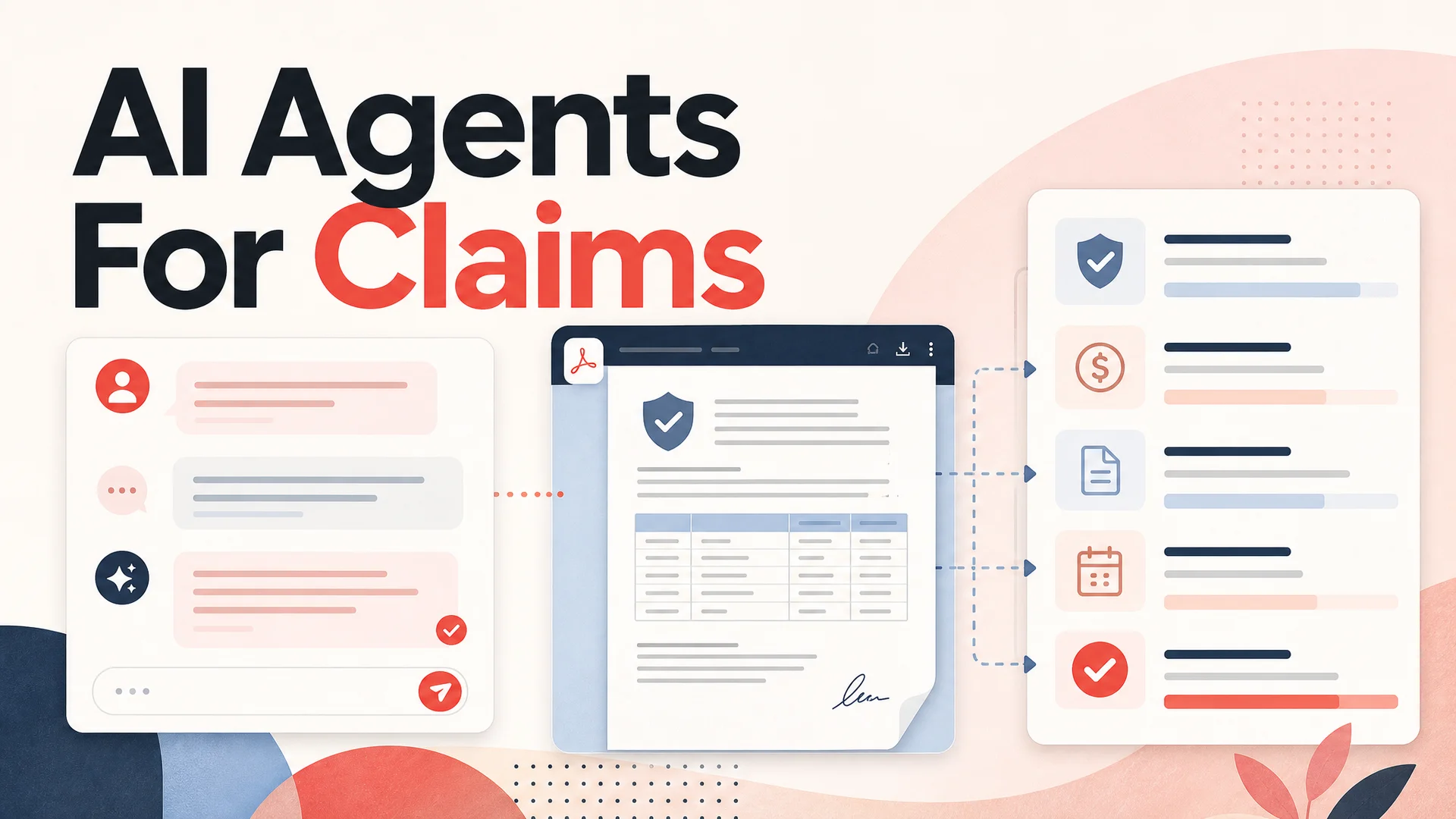
FNOL is the highest-leverage entry point. Carriers that wired an AI agent into the FNOL flow in 2025 are reporting median claim-open times measured in minutes rather than days. The pattern is consistent: the agent walks the claimant through a structured intake (date, location, parties, photos), extracts the structured fields the claims system needs, drafts the loss description, and routes the file to the right adjuster queue based on severity. For straightforward auto glass, minor property, and travel claims, an agent paired with a vision model can approve or deny on the spot - leaving adjusters to focus on the files that actually need a human eye.
2. Onboarding and self-service
A surprising share of inbound volume is small, repetitive, and policyholder-initiated: address changes, ID card resends, beneficiary updates, premium calculations, certificate-of-insurance requests. None of these need a human; all of them used to get one. With AI Actions wired to the policy admin system, the agent handles them end-to-end inside the chat. One Berrydesk customer in commercial lines moved roughly 70% of their service-request volume off the phone queue in the first quarter after deployment, which freed two FTEs for retention work.
3. Fraud signals at intake
Claim fraud is a multi-billion-dollar drag on the industry, and the cheapest place to catch it is at intake. A well-tuned agent compares the claimant's narrative against the policy, the prior claims history, public records, and the structured fields it just collected - flagging contradictions in real time rather than three weeks later in SIU review. Agentic models with long context (Claude Opus 4.7, GPT-5.5 Pro, GLM-5.1) are particularly strong at noticing the small inconsistencies - a date that does not match, a vehicle described differently from the original binder - that humans skim past on a busy day.
4. Lead qualification and quoting
For carriers and brokers selling direct, the agent is now the top of the funnel. It engages the visitor, asks the qualifying questions a producer would, generates an indicative quote, books a callback if the prospect needs a human, and writes the lead into the CRM with a summary the producer can read in fifteen seconds. Conversion lifts of 20–30% over plain web forms are typical when the agent is allowed to actually quote rather than just collect a name and email.
5. Renewal conversations
Renewal is where most retention damage happens, usually because the customer reads a premium increase, has a question, cannot reach anyone, and shops around. An agent that can explain the rate change in plain language - pulling from the underwriting notes, the loss history, and the rate filing - defuses most of those moments before they turn into churn.
The compliance picture in 2026
Insurance is a high-trust, high-regulation business, and the 2026 enforcement environment is real.
Data privacy and security
Insurance chats touch some of the most sensitive PII a person has: health data, financial data, addresses, claims history. GDPR, CCPA, and HIPAA all apply somewhere in the stack. The non-negotiables: encryption in transit and at rest, a documented data retention policy, the ability to honor deletion requests, and explicit consent before sensitive personal data enters the conversation. Berrydesk supports per-conversation redaction and configurable retention so the model never sees more than the workflow strictly needs.
The EU AI Act
The EU AI Act is in force in 2026 and treats certain insurance use cases - particularly anything that influences underwriting, pricing, or eligibility for life and health products - as high-risk. That triggers obligations: documented risk management, human oversight, transparency to the user that they are talking to an AI, technical documentation, and post-market monitoring. None of this kills the use case; it just means treating the agent as a regulated component, with the same change-control and audit trail your underwriting models already have.
NAIC and U.S. state-level guidance
In the U.S., the NAIC's model bulletin on AI use in insurance has been picked up by most states. The expectations are familiar to anyone who has dealt with model risk management: governance, testing for bias, ongoing monitoring, and clear accountability for decisions the system makes. If your agent influences a coverage or claim decision, treat it as in scope - even if the marketing department was the one who deployed it.
When on-prem actually matters
Some lines of business - health, life, certain specialty commercial - still need air-gapped or on-prem deployment for regulatory or contractual reasons. The 2026 open-weight frontier makes this much more viable than it was. GLM-5.1 ships under MIT, Qwen3.6-27B under Apache 2.0, and Xiaomi MiMo-V2 weights are MIT-licensed. You can stand up a frontier-class agent in your own VPC or data center and never send a token to a third party. Berrydesk supports private model endpoints so the rest of the agent - actions, routing, analytics - stays consistent whether the brain runs in Anthropic's cloud or on your own hardware.
Common pitfalls to avoid
A few patterns separate deployments that stick from ones that get rolled back:
- Over-automating the first six months. Start the agent on read-heavy workflows (policy questions, ID cards, FAQs) before letting it touch claims approvals or billing changes. Confidence comes from logged conversations, not slide decks.
- Skipping the escalation design. Every workflow needs a clean handoff to a human, with the full conversation context, when the agent's confidence drops or the customer asks. The handoff is the product, not the fallback.
- Treating the model as the project. Most failures are knowledge-base problems, not model problems. Stale policy docs, missing endorsement language, and out-of-date FAQ pages cause more bad answers than any model choice.
- Single-model lock-in. Routing routine traffic to a cheap open-weight model and reserving Claude Opus 4.7 or GPT-5.5 for the hard turns can cut inference costs by an order of magnitude with no quality hit. Build the routing in from day one.
- Forgetting the audit trail. Regulators will eventually ask. Log the prompt, the retrieved context, the model used, the action taken, and who (if anyone) reviewed it.
Where this is going
The next twelve months will see two clear shifts. First, agents that anticipate rather than react: pulling weather data and pre-filling FNOL drafts for customers in a storm path, flagging coverage gaps before renewal, surfacing the missing document the underwriter will ask for. Second, agentic workflows that span the full claim lifecycle - intake, triage, vendor coordination, settlement, payment - with a human reviewing exceptions rather than driving every step. The models to do this exist today; the work in 2026 is mostly integration, governance, and trust.
Berrydesk is built for that work. Pick the model - closed-frontier, open-weight, or both behind a router. Train it on your policies, claims docs, and Notion runbooks. Wire AI Actions for the high-value flows (FNOL, ID cards, quoting, payments). Brand the widget, deploy to your site or Slack or WhatsApp, and ship.
If you are sizing up an insurance agent project, start a free Berrydesk workspace and have a working prototype on your own policy documents this afternoon.
 Berrydesk
Launch a compliant insurance support agent in an afternoon
- Train on policies, FAQs, and claims docs in minutes
- Wire up FNOL, ID-card resends, and quoting as AI Actions
Set up in minutes

Chirag Asarpota is the founder of Strawberry Labs, the team behind Berrydesk - the AI agent platform that helps businesses deploy intelligent customer support, sales and operations agents across web, WhatsApp, Slack, Instagram, Discord and more. Chirag writes about agentic AI, frontier model selection, retrieval and 1M-token context strategy, AI Actions, and the engineering it takes to ship production-grade conversational AI that customers actually trust.