Conversational AI has gone from a novelty to a default layer in almost every customer-facing product. What used to be a single decision - "do we add a chatbot?" - is now a stack of decisions: rule-based or generative, single model or routed, off-the-shelf or trained on your own knowledge, and whether to build directly on a frontier LLM like ChatGPT or use a platform that handles the wiring for you.
The vocabulary hasn't kept up with the technology. Teams still use "chatbot" and "ChatGPT" almost interchangeably, even though they describe very different things - and pricing, accuracy, and what's possible in production have all shifted dramatically over the last year. This guide breaks the categories apart, shows where each one actually fits, and walks through how to pick the right approach for a real support, sales, or operations workload in 2026.
What "AI chatbot" actually means in 2026
A chatbot is any software that holds a conversation with a user, typically through text but increasingly through voice, video, or in-app widgets. That definition is broad enough to cover three meaningfully different generations of technology, and the difference matters because they fail in different ways.
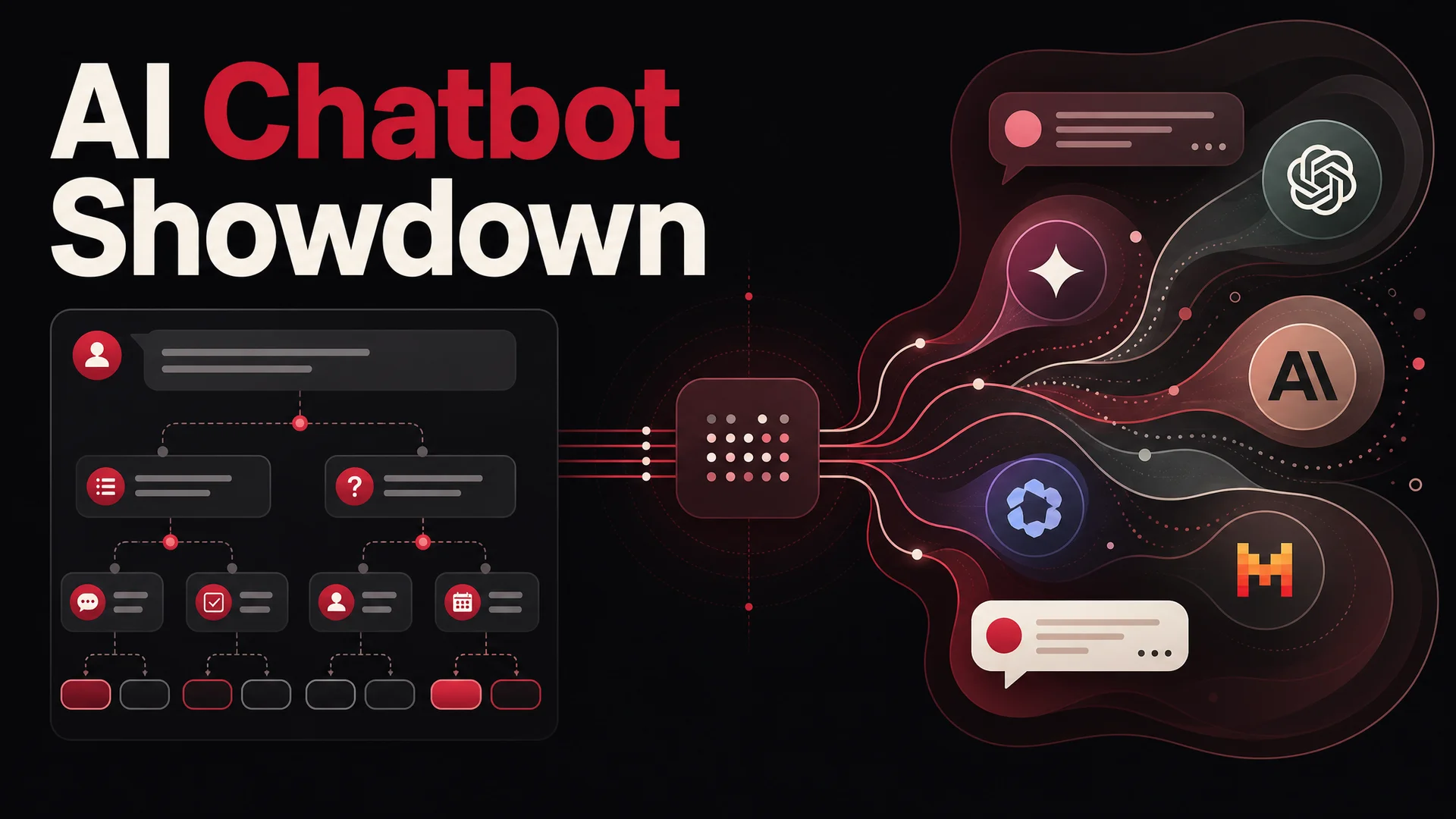
Rule-based chatbots follow a scripted decision tree. A user clicks a button or types a recognized keyword, and the bot returns a pre-written reply. There's no understanding involved - the system matches patterns and walks branches. They're cheap, deterministic, and easy to audit, which is why airlines, banks, and insurance companies still use them for narrow flows like "report a lost card" or "change my seat." The tradeoff is brittleness: anything off-script either dead-ends or hands off to a human.
Classical AI chatbots sit a layer above. They use intent classification, entity extraction, and dialogue management - typically built on smaller language models or NLU services - to figure out what a user wants and route them to the right answer. Tools like Dialogflow, IBM Watson Assistant, and Rasa popularized this style. They handle variation in phrasing better than rule-based bots, but they still rely on someone defining intents up front, and they collapse when users go off-script in interesting ways.
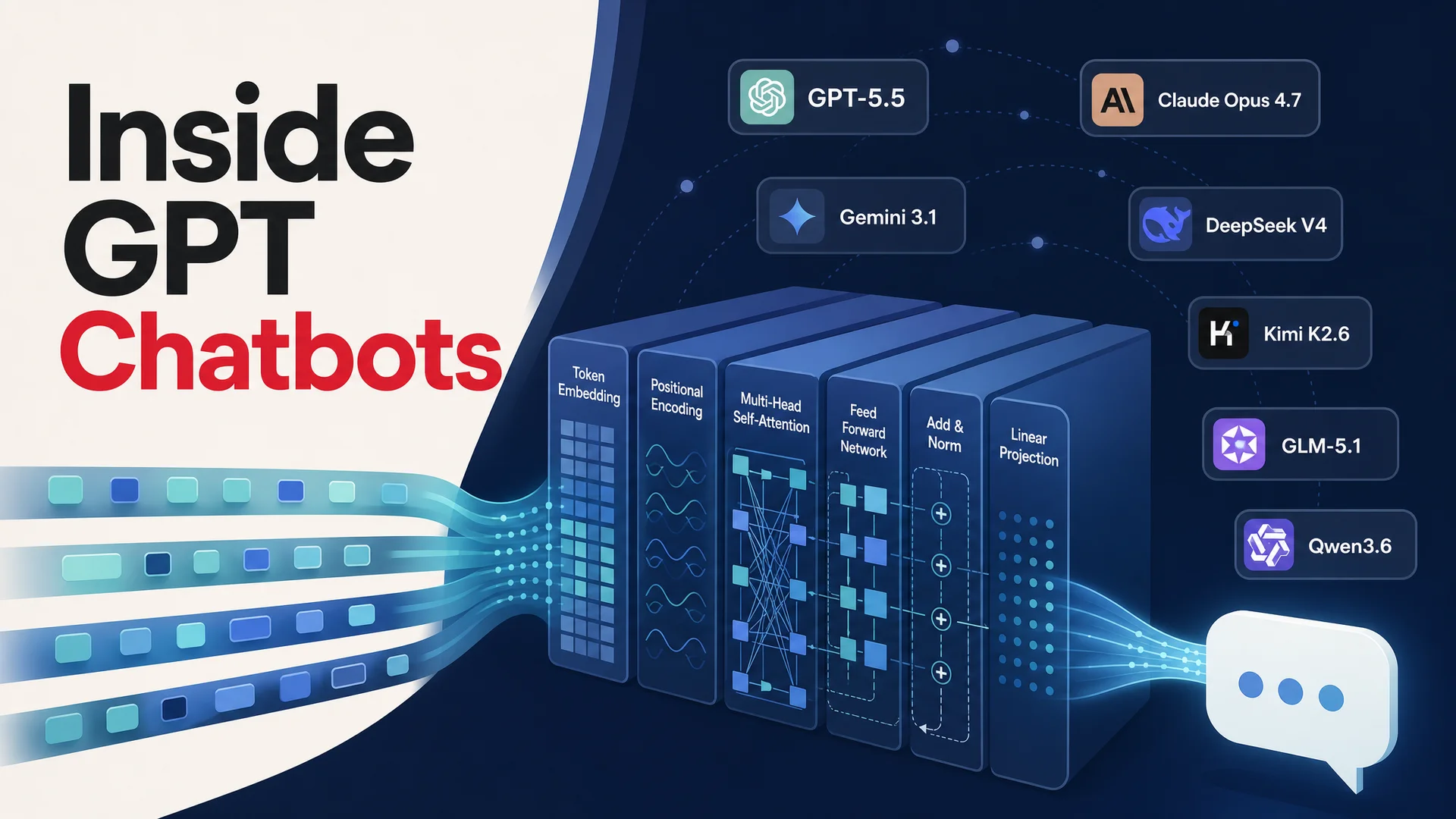
Generative AI agents are the current generation. They're built on large language models - GPT-5.5, Claude Opus 4.7, Gemini 3.1, DeepSeek V4, and others - and they generate replies token-by-token instead of pulling them from a script. They can hold context across long conversations, summarize policy documents on the fly, and adapt to wording the team never anticipated. Critically, today's generation can also call tools: book a meeting, issue a refund, look up an order, kick off a payment. That's the shift from chatbot to agent, and it's the reason most new deployments in 2026 skip the first two categories entirely.
ChatGPT belongs in this third bucket - but it's a single product, not a category. Conflating the two is where most of the confusion comes from.
What ChatGPT is - and what it isn't
ChatGPT is OpenAI's consumer-facing assistant, currently powered by the GPT-5.5 family. The Pro tier runs on GPT-5.5 Pro with parallel reasoning, released in April 2026. Underneath the chat interface, the same model family is available through the API, which is what most businesses actually use when they say they're "building on ChatGPT."
A few things ChatGPT does well out of the box:
- General reasoning across domains. The model can move from a tax question to a Python refactor to a draft press release without retraining. That breadth is genuinely useful for individual productivity.
- Long context. GPT-5.5 handles large inputs comfortably, which means it can hold a meeting transcript, a contract, and a project brief in the same conversation without external retrieval.
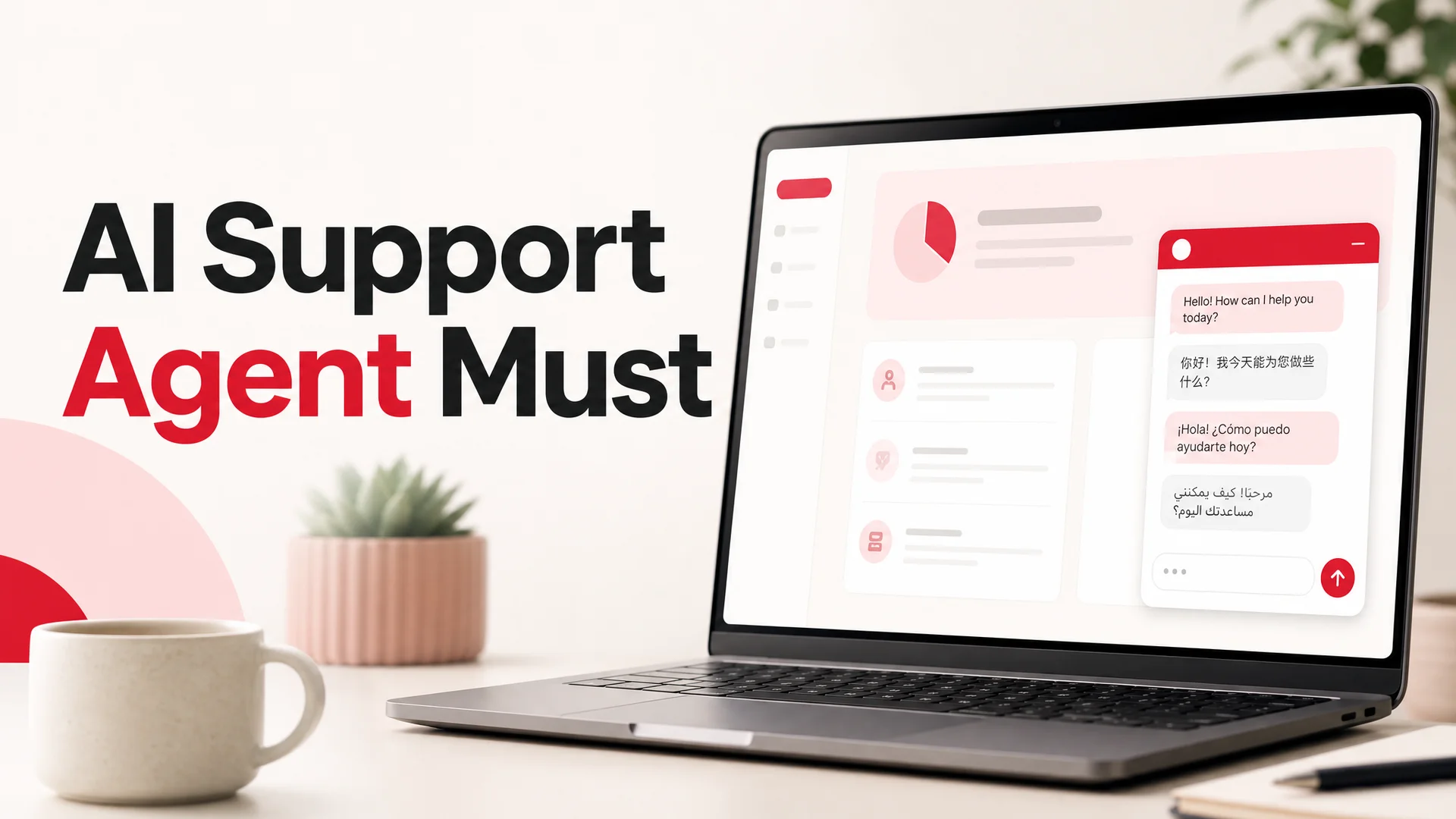
- Multilingual fluency. Conversations work across dozens of languages with no extra setup.
- Tool use. Via the API, the model can call functions, browse, run code, and chain those steps into multi-turn workflows.
What it isn't: a customer support agent for your business. Out of the box, ChatGPT doesn't know your refund policy, your product catalog, your pricing tiers, or which of your customers is a $50k/year enterprise account versus a free-trial signup. It will answer questions about your company, but those answers will be confidently wrong as often as they're right, because the model is filling in plausible text rather than reading your source of truth. Turning ChatGPT into something a support team can actually deploy means grounding it in your own data, wiring it to your own systems, and constraining its behavior - and that's the gap platforms like Berrydesk exist to close.
The frontier model landscape behind every modern chatbot
When the source of this article was first written, "ChatGPT vs other chatbots" was effectively "GPT-4 vs everything else." That's no longer the shape of the market. As of May 2026, there are four parallel tracks any serious AI chatbot is built on, and which one you pick changes the cost, latency, and capability profile of your deployment.
Closed frontier. OpenAI's GPT-5.5 and GPT-5.5 Pro lead on general reasoning. Anthropic's Claude Opus 4.7 leads SWE-bench Pro at 64.3% - relevant because the same skills that make a model good at code make it good at structured tool use, which is what powers AI Actions like refunds, bookings, and account updates. Claude Opus 4.6 and Sonnet 4.6 ship with 1M-token context at no surcharge, which lets a single conversation hold an entire help center plus the customer's full history. Google's Gemini 3.1 Ultra has a 2M-token context and is natively multimodal across text, image, audio, and video - useful when a customer pastes a screenshot of an error or sends a voice note.
Open-weight frontier. This is the cost story. DeepSeek V4 launched on April 24, 2026, with V4 Flash priced at $0.14 per million input tokens and $0.28 per million output tokens - roughly an order of magnitude cheaper than the closed frontier on routine workloads, with 1M context. Moonshot Kimi K2.6 (April 21) is built for agentic work, runs 12-hour autonomous coding sessions, and scores 58.6 on SWE-Bench Pro. Z.ai's GLM-5.1 (April 7) hits 58.4 on SWE-Bench Pro under an MIT license, beats GPT-5.4 and Claude Opus 4.6 on that benchmark, and was trained entirely on Huawei Ascend chips. Alibaba's Qwen 3.6 family, MiniMax M2.7, and Xiaomi's MiMo-V2-Pro round out a group of open-weight models that are genuinely competitive on agentic tasks and can be self-hosted for regulated workloads.
Routing. The practical move for most production support deployments is not picking one of these - it's routing. Send the easy 70–80% of tickets ("where's my order," "how do I reset my password," "what's your return window") to DeepSeek V4 Flash or MiniMax M2 at fractions of a cent per resolution. Reserve Claude Opus 4.7, GPT-5.5 Pro, or Gemini 3.1 Ultra for the long-tail escalations that actually need top-shelf reasoning. Berrydesk gives you that routing layer without you having to write it.
How chatbots and ChatGPT actually differ
Pulling this all together, here's the honest comparison across the criteria that matter for a business:
Conversational range. Rule-based bots handle a small, fixed menu. Classical AI bots handle a wider set of intents but still need each intent defined. Generative AI agents - including ChatGPT and any chatbot built on a modern LLM - handle effectively open-ended conversation, including questions the team never anticipated.
Accuracy on your specific business. This one inverts what you'd expect. Rule-based bots are the most accurate on the narrow flows they're built for, because their answers are literally hand-written. Generic ChatGPT is the least accurate, because it has no idea what your business actually does. A generative agent grounded in your knowledge base - through retrieval, long-context loading, or both - is the only configuration that gets both breadth and accuracy.
Cost. Rule-based bots are cheapest to run and most expensive to maintain (someone has to keep the tree current). Classical AI bots add training and intent management overhead. Generative agents shift the cost to inference, which used to dominate the equation but, with open-weight models like DeepSeek V4 Flash and MiniMax M2, has dropped enough that it's rarely the binding constraint anymore.
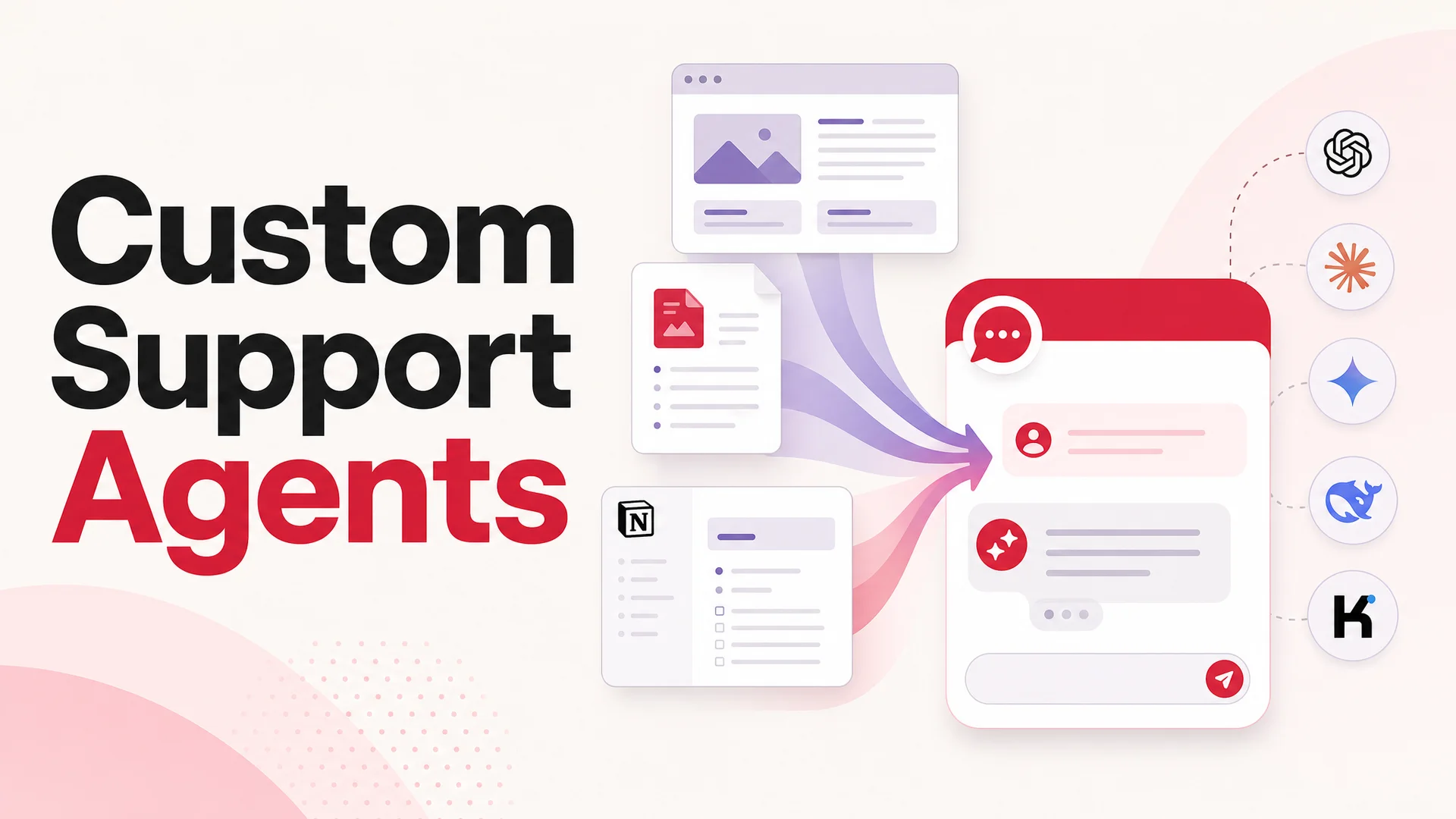
Time to launch. Building a rule-based bot for a moderately complex flow can take weeks. A classical AI bot with well-defined intents takes longer because you need training data. A generative agent on a platform like Berrydesk can be live in an afternoon - point it at your help center and Notion, brand the widget, drop the embed on your site.
Tool use. This is where the gap is widest. Rule-based bots can trigger predefined actions in a workflow engine. Classical AI bots can fire off a function call once an intent is recognized. Modern generative agents - especially on tool-use-strong models like Claude Opus 4.7, Kimi K2.6, GLM-5.1, and Qwen 3.6 - can decide on their own when to call a tool, chain multiple tools together, recover from a failed call, and only escalate to a human when the situation actually warrants it.
Choosing the right approach for your use case
There's no single right answer. The correct framing is: what are the conversations you're trying to handle, what does failure look like for each one, and how much variation do real users introduce?
When a rule-based bot is still the right call
Pick rule-based when the flow is genuinely narrow, the inputs are constrained, and the cost of a wrong answer is high. Filing a one-off insurance claim, navigating a regulated authentication step, walking a customer through a legally-prescribed disclosure - these are all places where you want the bot to do exactly one thing and refuse anything else. The honest truth is most "rule-based" deployments today are actually rule-based front-ends with an LLM fallback for anything off-script, and that's a perfectly reasonable architecture.
When a generative AI agent is the right call
Pick a generative agent when conversations branch, when users phrase things in ways you can't predict, and when answers depend on knowledge that lives in documents rather than in a workflow engine. Most modern customer support, internal IT helpdesks, sales-qualification chats, onboarding assistants, and product Q&A widgets fall into this category. So does anything where the agent needs to do something - book a meeting, look up an order, refund a charge, escalate to a human - because today's tool-use-strong models make those flows reliable in ways they weren't even a year ago.
When raw ChatGPT is enough
For a single user, ChatGPT.com or the OpenAI API directly is enough when you need general reasoning and don't care about grounding it in any specific business's knowledge. Drafting an email, summarizing a transcript, exploring a coding problem, brainstorming a campaign - these are all fine without any platform layer. You only need a chatbot platform once you want the model to behave consistently across thousands of customer conversations, draw from your specific data, take actions in your systems, and never confidently make things up.
Use cases worth thinking through concretely
A few examples to make this less abstract:
- A 200-seat SaaS company running a help center on Notion and a billing system on Stripe. Best fit: a generative agent grounded in the Notion content, with AI Actions for "look up subscription," "issue refund within policy," and "escalate to human." Routine traffic on DeepSeek V4 Flash, escalations to Claude Opus 4.7. Live in a day.
- A national bank's mobile app. Most flows - balance check, card lock, dispute filing - should stay rule-based or hybrid for compliance reasons. A generative layer can sit on top to handle "what does this fee mean" and "how do I change my address," grounded only in approved policy documents.
- A regional hotel chain. Booking confirmation flows can be rule-based and tightly controlled. A generative agent on top, deployed to WhatsApp and the website, can handle "what time is breakfast," "is the pool open," and "can you upgrade me to a balcony room" - with AI Actions wired to the property management system for the upgrade.
- An e-commerce brand selling 50,000 SKUs. A long-context generative agent can hold the whole catalog and policy set in-context and answer "does this jacket run small," "is it waterproof," and "when will it ship to Berlin." Cheap models handle the volume; a frontier model gets called only when the customer asks for a real recommendation.
- A clinic group running a patient portal. Symptom-triage and appointment booking can be split: a generative agent for explaining what to expect from a procedure, plus a tightly-scoped tool layer that only books appointments, never gives clinical advice, and always offers a human handoff.
What to watch out for
A few common pitfalls that bite teams who skip straight to "let's just plug ChatGPT into our website":
- Hallucinations on your product. Without grounding, the model will invent features, prices, and policies that sound plausible. Either retrieve from your knowledge base on every turn, or load it into the long-context window - and instruct the model to refuse anything it can't cite.
- Context decay. Even with a 1M-token window, behavior drifts as conversations get long. Refresh the system prompt and re-inject critical policy on every turn instead of trusting the model to keep it in mind.
- Tool-use without guardrails. A refund tool the model can call freely is a liability. Wrap each AI Action with policy checks (max amount, eligible products, customer tier) on your side, not just in the prompt.
- One-model lock-in. A year ago, "we run on GPT" was a reasonable architecture. Today, the cost difference between routing to DeepSeek V4 Flash for routine traffic and running everything on a closed frontier model is large enough that not routing is a real, ongoing tax.
- Skipping evaluation. Generative agents fail in ways rule-based bots don't - silently, in production, on edge cases. Set up an eval harness that replays real conversations against new prompts and new models before promoting changes.
Building your own vs using a platform
If you have an engineering team and a clear, narrow use case, you can absolutely build directly on a model API. The path is roughly: get an API key, set up retrieval against your knowledge base, write the system prompt, define your tools, build the UI, ship it, and then maintain it as models change, prompts drift, and edge cases pile up.
The reason most teams don't build it themselves is that the work doesn't end at launch. You need observability, conversation review tooling, prompt versioning, model routing, multi-channel deployment (web, Slack, Discord, WhatsApp), branding for the widget, knowledge base sync, action wiring, fallback handling, and ongoing evaluation. Each of those is a small engineering project; together, they're a team.
That's the gap platforms close. With Berrydesk, you pick a model - GPT-5.5, Claude Opus 4.7, Gemini 3.1, DeepSeek V4, Kimi K2.6, GLM, Qwen, MiniMax, or one of the others - point it at your docs, websites, Notion, Google Drive, or YouTube content, brand the widget, add AI Actions for booking and payments, and deploy to your website, Slack, Discord, WhatsApp, or anywhere else customers reach you. The infrastructure underneath - routing, evaluation, observability, knowledge sync - is handled.
So which is better - an AI chatbot or ChatGPT?
It's the wrong frame. ChatGPT is a frontier LLM in a consumer wrapper; an AI chatbot is what you build when you want that kind of intelligence to act on behalf of your specific business, grounded in your specific knowledge, talking to your specific customers, in your brand voice, with safe access to your systems. The right question isn't which one wins - it's how to combine the underlying model capabilities with the data, guardrails, and channels that turn raw intelligence into a product.
For most businesses in 2026, the answer is a generative AI agent built on a routed mix of frontier and open-weight models, grounded in your own content, deployed across the channels your customers actually use, and capable of taking real actions instead of just answering questions. That's the shape of conversational AI that's actually working in production right now.
If you want to see what that looks like for your team, you can spin up a free agent on Berrydesk, train it on your own docs, and have it answering real questions in the time it would take to write a project brief.
 Berrydesk
Launch your AI agent in minutes
- Pick from GPT-5.5, Claude Opus 4.7, Gemini 3.1, DeepSeek V4, Kimi K2.6, and more
- Train on docs, websites, Notion, and Drive - no code required
Set up in minutes

Chirag Asarpota is the founder of Strawberry Labs, the team behind Berrydesk - the AI agent platform that helps businesses deploy intelligent customer support, sales and operations agents across web, WhatsApp, Slack, Instagram, Discord and more. Chirag writes about agentic AI, frontier model selection, retrieval and 1M-token context strategy, AI Actions, and the engineering it takes to ship production-grade conversational AI that customers actually trust.