Walk through any well-run B2B or e-commerce site in 2026 and you will almost certainly run into a chat bubble in the corner - and the agent on the other side will not be a human. That is no longer a novelty or a "look how futuristic we are" stunt. AI support agents have moved from experimental side projects to load-bearing parts of the customer experience, doing real work that used to require either a large support team or a lot of frustrated visitors clicking away.
If you run a website that converts traffic into customers - software, SaaS, ecommerce, services, healthcare, education, fintech - adding an AI support agent is not a "nice to have" any more. The economics, the underlying models, and the integration story have all shifted decisively in your favor over the last twelve months. Below are seven reasons it should be near the top of your roadmap right now, plus a practical walkthrough of how to actually deploy one with Berrydesk.
1. Always-On Coverage Without an Always-On Payroll
A human support team that genuinely covers nights, weekends, and holidays is one of the most expensive things a small or mid-sized company can build. You either staff three shifts, which is brutal on margin, or you outsource overnight to a BPO and accept a quality drop, or you set an out-of-hours auto-reply and quietly lose customers to whoever is awake.
An AI agent does not get tired, does not need overtime, and does not check Slack at 3 a.m. with one eye open. With a Berrydesk deployment, your agent is online every minute of every day - picking up tickets the moment they come in, answering the routine 70% of questions instantly, and capturing context for human agents to follow up on when business hours start again. That alone changes the kind of company you can be: a four-person startup can credibly claim "24/7 support" without burning out the founders.
The smart pattern in 2026 is not "AI replaces humans" but "AI handles the long tail at all hours." Configure your agent to confidently resolve well-defined questions - billing, order status, password resets, plan comparisons, integration FAQs - and to gracefully hand off anything ambiguous, emotionally charged, or outside its scope. Berrydesk lets you draw that line wherever you want, and adjust it as you watch real conversations come in.
2. Instant Answers, Not Scavenger Hunts
The cost of a slow answer is invisible but massive. A visitor who has to dig through three nav menus, a help center, and a contact form to learn whether your product integrates with HubSpot is a visitor who, statistically, will give up partway and never come back. Even a five-second hesitation at checkout is enough to kill a conversion.
A well-trained support agent in the corner of your site removes that friction entirely. The visitor types a question in their own words - "do you support SOC 2 audits?", "what is your refund window?", "does this work with Shopify?" - and gets a grounded, accurate answer immediately, with citations back to the underlying doc. No tab-switching, no hunting, no waiting.
The model layer underneath has changed what is possible here. With 1M-token context windows now standard on Claude Sonnet 4.6, Claude Opus 4.6, and DeepSeek V4, and 2M tokens on Gemini 3.1 Ultra, your agent can hold an entire knowledge base, your last few months of product changelogs, and the visitor's full conversation in working memory at the same time. The result is answers that feel like they came from a senior support rep who knows your product cold - not a keyword-matching FAQ widget. RAG is still useful as a tuning lever for very large corpora, but it is no longer the hard requirement it was two years ago.
3. Multilingual Support Without Hiring Multilingual Staff
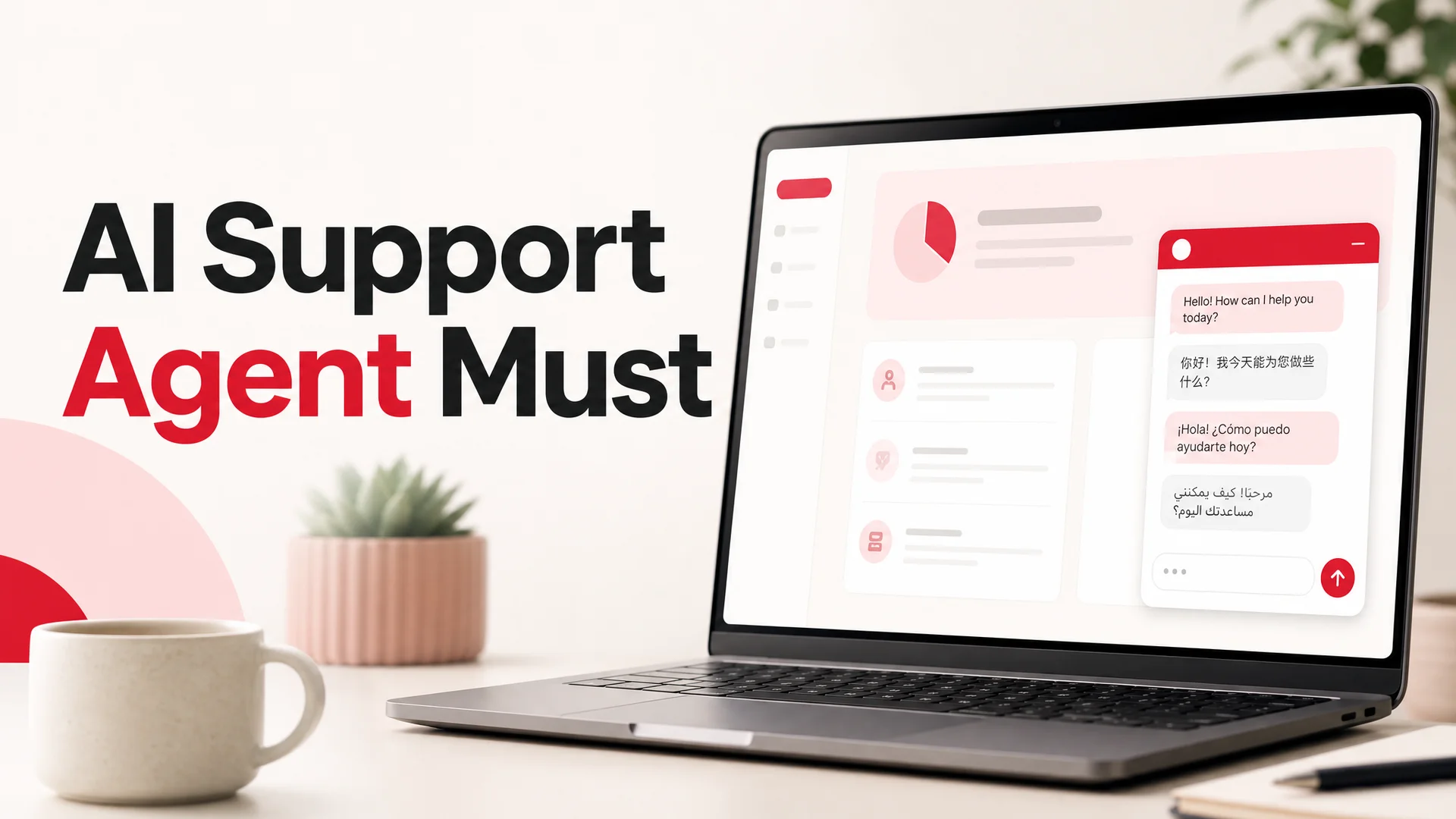
Your customers are almost certainly not all in one country, and they are definitely not all speaking the same language at home. Hiring a support team that covers Spanish, French, German, Portuguese, Japanese, Arabic, Mandarin, Hindi, and a long tail of smaller markets is genuinely impossible for most companies - the cost is enormous and the recruiting funnel takes years to build.
This is one of the cleanest wins for AI support. Modern frontier models - GPT-5.5, Claude Opus 4.7, Gemini 3.1 Ultra - handle dozens of languages fluently, and the open-weight frontier (DeepSeek V4, Qwen 3.6, Kimi K2.6, GLM-5.1) brings strong multilingual coverage with particularly good performance in Chinese, Japanese, Korean, Arabic, and several Southeast Asian languages. A Berrydesk agent built on top of any of these can detect a visitor's language automatically, respond in kind, and translate context behind the scenes when handing off to a human.
The scale story matters too. One agent can serve hundreds of visitors simultaneously across all those languages, at a per-conversation cost that rounds to fractions of a cent if you route routine traffic to a model like DeepSeek V4 Flash at $0.14 / $0.28 per million input/output tokens. Going from "we only support English" to "we support thirty languages" used to be a multi-year initiative; today it is a configuration change.
4. A Continuous Stream of Voice-of-Customer Data
Every conversation your AI agent has is, in effect, a tiny structured interview with a real prospect or customer. At any reasonable volume, that data is more valuable than almost anything you would learn from a quarterly survey. People tell a chat agent things they would never write in a feedback form - what confused them, which competitor they are comparing you to, which feature they wished you had, which pricing tier they bounced off.
A platform like Berrydesk gives you that signal in a structured way: full transcripts, tagged intents, unresolved-question reports, and trends over time. Product teams use it to spot doc gaps and feature requests; marketing teams use it to refine messaging that is clearly not landing; sales teams use it to identify high-intent visitors and route them in real time.
Two years ago, mining this kind of qualitative data at scale required someone (or a whole team) reading transcripts. With long-context models, you can ask your agent to summarize last week's conversations across a few thousand tickets in a single pass, surface the top ten unresolved questions, and draft new help-center articles to close those gaps. The data collection becomes the data analysis.
5. Real Cost and Time Savings - Especially in 2026
The numbers behind running an AI support layer have moved dramatically in the last year, and most companies have not updated their mental model yet. The open-weight frontier - DeepSeek V4 Flash, MiniMax M2 (~8% the price of Claude Sonnet at roughly 2x the speed), Qwen 3.6, Kimi K2.6, GLM-5.1 - has collapsed the cost of high-quality inference. A typical support deployment can route the bulk of routine traffic through one of these inexpensive models, and reserve premium frontier reasoning (Claude Opus 4.7, GPT-5.5 Pro, Gemini 3.1 Ultra) for the small percentage of escalations that genuinely need it.
What that means in practice: a Berrydesk deployment serving thousands of conversations a month costs less than a single part-time support hire, and the marginal cost of one more conversation is rounding error. You stop paying linearly for support volume. That is a structural change, not a discount.
The time savings compound just as fast. The hours your team currently spends triaging duplicate "where is my order?" questions, copy-pasting answers from the same five help articles, and chasing down basic account details - those hours are mostly recoverable. Your human agents shift from typing the same thing for the hundredth time to handling the genuinely interesting cases: angry power users, complex refunds, technical edge cases, expansion conversations. That is also a happier job, which helps with retention.
6. Lead Capture That Actually Feels Helpful
Forms convert at single digits. Conversations convert much, much better. An AI agent on your site is, among other things, the most patient and consistent SDR you will ever have - one that engages every visitor who shows interest, qualifies them with natural questions, and routes hot leads to your sales team in real time.
The mechanics are straightforward in Berrydesk. You give the agent a clear definition of an ideal-fit lead (industry, team size, current stack, intent signals), a set of qualifying questions, and an escalation rule. When a visitor lands on a pricing page and starts asking about implementation timelines, the agent quietly collects their email and use case, books a meeting via your calendar AI Action, or pings a sales rep directly in Slack. None of that requires the visitor to fill out a form they were going to abandon anyway.
Crucially, this is not the old "intercept the visitor with a popup" pattern that everyone has learned to ignore. It is a conversation that the visitor opted into, in their own words, with answers that genuinely help them - and it just happens to also generate qualified pipeline. The conversion lift over a static "contact us" form is generally not subtle.
7. Higher Customer Satisfaction Across the Board
Stack the previous six benefits together and the customer-satisfaction story almost writes itself. Visitors get answered immediately, in their own language, at any hour, with accurate information drawn from your real docs - and when they need a human, the handoff is clean and the human already has context. The most common drivers of poor support CSAT - long wait times, unhelpful first responses, having to repeat yourself across channels - are exactly the things AI agents fix structurally.
There is also a quieter benefit: consistency. Human agents have good days and bad days, and a customer's experience can vary wildly based on who picks up the chat. An AI agent does not have a Monday morning. It applies your tone, your policy, and your knowledge identically every time, which is genuinely better for trust at scale.
What's New in 2026: Why AI Agents Finally Earn Their Keep
A quick word on why 2026 is the year this stops being a gamble. Three shifts converged:
Long-context models removed the "knowledge" bottleneck
Claude Opus 4.6, Sonnet 4.6, and DeepSeek V4 ship with 1M-token windows. Gemini 3.1 Ultra goes to 2M, natively multimodal. That means your agent can hold your entire help center, recent product updates, the user's full session history, and your tone-of-voice guide in-context simultaneously. Hallucinations drop sharply when the model can actually see the source material instead of trying to recall it.
Agentic tool-use models made AI Actions production-ready
Earlier generations of chatbots were good at talking and bad at doing. Models like Claude Opus 4.7 (64.3% on SWE-bench Pro), Kimi K2.6 (12-hour autonomous coding sessions, swarms of up to 300 sub-agents), GLM-5.1 (8-hour plan-execute-test-fix loop, 58.4% SWE-bench Pro), Qwen 3.6, and MiMo-V2-Pro have changed that. They can call tools, chain multi-step actions, and recover from errors mid-flow. In a Berrydesk context, that means AI Actions for booking appointments, processing refunds, looking up orders, taking payments, and updating records work reliably for real customers - not just in demos.
Open-weight Chinese models collapsed the price floor
DeepSeek V4, MiniMax M2/M2.7, Qwen 3.6, Kimi K2.6, GLM-5.1 (Apache/MIT licensed, trained entirely on Huawei Ascend chips), and Xiaomi MiMo-V2 are open-weight or open-source frontier models that beat the previous generation of closed models on serious benchmarks at a fraction of the price. For regulated industries, the MIT/Apache licenses on GLM-5.1, Qwen 3.6-27B, and MiMo also unlock on-prem and air-gapped deployments - which makes AI support viable in healthcare, finance, and government for the first time.
The practical takeaway: an AI agent built today is materially smarter, cheaper, and more capable than one built even a year ago, and the gap is still widening.
How to Add an AI Support Agent to Your Website
The choice of platform matters more than people initially think. The wrong one locks you into a single model, charges per message in ways that punish growth, makes basic customization a paid add-on, or - most commonly - produces an agent that is a polished demo and a mediocre worker. A few things to look for:
- Model flexibility. You want to be able to swap or route between models - premium frontier for hard escalations, cheap open-weight for routine traffic, on-prem if you are regulated. A platform locked to a single vendor will burn you within a year.
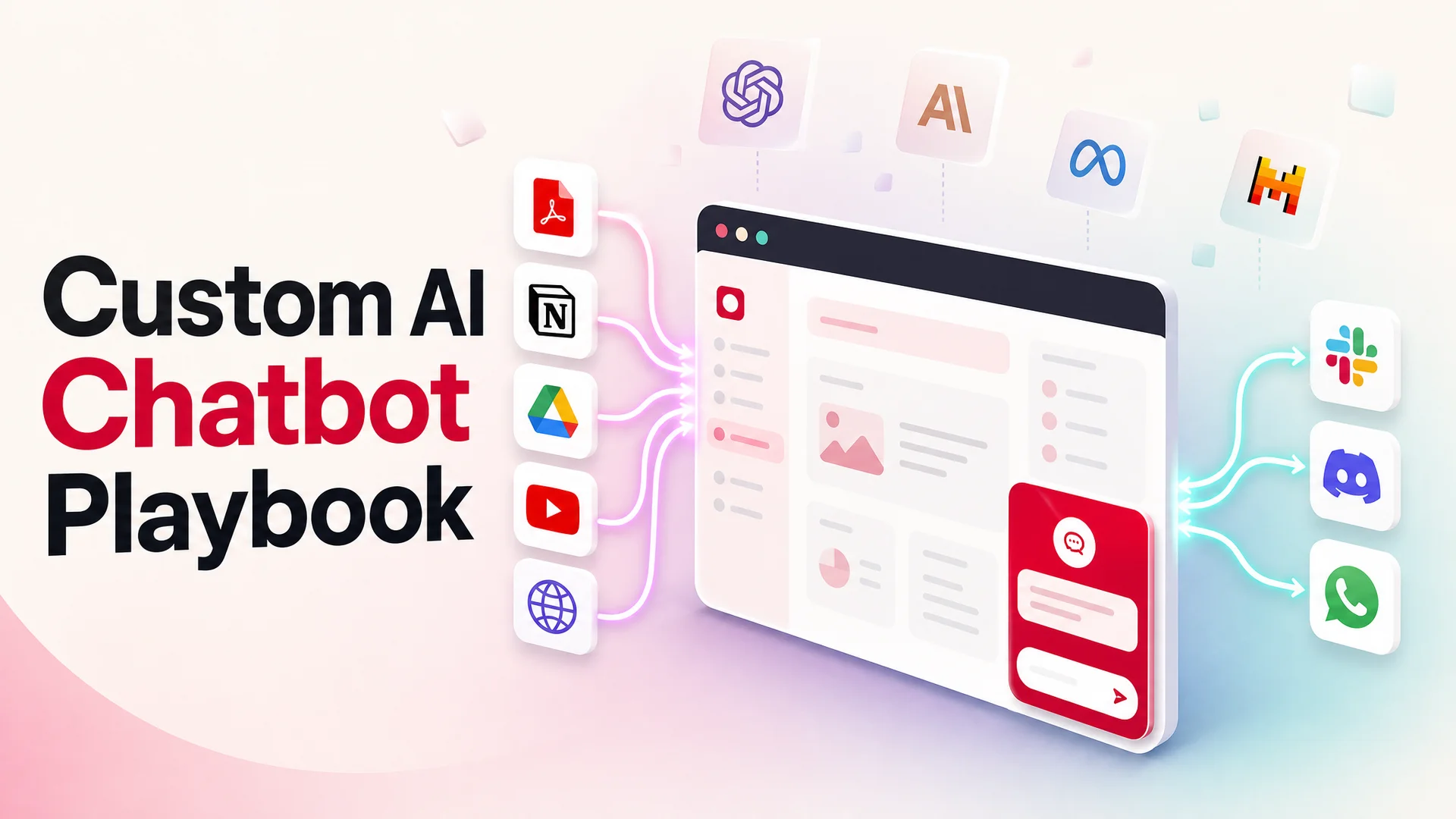
- Real training surface. The agent is only as good as what it knows. Look for first-class ingestion from documents, websites (with crawl), Notion, Google Drive, and YouTube - not just a single PDF upload box.
- Branded experience. The widget should look like your product, not like the vendor's. Colors, avatar, position, copy, suggested prompts - all should be configurable.
- AI Actions, not just chat. A modern agent should be able to book meetings, take payments, look up orders, create tickets, and call your APIs. If the platform tops out at "answers questions," it is a 2023 product.
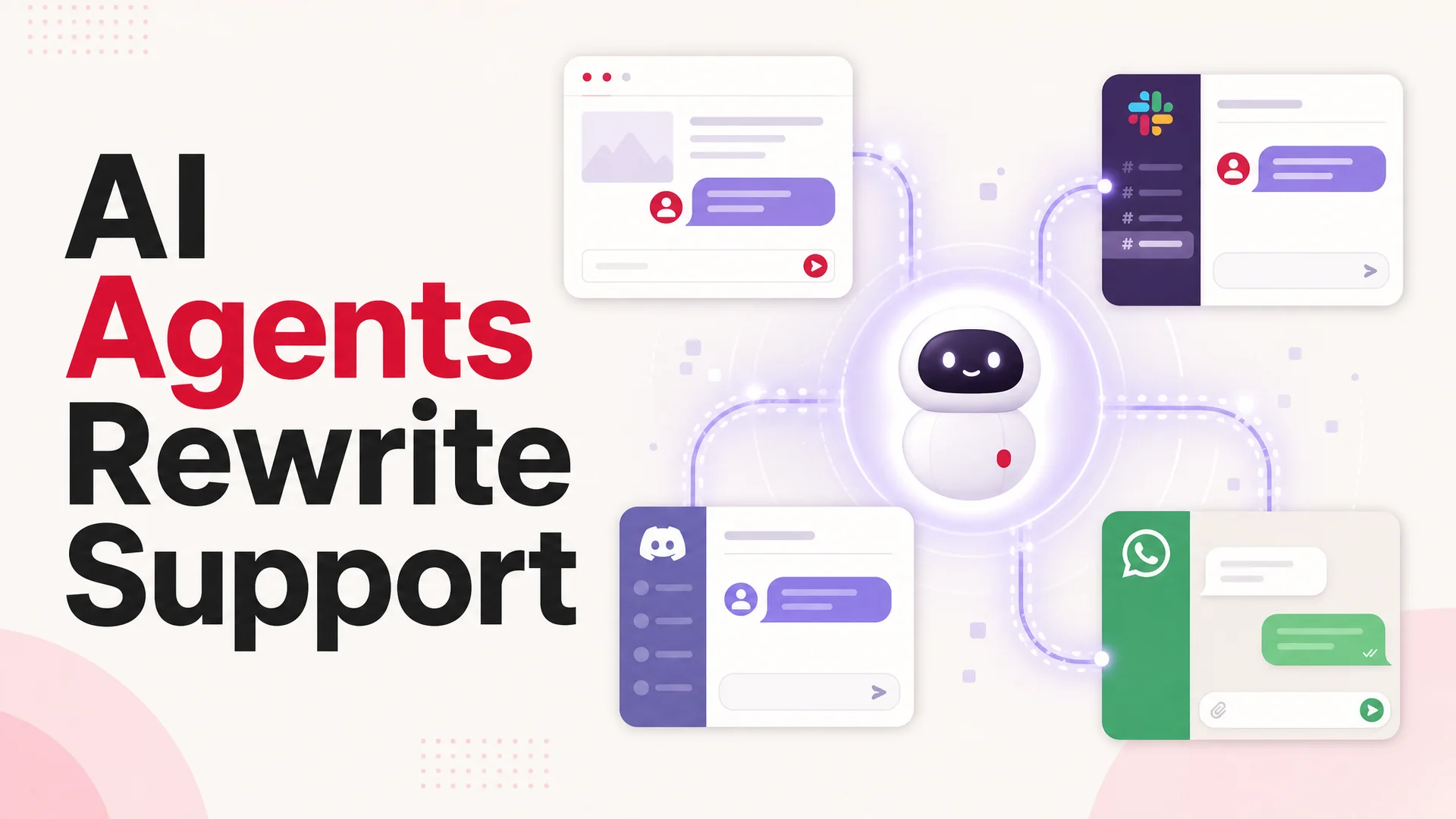
- Multi-channel deploy. Your customers are on your website, but also in Slack, Discord, WhatsApp, and email. A good platform deploys the same agent everywhere with one source of truth.
- Honest free tier and clean pricing. Test before you commit. Avoid platforms whose pricing punishes you the moment you become successful.
- Security. SSO, role-based access, audit logs, data residency options, and clear data-handling policies. Non-negotiable for any company touching customer data.
Why Berrydesk
Berrydesk is built around exactly this checklist. You can pick from GPT-5.5, GPT-5.5 Pro, Claude Opus 4.7, Sonnet 4.6, Gemini 3.1 Ultra, Gemini 3.1 Pro, DeepSeek V4, Kimi K2.6, GLM-5.1, Qwen 3.6, MiniMax M2, and more - and route between them based on cost, latency, or complexity. Training is a few clicks: drop in documents, point at your website, connect Notion or Google Drive, ingest a YouTube channel for product walkthroughs. The widget is fully branded. AI Actions cover bookings, payments, order lookups, and arbitrary API calls. Deploy to your site, Slack, Discord, WhatsApp, and other channels from the same workspace.
Setting It Up in Four Steps
The end-to-end flow takes about ten minutes for a first agent.
1. Create your agent. Sign up at berrydesk.com, open the dashboard, and create a new agent. Give it a name, pick a model (a sensible default is Claude Sonnet 4.6 for quality-per-dollar; switch later if needed).
2. Train it. Add your knowledge sources. The most common starting set is a website crawl (your marketing site and help center), a few PDFs (policy docs, pricing, internal FAQ), and a Notion or Google Drive sync for anything that updates frequently. Berrydesk will pull, chunk, and index everything automatically, and re-sync on a schedule so the agent stays current.
3. Brand and shape it. In the agent settings, configure the persona - name, avatar, tone, opening message, suggested questions. Set a system prompt that captures your voice and any non-negotiable policies ("never promise a specific delivery date", "always offer to book a demo if the visitor mentions enterprise"). Add AI Actions if you want the agent to book meetings, process refunds, look up orders, or take other actions.
4. Deploy. Click "Embed on site" to copy a snippet you can drop into your homepage, pricing page, product pages, and docs. For Slack, Discord, WhatsApp, or other channels, use the channel-specific install flows. The same agent serves all of them with the same brain.
That's it. Most teams have a working agent live in under an hour and spend the next week tuning conversations they observe in production.
Best Practices Once It's Live
A handful of patterns separate the agents that quietly become indispensable from the ones that get quietly removed three months later.
- Make it visible on the pages that matter. Pricing, product, integrations, docs, contact. Don't bury it on the homepage only.
- Open with a real question, not a wave. "What are you trying to set up today?" outperforms "Hi! How can I help?" by a wide margin.
- Use suggested prompts. Two or three pre-written questions inside the widget dramatically increase first-turn engagement.
- Watch the unresolved-questions report weekly. Every gap is either a doc update, a knowledge source you forgot to connect, or a feature request worth surfacing to product.
- Be deliberate about handoff. Define exactly when the agent should escalate to a human - frustration signals, refund requests over a threshold, enterprise inquiries - and make sure the human gets the full transcript on arrival.
- Test on mobile. Most of your traffic is on a phone. The widget needs to be readable, easy to dismiss, and fast.
- Iterate on the system prompt. The biggest quality wins after launch usually come from sharpening the persona and policy prompt, not from changing models.
Common Pitfalls to Avoid
A few traps worth flagging up front:
- Training the agent on stale or contradictory docs. If your website says one refund policy and your help center says another, the agent will confidently quote whichever it sees first. Clean the source of truth before pointing the agent at it.
- Setting the temperature too high for support. Creative writing benefits from variance; support answers don't. Keep it low and let the model stick to grounded answers.
- Skipping the escalation path. An agent with no handoff route will eventually frustrate someone who needed a human three turns ago. Always have an out.
- Ignoring cost routing. Running 100% of traffic through Claude Opus 4.7 or GPT-5.5 Pro is overkill and expensive. Route routine queries to a cheaper model and reserve the frontier for hard cases.
The bar for an AI support agent in 2026 is no longer "passable chatbot." It is "indistinguishable from a great support hire who never sleeps, speaks every language, and can hand off cleanly to your team." That bar is reachable today, with the model lineup and tooling now available, by any team that can spare an afternoon.
If you want to see what your support experience looks like with a Berrydesk agent on it, you can build one for free at berrydesk.com - pick a model, point it at your docs, and have it live on your site before lunch.
 Berrydesk
Launch your branded AI support agent in minutes
- Pick from GPT-5.5, Claude Opus 4.7, Gemini 3.1, DeepSeek V4, Kimi, GLM, Qwen, MiniMax, and more
- Train on docs, websites, Notion, Drive, and YouTube - then deploy to web, Slack, Discord, and WhatsApp
Set up in minutes

Chirag Asarpota is the founder of Strawberry Labs, the team behind Berrydesk - the AI agent platform that helps businesses deploy intelligent customer support, sales and operations agents across web, WhatsApp, Slack, Instagram, Discord and more. Chirag writes about agentic AI, frontier model selection, retrieval and 1M-token context strategy, AI Actions, and the engineering it takes to ship production-grade conversational AI that customers actually trust.