Most innovation comes from the same quiet impulse: somebody got tired of doing a thing the slow way.
That impulse is doing serious damage to the legacy customer support stack right now. Anyone who has spent a shift in a queue knows how much of frontline support is the same five questions, asked in fifteen different tones, a thousand times a day. Where is my order. How do I reset my password. Can I change my plan. What is your refund policy. Do you ship to Germany.
The cleanest way to describe what AI changes is this: an AI agent does not get bored. It will answer the same question for the ten-thousandth time at 3 a.m. with the same patience and the same accuracy as the first time, and it will do it for a fraction of a cent. That is the entire commercial argument for business chatbots in one sentence.
The rest is implementation.
By 2026, "implementation" looks very different than it did even a year ago. The frontier of AI moved from GPT‑4-class models to GPT‑5.5, Claude Opus 4.7, and Gemini 3.1 Ultra on the closed side, and to a wave of open-weight models - DeepSeek V4, Moonshot Kimi K2.6, Z.ai's GLM‑5.1, Alibaba's Qwen 3.6 family, MiniMax M2.7, Xiaomi MiMo‑V2 - that have collapsed the cost of running production support agents. Context windows are now measured in millions of tokens, agentic tool-use is reliable enough to take real actions, and a routed deployment can handle 80% of tickets on a model that costs cents per million tokens while reserving the heavy hitters for the 20% that actually need them.
This piece walks through what that means in practice - what business chatbots are now good at, where they earn their keep, where they still trip, and how to ship one without lighting a quarter on fire.
What we will cover:
- Why AI chatbots are a structural shift for businesses, not a feature
- High-leverage, real-world plays in marketing and support
- How model choice in 2026 changes the cost and quality math
- Common pitfalls - and how Berrydesk handles the messy parts
Why Chatbots Became a Structural Shift for Businesses
Customer-facing AI has crossed a few thresholds at once. The work that used to require a 30-person offshore team plus a brittle decision-tree bot is now within reach of a four-person ops team with a credit card.
A few reasons the math has flipped:
- Engagement actually clears the bar. In-flow conversations consistently convert at multiples of cold email - order-of-magnitude differences are common. A widget that answers a sizing question on a product page beats a follow-up nurture email that lands three days later.
- Always-on is now table stakes. A meaningful share of online buyers expect a response in under five minutes. Human teams cannot cover that around the clock without expensive 24/7 staffing. AI agents handle off-hours, weekends, holidays, and traffic spikes without overtime.
- Personalization works at the message level. Modern agents recognize returning customers, pull context from your CRM, address them by name, and adapt tone for first-time visitors versus loyal accounts. The same agent can be cheerful for a B2C apparel brand and clinical for a B2B SaaS.
- They earn their keep on the marketing side too. Lead capture, qualification, abandoned-cart recovery, paid-ad landing flows, and social DMs are all conversational by nature. A chatbot that lives where the conversation is happening converts better than a form.
- They lift, not replace, the support team. Most support tickets resolve in a handful of messages. AI agents take care of the bottom-of-the-pyramid volume, which is where burnout lives, and route the genuinely tricky cases to humans with a clean summary already attached.
- Cost-per-resolution is no longer the constraint. With open-weight models like DeepSeek V4 Flash priced at $0.14 / $0.28 per million input/output tokens, the marginal cost of an automated resolution rounds to fractions of a cent.
That last point is the one that has changed the most since 2024. A chatbot is not a "cost center with better margins" anymore - for routine support it is closer to free.
So how does that show up day-to-day? Here are the plays that are actually working in 2026.
Chatbot Plays That Are Actually Working in 2026
1. A Real Front Desk for FAQs (Not a Decision Tree)
The "Have you tried turning it off and on again?" era of bots is over. Long-context models can hold an entire help center, terms of service, return policy, and recent product changelog in working memory at once. With a 1M-token window - standard now on Claude Opus 4.6, Sonnet 4.6, DeepSeek V4, MiMo‑V2‑Pro - RAG becomes a tuning lever rather than a hard requirement. The agent does not have to guess which document is relevant; it can see them.
The practical effect: customers stop hitting the dead ends of "I'm sorry, I didn't understand that." A modern agent can answer "Can I return a sale item I bought during the spring promo if I used a gift card?" because it can simultaneously read the returns policy, the spring promo terms, and the gift card terms, then reconcile them. That is a question a tier-1 human agent often gets wrong.
2. Quietly Gathering Real Customer Intel
The richest source of voice-of-customer data in your company is sitting in support transcripts, and almost nobody mines it well. AI agents can do two things humans cannot: tag every conversation in real time against a taxonomy you define (feature requests, pricing complaints, competitor mentions, churn signals), and generate weekly summaries of what customers are actually saying.
You can also just ask. A short, well-timed in-chat survey at the end of a resolved conversation gets dramatically higher response rates than email NPS, because the customer is already engaged. The bot can adapt the question - a customer who got a refund gets a different follow-up than one who upgraded a plan.
3. Personalized Recommendations That Feel Like a Concierge
The "personal shopper" promise of the early bot era never quite landed because the bots were not smart enough. They are now. An agent that has access to a customer's order history, current cart, and browsing context can do real recommendation work - "the boots you returned last month came back in your size in the wide fit," or "based on the workspace you're setting up, most customers also pick up the cable kit."
Pair that with the agentic tool-use capabilities of models like Claude Opus 4.7, Kimi K2.6, GLM‑5.1, and Qwen 3.6 - which can reliably call APIs and chain actions across multiple steps - and the agent can not just suggest, but actually take the next step: add to cart, apply a loyalty discount, schedule a fitting appointment. That is the difference between demoware and a feature that moves revenue.
4. Lead Capture That Actually Captures Leads
The conventional wisdom - "offer them something in exchange for their email" - still works, but the conversational version is a real upgrade over a static popup. A bot that answers two pre-sales questions and then offers a tailored discount code converts better than a generic 10%-off bar across the top of the page, because the offer arrives in the middle of an answer the visitor wanted.
The qualification side matters too. A B2B agent can ask a few sharp questions - company size, current stack, timeline - and route hot leads directly to a sales rep's calendar via an AI Action, while parking lukewarm ones in a nurture flow. No more manual triage on the morning of the SDR's shift.
5. Sales on Social, Done Right
Paid traffic is expensive and getting more so. The lever most teams underuse is what happens after the click. A landing page is a one-way broadcast; a chat widget on the same page is a conversation. The same is true for DMs on Instagram, Messenger, WhatsApp, and increasingly Discord and Slack - these are where younger buyers actually want to talk to brands.
A chatbot deployed across those surfaces, with the same memory of the customer and the same product knowledge, gives you a single front line across every channel instead of five different teams answering five versions of the same question. The 2026 difference is that the model on the back end is now good enough to handle nuance - sarcasm, mixed languages, multi-turn context - without the customer feeling like they are talking to a tree of if/then rules.
Choosing the Right Model: 2026's Cost and Quality Math
This is the section that has changed the most in the last twelve months, and the one most teams still get wrong.
There is no longer a single "best" model for customer support. There is a routing problem, and the right answer depends on the ticket.
The closed frontier - for hard escalations. Claude Opus 4.7 is the strongest reasoning model for complex coding and multi-step problem solving (it leads SWE-bench Pro at 64.3%), which translates to handling weird, multi-policy edge cases in support. GPT‑5.5 and GPT‑5.5 Pro, with parallel reasoning, are excellent for nuanced policy adjudication. Gemini 3.1 Ultra brings a 2M-token context and native multimodality, which is the cleanest fit for support flows that involve screenshots, photos of damaged products, or video walkthroughs. Gemini 3.1 Pro leads GPQA Diamond at 94.3% - useful when your support involves technical depth.
The open-weight frontier - for the long tail of routine traffic. DeepSeek V4 Flash at $0.14 / $0.28 per million tokens is, for most teams, the workhorse. MiniMax M2.7 - open-weight, around 8% the price of Claude Sonnet at roughly 2x speed, hitting 56.22% on SWE-Pro - is competitive on agentic actions. Z.ai's GLM‑5.1 (754B-param MoE, MIT licensed, 58.4 on SWE-Bench Pro, beating GPT‑5.4 and Claude Opus 4.6 on that benchmark) is built for agentic engineering and runs an 8-hour autonomous loop - overkill for a single ticket, but exactly what you want for an agent that needs to chase a refund through three internal systems.
The on-prem story. GLM‑5.1, Qwen3.6‑27B (Apache 2.0), and Xiaomi's MiMo‑V2 (MIT) make air-gapped deployment a real option for healthcare, legal, financial services, and government. That was not really feasible in 2024. It is now.
The pattern that wins: route 70–85% of routine traffic to a cheap, fast open-weight model, escalate the hard cases to a frontier model, and let a strong agentic model handle the multi-step actions in the middle. Done well, this collapses unit costs by an order of magnitude versus running everything on a single premium model - without giving up quality on the hard tickets.
This is the kind of routing Berrydesk handles for you out of the box. You pick the models you want available - GPT, Claude, Gemini, DeepSeek, Kimi, GLM, Qwen, MiniMax, and others - and the agent picks the right one per turn.
Common Pitfalls (And How to Avoid Them)
Most chatbot deployments that go badly fail in one of five predictable ways. None of them are model-quality issues.
Treating it as a launch, not a product. Teams stand up a bot, ship it, and then leave it alone. The chatbot that worked in week one drifts as your product, policies, and pricing change. Build a weekly review loop - pick ten randomly sampled conversations, label what went wrong, feed the corrections back into your knowledge base. The same model gets noticeably better over a quarter when you do this.
Underspecifying the handoff. A bot that confidently answers a question it should have escalated is more dangerous than one that is too cautious. Define escalation triggers explicitly: refund requests over a threshold, billing disputes, anything involving a regulated topic, repeat contacts within 24 hours. Hand the agent's full context to the human - not just "customer wants help."
Skipping AI Actions. A bot that says "I'll have someone look into that" when it could have actually issued the refund, looked up the order, or rescheduled the appointment is a worse experience than a clean transfer to a human. The agentic tool-use of 2026 models means there is no good reason for a support bot to be read-only. Bookings, payments, order lookups, refund flows - these should all be in scope.
No analytics, no improvement. If you cannot see deflection rate, CSAT by topic, escalation rate, average resolution length, and which knowledge gaps are driving the most repeat questions, you are flying blind. Pick a platform that gives you this in a dashboard, not in a CSV export you have to wrangle every Friday.
Brand voice as an afterthought. A bot that sounds like ChatGPT - "I'd be happy to help!" "Certainly! Here are some thoughts…" - telegraphs to your customer that they are not really talking to your company. Spend an afternoon writing a real voice guide and bake it into the system prompt. The difference is enormous and almost free.
Berrydesk: The AI Agent Platform Built for Customer Support
There are dozens of ways to build a business chatbot in 2026. Berrydesk is built specifically for the version that most companies actually need: a branded AI support agent, live in production, in four steps.
1. Pick the Model - or Models
Berrydesk gives you direct access to GPT, Claude, Gemini, DeepSeek, Kimi, GLM, Qwen, MiniMax, and a growing roster of open and closed models. You can route by ticket type, fall back automatically when a model is overloaded, and run cost/quality experiments without rebuilding your stack. If a new frontier model ships next week, you swap it in from a dropdown.
2. Train on What You Already Have
Point the agent at your docs, your website, your Notion workspace, your Google Drive, or your YouTube channel. Berrydesk ingests it, keeps it in sync, and gives you tools to spot gaps before customers do. With million-token context windows, your agent can reason across the whole knowledge base in a single turn - the boundary between RAG and long-context is now a tuning decision, not an architecture one.
3. Brand the Widget
The chat widget should look like your product, not like a generic SaaS bolt-on. Colors, fonts, avatar, greeting, voice, multilingual defaults, position on the page - all of it is configurable without code. White-label deployments are available if you are reselling support to your own customers.
4. Add AI Actions - Real Ones
Bookings, payments, order lookups, refund flows, account updates, ticket creation, calendar holds. Berrydesk's AI Actions are the bridge between answering questions and actually resolving them. Built on the agentic tool-use of 2026 models, these are reliable enough to put in front of customers - not just demos.
5. Deploy Everywhere Your Customers Already Are
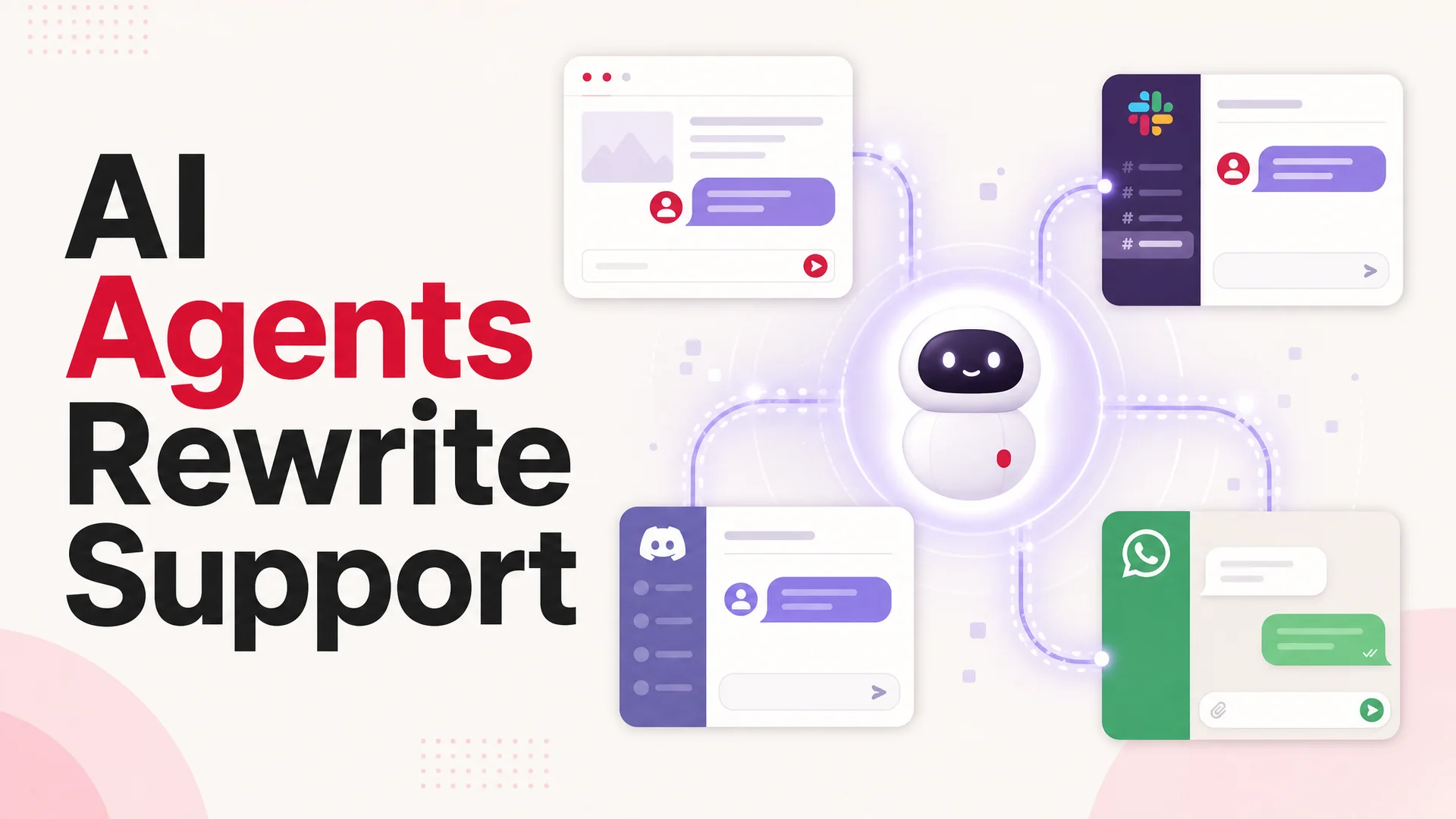
Your website, Slack, Discord, WhatsApp, and a growing list of channels - one agent, one knowledge base, one set of analytics. Customers get the same experience whether they DM you on WhatsApp at midnight or hit the widget on your pricing page on a Tuesday morning.
6. Integrations and Workflows
Berrydesk plugs into the tools your team already runs on - CRM, helpdesk, e-commerce, calendaring, payments. Workflows, escalation rules, business hours, language detection, and SLA targets are configurable per channel.
7. Privacy and Compliance
GDPR-compliant by default, with regional data residency options and SSO for enterprise. For regulated industries, you can run on-prem or air-gapped using open-weight models like GLM‑5.1 or Qwen3.6‑27B without leaving the Berrydesk control plane.
Wrapping Up
A great business chatbot is not a gimmick. It is a calmly-stated value prop, a clear handoff to a human when needed, and a quiet engine resolving the long tail of repetitive work that was eating your support team's attention.
You do not have to nail it on day one. The best teams ship a v1 that handles the top 20 questions, watch the transcripts for a week, and iterate. Two weeks of that beats two months of pre-launch wireframing.
Use the routing, the AI Actions, and the analytics to compound improvements. Pick a model lineup that matches your traffic shape - cheap and fast for the common case, frontier for the genuinely hard ones. And keep a human in the loop where it matters.
If you want to skip the plumbing and get to the part where customers are getting answered, build a free agent on Berrydesk. Connect a knowledge base, brand the widget, plug in the channels you care about, and you can be live the same afternoon.
 Berrydesk
Launch your AI agent in minutes
- Train on docs, websites, Notion, Drive, or YouTube - no engineering required
- Deploy a branded agent to your site, Slack, Discord, and WhatsApp from one console
Set up in minutes

Chirag Asarpota is the founder of Strawberry Labs, the team behind Berrydesk - the AI agent platform that helps businesses deploy intelligent customer support, sales and operations agents across web, WhatsApp, Slack, Instagram, Discord and more. Chirag writes about agentic AI, frontier model selection, retrieval and 1M-token context strategy, AI Actions, and the engineering it takes to ship production-grade conversational AI that customers actually trust.