Most support teams only show up after something has already gone sideways. The ticket lands, the customer is annoyed, and the team scrambles to repair the experience.
There is a better posture: get there first. Spot the friction, surface the answer, and resolve the issue before the customer ever has to type the word "help."
That is what proactive customer support is, and in 2026 it is finally cheap and reliable enough to do at scale. This guide breaks down what it actually means, why it pays off, what it looks like in real products, and a step-by-step way to roll it out without rebuilding your stack.
What proactive customer support really means
Proactive customer support is help that the business initiates - not the customer. Instead of sitting behind a contact form waiting for tickets, you watch for the moments where users are likely to get stuck, and you intervene early.
It might be a tooltip that appears the first time a new admin lands on a settings page. It might be an email warning a merchant about a billing renewal that is about to fail. It might be an AI agent that notices a customer typing "this isn't working" into a chat window and routes the conversation to the right specialist before the user gives up.
The key shift is who owns the first move. In reactive support, the customer carries the burden of describing the problem and finding the right channel. In proactive support, the company watches for the signals and takes the first step.
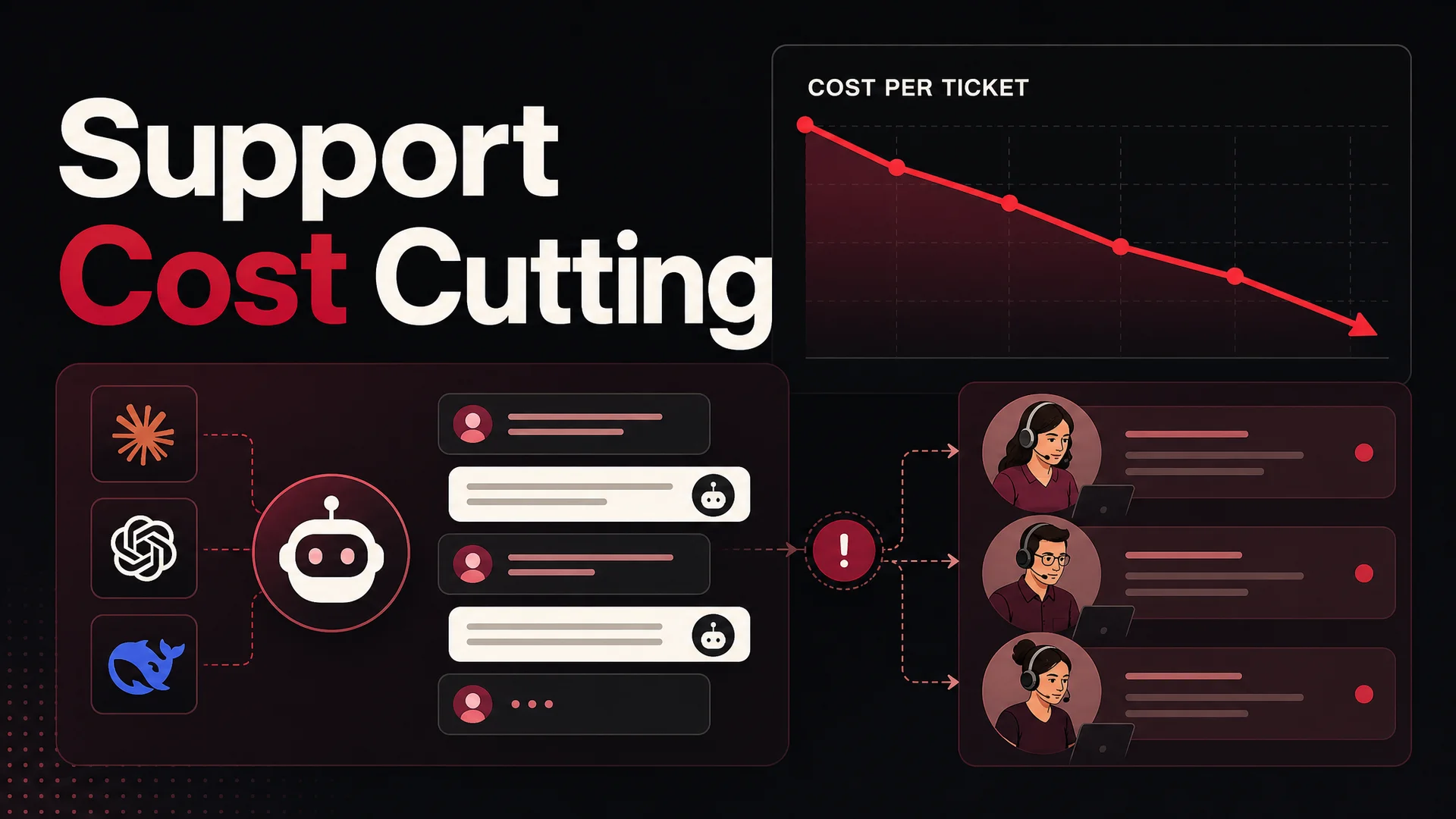
That changes the economics of support, too. Reactive support tends to scale with ticket volume - more customers, more tickets, more headcount. Proactive support compounds in the other direction: every issue you prevent never becomes a ticket, never costs an agent's time, and never erodes a customer's patience.
Reactive vs. proactive at a glance
- The conversation starter flips. In a reactive model, the customer initiates. In a proactive model, the company does - through messages, prompts, alerts, or in-app guidance.
- The timing flips. Reactive support arrives after the friction. Proactive support tries to land before it.
- The cost curve flips. Reactive cost rises with growth. Proactive cost falls per ticket as your prevention surface gets smarter.
- The emotion flips. Reactive support meets a customer who is already frustrated. Proactive support meets a customer who is mildly curious or briefly stuck.
- The team's job flips. Reactive teams firefight. Proactive teams design - they build the systems and content that quietly handle the first 70% of would-be problems.
Why it is worth the investment
Proactive support is not a nice-to-have polish layer. Done well, it directly moves the metrics every support leader is held to.
It cuts ticket volume at the root. Most help requests are not unique - they cluster around a small number of confusing flows, ambiguous policies, or first-run gotchas. If you answer those questions where they are asked (the page, the moment, the keyword), the ticket never has to be created. Your queue shrinks even as your customer base grows.
It prevents quiet churn. This is the underrated half of the argument. The customers who file tickets are the ones who care enough to complain. The dangerous ones are the silent customers who hit a snag, decide your product is too much work, and cancel without ever talking to you. Proactive support reaches that silent majority - the people who would never raise a hand but will absolutely benefit from a well-timed nudge.
It moves CSAT in the right direction. When a customer gets the answer before they had to ask, they remember it. The interaction lands in a different emotional bucket than "tech support" - it feels like care. That is what turns a transactional relationship into a loyal one.
It frees the team to do work that matters. When the easy 70% of questions get deflected, the remaining tickets are the genuinely hard ones - the cases where a human's judgment, empathy, or creativity actually changes the outcome. Agents stop being inbox processors and start being problem solvers, which is also better for retention on your own team.
It pays for itself across the funnel. A proactive prompt on a pricing page can recover a stalled deal. A proactive walkthrough on day three of onboarding can save a trial. A proactive refund on a known shipping delay can save a long-term customer. The same muscle that reduces support cost also moves revenue.
How modern AI changed the math on this
Proactive support has been a goal for a decade, but until recently it was painful to deliver outside of a few well-resourced teams. Hand-built rule engines were brittle. Old chatbots routinely hallucinated or got stuck on anything off-script. Watching every conversation in real time was a luxury reserved for the biggest companies.
The 2026 model landscape changed that calculation in three ways.
First, the cost floor collapsed. Open-weight frontier models like DeepSeek V4 Flash run at roughly $0.14 per million input tokens, and MiniMax M2 lands at about 8% the price of Claude Sonnet at twice the speed. That makes it economically reasonable to have an AI agent reading every message in real time, classifying intent, and deciding whether to intervene - something that would have been wildly expensive on the older GPT-4 generation.
Second, context windows got long enough to reason properly. With Claude Opus 4.6 and Sonnet 4.6 shipping a 1M-token context at no surcharge, and Gemini 3.1 Ultra at 2M, an AI support agent can hold your entire knowledge base, the customer's full history, and your refund policy in working memory at the same time. RAG is now a tuning lever, not a hard requirement to fit anything into the prompt.
Third, agentic tool use became reliable. Models like Claude Opus 4.7 (64.3% on SWE-Bench Pro), Kimi K2.6, GLM-5.1 (58.4 on SWE-Bench Pro under MIT license), Qwen3.6, and MiMo-V2-Pro can plan and execute multi-step actions - looking up an order, processing a refund, rescheduling a booking - without falling apart halfway through. AI Actions in production are no longer a demo; they are the table stakes for proactive support that does more than just hand out FAQ links.
The practical implication: you can put an AI agent in front of your funnel that watches every message, knows your full policy and product context, and can take real action when it spots a real problem - at a per-resolution cost that would have been impossible eighteen months ago.
Examples of proactive support in the wild
Proactive support shows up in subtle, almost invisible ways - usually you only notice it when it is missing. Here are a few patterns from real products, plus how the same idea translates with a Berrydesk-style AI agent.
- Onboarding tooltips that read your behavior. Tools like ClickUp guide new users through their first task with contextual nudges. If a user lingers on a feature without engaging, a soft tooltip appears with a one-line explanation. The 2026 version is more powerful: a Berrydesk agent trained on your docs can answer the user's exact question in plain language instead of pointing at a generic walkthrough.
- Pre-issue alerts during high-stakes windows. Shopify warns merchants about platform maintenance ahead of Black Friday. The pattern generalizes - anything you know is about to go wrong (a known outage, a renewal that will fail, a delivery that will slip) is a chance to message the customer first instead of waiting for the inbound complaint.
- Engagement-based check-ins. Notion sends tailored emails when a workspace is empty after signup. Modern AI agents do something similar in-app - when usage data shows a user is stuck on step three of a four-step setup, a friendly chat opens with a tip pulled from the right help article, no human in the loop.
- Hesitation-triggered live chat at checkout. ASOS opens a chat window when shoppers idle on cart and checkout pages. The 2026 upgrade: instead of a generic "Need help?", an AI agent reads the cart contents, knows the shipping rules, and proactively answers the question the shopper was probably about to type.
- Help suggestions as users type. Several support tools surface relevant articles based on what the customer is writing. With long-context models, the suggestion can be smarter - the agent reads the user's full message and any prior conversation, and surfaces an answer rather than just an article.
- Crash and error follow-ups. Duolingo emails users after detected app crashes, sometimes with a perk. The same idea applies to web products: detect a 500 in a critical flow, log it, and have an AI agent reach out the next time the user opens the chat with both an apology and a fix.
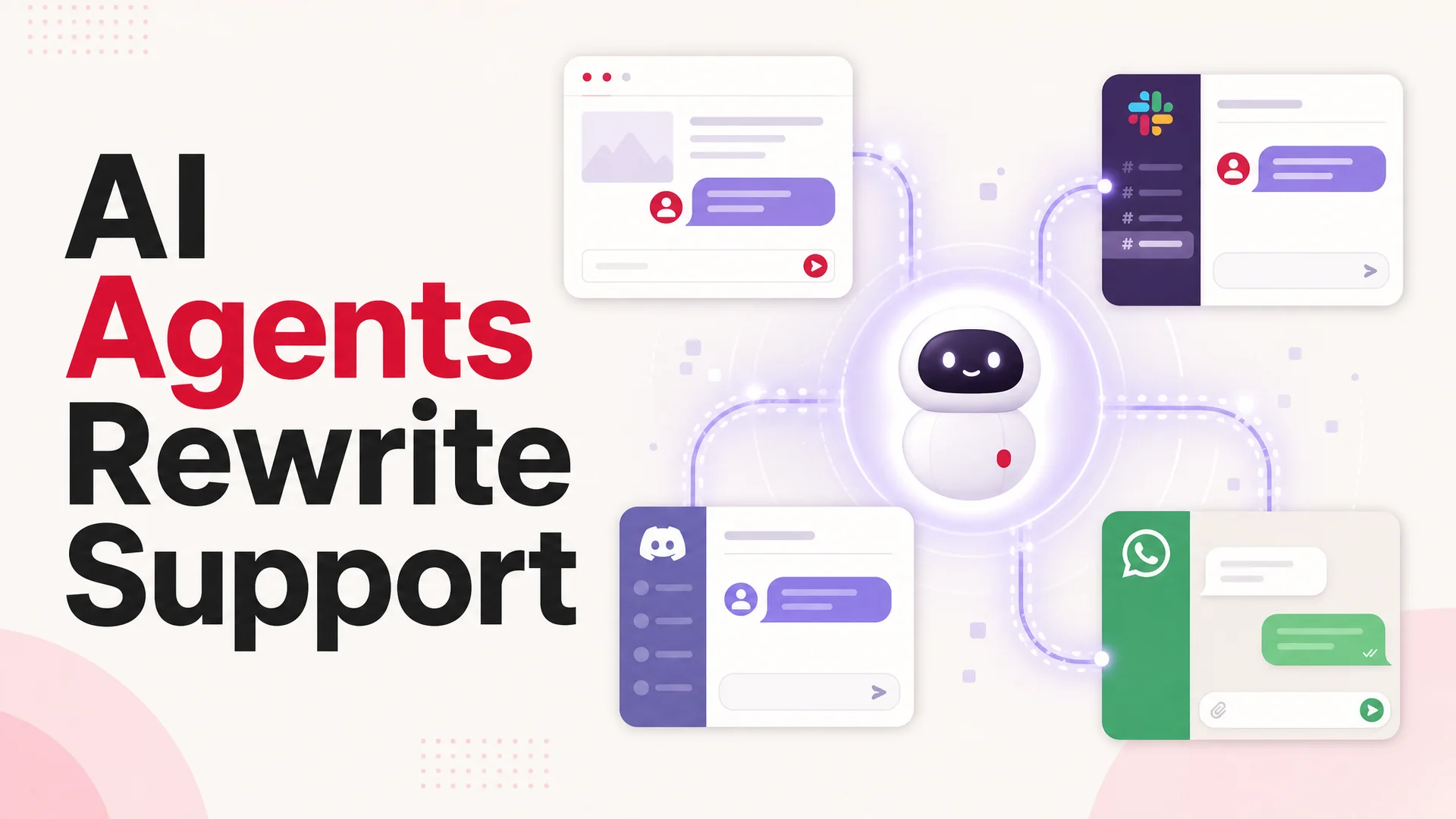
- Keyword and sentiment monitoring. This is the highest-leverage one. An AI agent watches every conversation for high-stakes signals - "cancel," "refund," "broken," "not working," "this is ridiculous" - and either intervenes itself or pages a human before the customer escalates. With a Berrydesk agent, you configure the watchlist once, and the agent flags those moments across web chat, Slack, Discord, and WhatsApp simultaneously.
How to actually implement proactive support
You do not need to rebuild your support stack to get started. The trick is to layer proactive moments onto the system you already have, then iterate.
1. Map the journey and find the friction
You cannot intervene where you cannot see. Walk through the customer journey from the outside - signup, first session, first value, billing, renewal - and mark every step where users get confused, slow down, or churn. Pair that with quantitative data: where do funnels drop, where do tickets cluster, where does session replay show rage clicks?
Tools like Hotjar, FullStory, and your analytics layer give you the heatmap. Your support inbox gives you the qualitative side. Where the two overlap is where proactive support has the most leverage.
2. Mine your support history for patterns
Open your last 90 days of tickets and group them. You will almost certainly find that a small number of root causes generate a large share of volume - a confusing onboarding step, a billing edge case, an integration that is hard to set up. Each of those is a candidate for a proactive intervention.
If your support stack does not already cluster tickets, an AI agent can do this for you in an afternoon. Feed conversations into a model with a long context window (Claude Sonnet 4.6's 1M tokens is more than enough) and ask it to extract recurring themes and the language customers use to describe them. Those phrases become your trigger keywords.
3. Set up the right automated touchpoints
Now you can layer in messages and guides that fire on behavior, not on inbound. Examples:
- A user signs up but never imports data → an in-app guide on day three.
- A trial admin invites no teammates by day five → an email with a one-click invite link.
- A customer's payment method expires next week → a heads-up in the dashboard banner.
- A first-time buyer adds an item to cart but stalls for 90 seconds → a chat prompt with a sizing or shipping answer.
The mechanics here are old; the difference in 2026 is that the agent answering on the other end can actually understand the customer. A Berrydesk agent trained on your knowledge base, branded to match your product, and connected to your CRM and billing system can answer with specifics, not boilerplate.
4. Watch the conversation for high-intent signals
Set a watchlist of keywords and phrases that signal escalation risk: "cancel," "refund," "broken," "downgrade," "ridiculous," "not working," competitor names. The AI agent flags any conversation containing those patterns and either responds itself, hands off to a human, or both.
This is also where sentiment analysis pays for itself. Modern open-weight models are cheap enough to run on every message - DeepSeek V4 Flash or MiniMax M2 will sentiment-tag a million messages for under fifty dollars. You can afford to watch everything.
5. Put live help where decisions get made
Pricing pages, checkout flows, plan-comparison pages, and feature-heavy dashboards are decision moments. Drop a Berrydesk agent on those pages with the right knowledge - your pricing rules, your refund policy, your shipping windows - and let it answer the questions that would otherwise turn into abandoned carts or stalled deals.
The bar is not "everywhere all the time." The bar is the three or four screens where most of your revenue and churn risk lives.
6. Build a help center that surfaces itself
A knowledge base hidden behind a footer link is useless. Modern proactive support means the right article - or better, a synthesized answer - shows up where the user is, without them ever leaving the app. With long-context models, you can stop optimizing chunked RAG retrieval as your only strategy and start letting the agent reason directly over your full documentation.
Berrydesk supports training on docs, websites, Notion workspaces, Google Drive folders, and YouTube videos, so the same knowledge can power both your formal help center and the agent that answers proactively in chat.
7. Measure, iterate, and keep cutting
Track three numbers per intervention: did ticket volume on this topic drop, did completion rate on the related flow go up, did CSAT or retention move? If a tooltip cut "how do I export?" tickets by 30%, ship more like it. If a checkout chat prompt has no measurable effect, kill it and try a different trigger.
Proactive support is a portfolio strategy. Some interventions will be huge; some will be neutral; a few will hurt. The point is to keep adding, measuring, and pruning.
Common pitfalls to avoid
A few traps catch teams the first time they roll proactive support out:
- Over-prompting. Every page does not need a chat popup. If your widget interrupts users who were doing fine, you turn proactive support into proactive annoyance. Trigger on real signals - idle time, error events, hesitation on a high-value page - not on page load.
- Generic AI answers. A bot that says "I can help with that, please describe your issue" is not proactive. If you cannot answer specifically, do not interrupt. This is a knowledge problem; train the agent on the actual product, not just public docs.
- Hiding the human. Proactive AI is a force multiplier, not a replacement. The best setups make handoff to a human seamless when the agent is unsure. Customers tolerate AI; they do not tolerate being trapped in AI.
- Set-and-forget. Proactive support drifts. The checkout flow you instrumented six months ago has changed. The keywords customers used last year are different. Treat your proactive layer like product code - review it quarterly.
- Picking one model for everything. A small classifier on every message and a frontier model on every reply is wasteful. The 2026 pattern is to route: cheap, fast, open-weight models (DeepSeek V4 Flash, MiniMax M2) handle classification and routine answers, and you reserve Claude Opus 4.7, GPT-5.5, or Gemini 3.1 Ultra for the genuinely hard escalations. Berrydesk lets you choose the model per agent and per use case for exactly this reason.
A quick word on open vs. closed models for support
For regulated industries - finance, healthcare, government contractors - the rise of MIT-licensed open weights changes the calculus. GLM-5.1 (754B-param MoE, MIT license, 58.4 on SWE-Bench Pro) and Qwen3.6-27B (Apache 2.0, dense, surprisingly competitive on agentic benchmarks) make it realistic to run a frontier-grade support agent on-prem or in a fully air-gapped deployment.
If your buyers ask about data residency or model lineage, the option to deploy on open weights - without sacrificing capability - is increasingly the difference between a yes and a no in procurement. Most teams will still pick a hosted closed model for convenience, but it is worth knowing the open path exists.
Show up before the customer has to ask
Proactive support is not about doing more work. It is about doing the right work earlier - meeting customers in the moments where a small intervention saves a big problem.
That is exactly what Berrydesk is built for. You can launch a branded AI agent in four steps, train it on your documentation and product knowledge, and put it on the pages that matter - pricing, onboarding, checkout, post-purchase. The agent watches conversations for risk signals, answers in your voice, takes real actions like bookings and refunds through AI Actions, and pages a human the moment a conversation needs one.
Pick the model that fits the workload - frontier reasoning from Claude Opus 4.7, GPT-5.5 Pro, or Gemini 3.1 Ultra for hard cases, and cheap open-weight models like DeepSeek V4 Flash, MiniMax M2, or Kimi K2.6 for routine traffic. Deploy to a website, Slack, Discord, WhatsApp, or all of them at once.
If you want to cut churn, deflect repetitive tickets, and start meeting customers before they reach for the contact form, start building your agent for free at Berrydesk.
 Berrydesk
Launch a proactive AI support agent in minutes
- Watch for risky keywords and step in before tickets pile up.
- Trigger help on pricing, checkout, and onboarding pages automatically.
Set up in minutes

Chirag Asarpota is the founder of Strawberry Labs, the team behind Berrydesk - the AI agent platform that helps businesses deploy intelligent customer support, sales and operations agents across web, WhatsApp, Slack, Instagram, Discord and more. Chirag writes about agentic AI, frontier model selection, retrieval and 1M-token context strategy, AI Actions, and the engineering it takes to ship production-grade conversational AI that customers actually trust.