Ever since conversational AI went mainstream, customers have stopped grading brands on a "good enough" baseline. They expect every product surface - the homepage, the email, the support widget, the in-app nudge - to feel like it already knows who they are. Generic experiences now read as friction.
This is what AI personalization is built to solve. Modern models can read a customer's history, intent, and context in milliseconds and shape a response that feels handcrafted. For support and revenue teams, that shift turns personalization from a nice-to-have into the operating layer the rest of the experience runs on. Below, we'll unpack what AI personalization actually is in 2026, why it pays off, where it's working in the wild, and the traps to plan around before you ship it.
What AI personalization actually means in 2026
AI personalization is the use of large language models, retrieval systems, and behavior signals to tailor an experience - a message, a recommendation, a support reply, a product layout - to a specific person, in real time. The system fuses what it knows about the customer (account state, past tickets, browsing trail, purchase history, plan tier, locale) with what it knows about your business (docs, policies, inventory, pricing) and produces a response that fits the moment.
What changed this year is depth and breadth at the same time. Frontier models like Claude Opus 4.7, GPT-5.5, and Gemini 3.1 Ultra now ship with 1M–2M-token context windows, which means an agent can hold a customer's entire message history, your full knowledge base, and your policy library in working memory without juggling fragile retrieval chains. Open-weight models - DeepSeek V4, Moonshot Kimi K2.6, Z.ai's GLM-5.1, Alibaba's Qwen 3.6, MiniMax M2.7, Xiaomi MiMo-V2-Pro - have collapsed inference costs to fractions of a cent per resolution, so personalizing every conversation is no longer a budget conversation. You can route routine traffic through DeepSeek V4 Flash at $0.14 per million input tokens and reserve Claude Opus 4.7 for the high-stakes escalations.
The mechanic underneath is the same as it has always been: ingest signal, model the person, deliver a response shaped to them. The difference is that the modeling now happens with frontier-grade reasoning, not a rules engine bolted onto a CRM.
Why personalization pays off
Engagement that holds attention
A generic message gets skimmed. A message that calls out a customer's plan, uses their preferred channel, and references the thing they were stuck on yesterday gets read. AI personalization lifts engagement because it removes the cognitive cost of figuring out whether a message applies to you - the answer is built into the framing.
Higher conversion rates
The right product, surfaced to the right customer, at the right moment, simply converts more. Personalization engines do this by combining intent (what the customer just searched, clicked, or asked) with affinity (what people like them tend to buy) and constraint (what's in stock, what they qualify for). A support agent on Berrydesk can do the same thing inside the conversation - recommend the plan that fits, or offer the upgrade that unblocks the feature the customer just hit a wall on.
Retention and lifetime value
Customers stay with brands that feel like they pay attention. When the agent remembers the last conversation, the unresolved issue, the upcoming renewal, and the language preference, the relationship compounds. Churn drops not because the product changed but because friction did.
Marketing efficiency
Generic blasts have terrible economics. Personalized journeys segment automatically - every customer is, in effect, a segment of one - and budget flows toward whatever signal the model is finding. Teams running personalized lifecycle programs routinely report higher revenue per send with smaller lists.
Five examples of AI personalization in the wild
Berrydesk: personalized AI agents for customer support
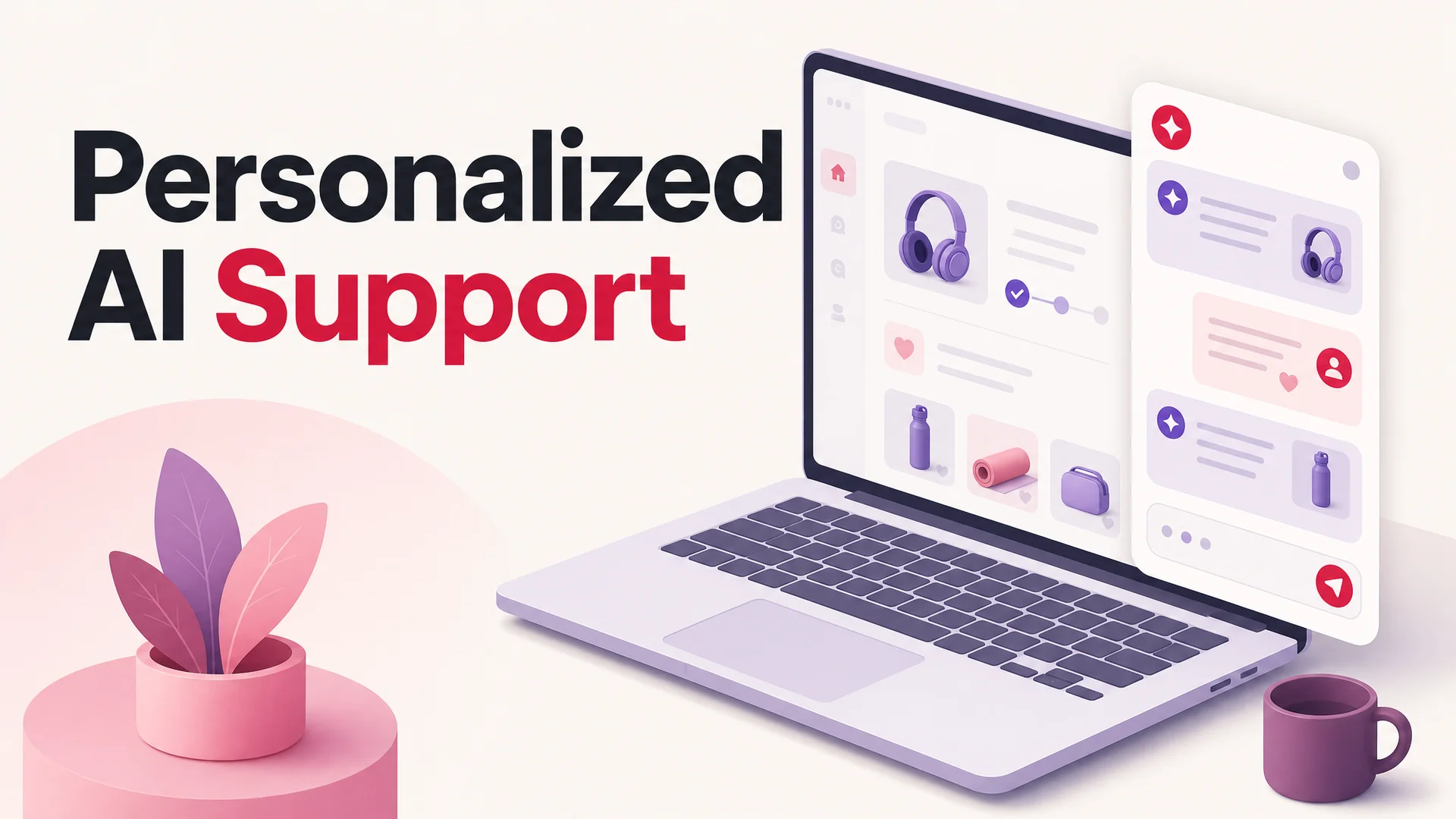
Berrydesk lets companies launch a branded AI support agent that knows the customer, the product, and the policies - without writing flow logic. You train the agent on your docs, Notion, Google Drive, websites, and YouTube content, pick the model that fits the workload (GPT-5.5, Claude Opus 4.7, Gemini 3.1, DeepSeek V4, Kimi K2.6, GLM-5.1, Qwen 3.6, MiniMax M2.7, and others), brand the chat widget, wire up AI Actions for bookings, refunds, order lookups, and payments, and deploy to the website, Slack, Discord, WhatsApp, and beyond. Because the agent can route across both closed-frontier and open-weight models, personalization runs at production cost - every conversation gets the customer's name, plan, history, and preferences without breaking the budget.
Netflix: recommendations as the entire surface
Netflix is the canonical case study because the home screen is the personalization. Models analyze viewing time, ratings, search behavior, drop-off points, and rewatch patterns to assemble a feed that's different for every household. The thumbnails themselves are personalized - the same title may be rendered with different artwork depending on what's likely to pull each viewer in.
Amazon: a recommendation engine that runs the storefront
Amazon's personalization stack has been quietly upgraded over the past few years to use LLM-driven understanding of product attributes and customer intent rather than purely collaborative filtering. The result is a storefront that adjusts not just to your purchase history but to the underlying need behind it - replacement parts after a recent appliance buy, seasonal items in your size, and accessories that match the model of the device you bought last month.
Starbucks: app-driven micro-personalization
The Starbucks app uses customer data - visit cadence, store preference, drink history, time of day, weather - to personalize offers, rewards, and recommendations. A regular cold-brew customer gets a different push notification than someone who only buys oat-milk lattes on weekends. The personalization is small at any given touchpoint and large in aggregate.
Sephora: visual personalization with AR
Sephora's Virtual Artist combines AI with augmented reality to recommend products tied to skin tone, undertone, facial features, and stated preferences. It's a useful pattern because it shows that personalization is not only about text - it can be visual, embodied, and live. The customer sees the product on their own face before deciding.
Where it gets hard: the pitfalls to plan around
Privacy and data protection
The data fueling personalization - purchase history, chat transcripts, account state - is also exactly the data your privacy team is most worried about. GDPR, CCPA, and an expanding set of regional regimes require clear consent, defensible retention windows, and the ability to delete on request. The MIT and Apache-licensed Chinese open-weight models (GLM-5.1, Qwen3.6-27B, MiMo) make on-prem and air-gapped deployments viable for regulated industries that previously had to settle for sanitized prompts and stripped-down context.
The personalization-creep line
There is a comfortable level of personalization, and there is the level past it where the customer feels watched. The line is industry-specific and culture-specific, and it moves over time. The safest pattern is to personalize on signals the customer actively gave you - the page they clicked, the question they asked, the preference they set - and be conservative about inferring things they didn't say out loud.
Integration and data plumbing
Personalization is only as good as the systems feeding it. Stitching together a CRM, a help desk, an order system, and a product analytics pipeline so the agent can see all of it in one frame is real engineering work. Long-context models help here - when the agent can hold a million tokens of context, you can pass more raw history and lean less on brittle ETL - but you still need clean identity resolution across systems.
Data quality and drift
Personalization built on stale, duplicated, or wrong data produces confidently wrong recommendations, which is worse than no personalization. Audit your sources, dedupe customer records, and put monitoring on the inputs as well as the outputs. Track when the model is recommending things that contradict ground truth - that's usually a data problem, not a model problem.
Routing and cost discipline
In a world where you can pick from a dozen frontier and open-weight models, the temptation is to default to the most powerful one. That's expensive and usually unnecessary. The discipline is to route: use a fast, cheap open-weight model (DeepSeek V4 Flash, MiniMax M2.7, Qwen3.6-27B) for the 80% of routine traffic, and reserve Claude Opus 4.7, GPT-5.5 Pro, or Gemini 3.1 Ultra for the long-tail cases that actually need parallel reasoning or 2M-token context. Berrydesk treats this as a configuration choice, not an engineering project.
RAG, long context, or both?
A trade-off worth naming explicitly: with 1M–2M-token windows now standard at the frontier, you can fit a substantial knowledge base directly in the prompt and skip retrieval entirely. That's tempting, and for small or medium corpora it works. But long context isn't free - latency and per-conversation cost both scale with what you stuff in the window. The pragmatic answer for most support teams is hybrid: retrieval to narrow the field, and long context to hold the conversation, the customer profile, and the top-N retrieved chunks together. Treat retrieval as a tuning lever for cost and latency, not a hard architectural requirement.
What's next
Personalization is moving past text. Voice agents that sound like your brand, multimodal agents that can read screenshots and product photos a customer sends in chat, and agentic systems that can complete actions on the customer's behalf - booking the appointment, processing the refund, updating the address - are all production-ready today. Models built specifically for agentic tool use (Kimi K2.6's swarms of sub-agents, GLM-5.1's multi-hour autonomous loops, Claude Opus 4.7's tool reliability, Qwen3.6's coding-grade execution) make those flows dependable rather than demoware.
The other shift is regional. The frontier is no longer a single Silicon Valley line. Open weights from Chinese labs - DeepSeek, Moonshot, Z.ai, Alibaba, MiniMax, Xiaomi - are now genuinely competitive on coding and agent benchmarks, and several are MIT or Apache licensed. For personalization in regulated verticals, that means the option to run a frontier-grade model entirely inside your own VPC, with your own data, on your own terms.
Bringing it together
AI personalization in 2026 is no longer a sales pitch - it's the baseline customers grade you against. The brands that win the next few years will be the ones that turn every touchpoint into something that feels handmade for the person on the other end of it, while staying disciplined about privacy, data quality, and cost.
If your front line is customer support, that's where most companies should start. A personalized AI support agent - one that knows the customer, the policies, and the product, and can take real actions on their behalf - pays for itself faster than any other personalization investment we see. Build yours on Berrydesk in an afternoon.
 Berrydesk
Launch a personalized AI support agent in minutes
- Train on your docs, Notion, Drive, websites, and product data - no engineering required.
- Route across GPT-5.5, Claude Opus 4.7, Gemini 3.1, DeepSeek V4, Kimi K2.6, and more from one dashboard.
Set up in minutes

Chirag Asarpota is the founder of Strawberry Labs, the team behind Berrydesk - the AI agent platform that helps businesses deploy intelligent customer support, sales and operations agents across web, WhatsApp, Slack, Instagram, Discord and more. Chirag writes about agentic AI, frontier model selection, retrieval and 1M-token context strategy, AI Actions, and the engineering it takes to ship production-grade conversational AI that customers actually trust.