ChatGPT has gone from a novelty that wrote sonnets about toasters to a piece of infrastructure that drafts contracts, writes code, plans logistics, and handles a meaningful share of customer questions before a human ever sees them. Every few months it learns something new - longer memory, better reasoning, sharper tool use - and the goalposts move again.
So it's worth pausing on a question that gets glossed over in the hype cycle: how does ChatGPT actually work? Not as a metaphor, and not as a marketing slogan, but as a system you can reason about - especially if you're betting your support operation on something built on top of it.
The phrase "GPT chatbot" used to mean a thin wrapper around an OpenAI endpoint that paraphrased FAQs and gave up the moment a user asked something off-script. In 2026, the same phrase means something very different: a transformer-powered agent that reads your knowledge base, runs tools on your systems, and resolves real customer tickets end-to-end. The underlying technology has matured, the model menu is wider than most teams realize, and the gap between a demo bot and a production support agent has finally closed.
This guide walks through where ChatGPT came from, what the letters G, P, and T really stand for, how the model is trained, what's in the data, where the boundaries are, the 2026 model lineup, and how a platform like Berrydesk takes a generic frontier model and turns it into an agent that knows your products, your policies, and your brand voice well enough to handle real customer traffic.
Where ChatGPT came from
ChatGPT is not a single piece of software. It's a product surface - a chat window - sitting on top of a family of underlying language models built by OpenAI. When you type into chat.openai.com, the message is routed to whichever GPT model your tier and settings have configured, the model produces a response, and the interface streams the tokens back into the conversation.
OpenAI is the lab that built the GPT line, alongside other systems like the image-generation model DALL·E and the coding assistant Codex (now running on the GPT-5 stack). What made ChatGPT a cultural event in late 2022 was not so much the underlying model, which had existed for months, but the decision to wrap it in a free, conversational interface that anyone could try.
That distinction - between the model and the interface - matters more than it sounds. The interface is the friendly host: it remembers your conversation, formats markdown, runs tools, and politely refuses certain requests. The model is the engine: a multi-billion-parameter neural network trained on a substantial slice of the public internet plus licensed datasets, optimized to predict the next token given everything that came before it. When people say "ChatGPT got smarter," what they usually mean is "OpenAI swapped in a newer GPT model behind the same chat window."
As of May 2026, that newer model is GPT-5.5, with a high-end variant called GPT-5.5 Pro that runs parallel reasoning chains for harder problems. Both shipped in April 2026 and represent a meaningful jump in coding, multi-step tool use, and grounded reasoning over the GPT-5.0 through 5.4 line that came before them. Codex, the coding assistant, now runs on the GPT-5 stack as well.
What a GPT chatbot is in 2026
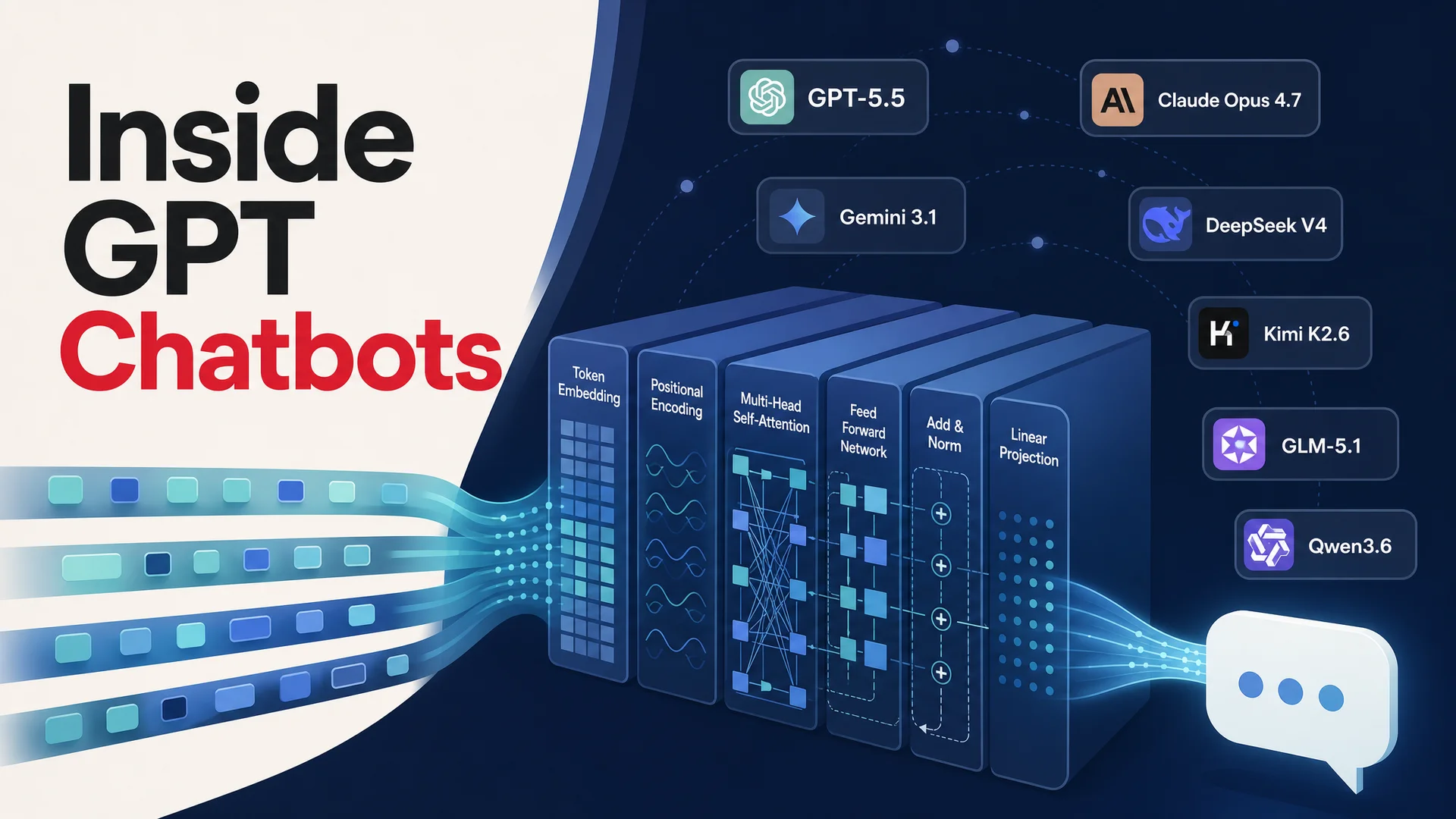
A GPT chatbot is an AI conversational agent built on a Generative Pre-trained Transformer. The name is now a bit of a category, not a single product. It still applies to OpenAI's GPT-5.5 and GPT-5.5 Pro, but in practice it covers any large language model that uses the transformer architecture to generate responses on the fly - Claude Opus 4.7 and Sonnet 4.6 from Anthropic, Google's Gemini 3.1 Ultra and Pro, and a deep bench of open-weight models from DeepSeek, Moonshot, Z.ai, Alibaba, MiniMax, and Xiaomi.
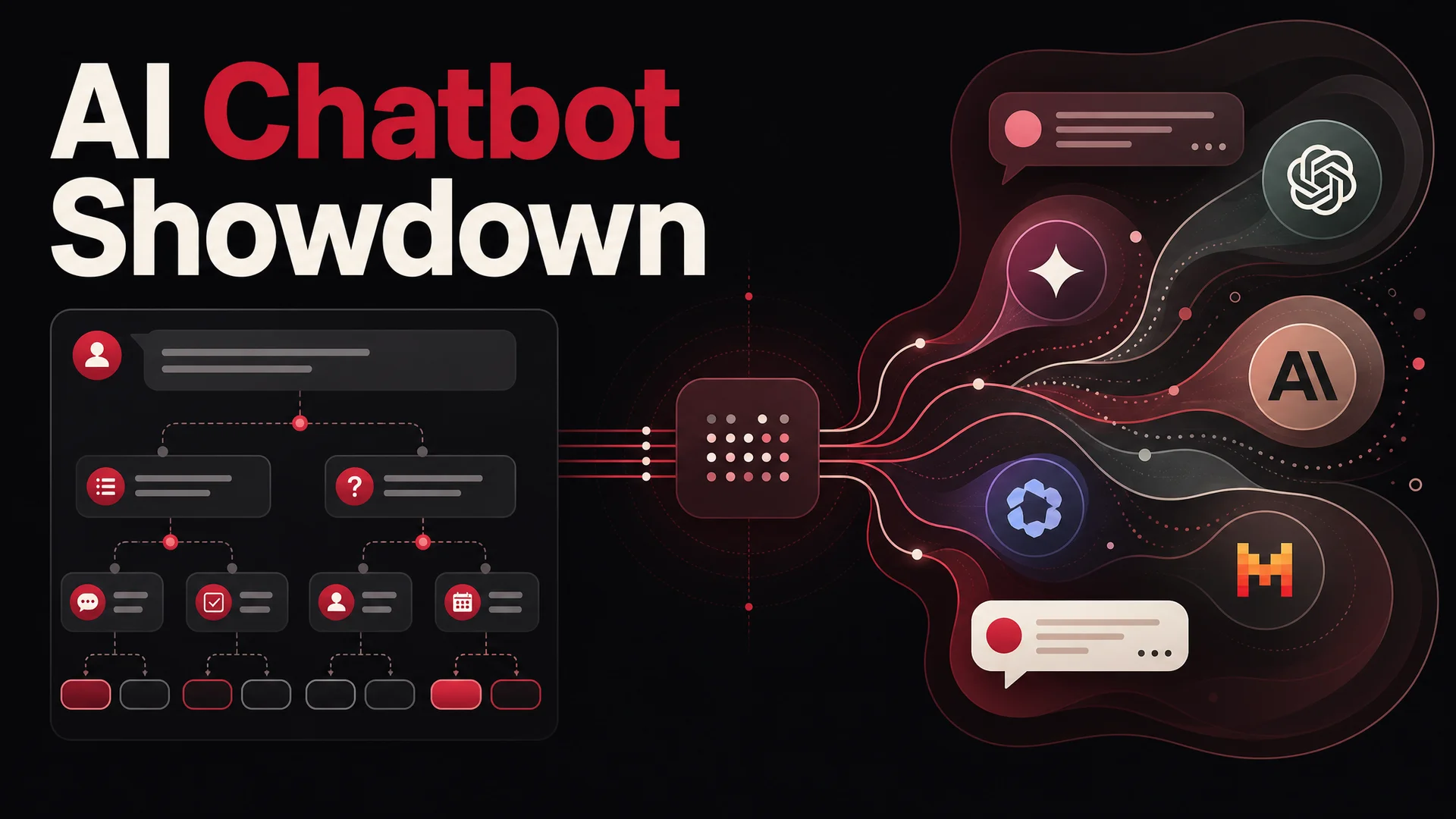
What separates a GPT-style chatbot from the menu-driven bots of the last decade is generation. A scripted bot picks an answer from a finite list, often via a decision tree authored by a human. A GPT chatbot writes the answer token by token, conditioned on the user's exact wording, the conversation so far, and whatever context you've attached to the system prompt. That is why it can handle a question it has never literally seen before, in a tone that matches your brand, while still pulling the correct refund policy out of your help center.
Decoding the name: Generative, Pre-trained, Transformer
GPT is the technology that makes ChatGPT what it is. The acronym is unusually descriptive - each word genuinely tells you something about how the model behaves.
Generative
The model produces output rather than retrieving it. When you ask GPT a question, it isn't searching a database of pre-written answers and picking the closest match. It's generating a response token by token, where a token is roughly a word fragment, choosing each next token based on the probability distribution it has learned from training. That's why two identical prompts can yield slightly different answers, and why the model can produce text it has never seen before - a limerick about your dog, a draft email to your CFO, a JSON object that conforms to your schema. Generation is the property that makes the model feel creative rather than canned.
That gives you flexibility, but also means quality control has to be designed in - usually through retrieval, tool use, and guardrails - rather than enforced at the script level.
Pre-trained
Before the model ever talked to you, it spent weeks or months ingesting a vast corpus of text. The "pre" is the giveaway: the bulk of the learning happens up front, not during your conversation. Think of it like medical school versus a clinical rotation. The pre-training phase is medical school - a long, expensive, general education on the structure of language, factual knowledge, reasoning patterns, and stylistic conventions. Talking to you is the rotation, where the model applies what it learned to a specific case.
Crucially, your conversations don't change the model's weights in real time. Updates happen in distinct training runs, on the model lab's schedule. Out of the box it knows English grammar, basic accounting, common programming idioms, and how a polite support reply sounds. You are not teaching it language. You are teaching it your business.
Transformer
The transformer is the underlying neural network architecture, introduced by Google researchers in the 2017 paper "Attention Is All You Need," that makes all of this work at scale. Without going deep into the math, the key idea is attention: each token in the input gets to "look at" every other token and weight how relevant it is to the current prediction. That's how the model figures out that the it in "the trophy didn't fit in the suitcase because it was too small" refers to the suitcase, not the trophy. Transformers also parallelize well on GPUs, which is why they scaled up while older sequential architectures stalled out.
This is also what lets a 2026 model like Gemini 3.1 Ultra hold two million tokens of context - your whole knowledge base plus a long conversation - and still keep track of which sentence answers which question.
Put it together and GPT is a generative, pre-trained, transformer-based language model. It writes new text, it learned how to do that ahead of time from a massive dataset, and it does the writing using an architecture that's particularly good at tracking long-range relationships in text.
How a GPT chatbot actually works
Under the hood, every message your customer sends triggers roughly the same pipeline. The details differ across providers, but the shape is consistent.
Tokenization. Incoming text is sliced into tokens - often subword units rather than whole words. "Berrydesk" might become two or three tokens; "the" is usually one. Tokenization is the unit billing happens in, which is why prompt design has direct cost implications at scale.
Embedding and self-attention. Each token is converted into a high-dimensional vector. The transformer then runs many layers of self-attention, letting every token attend to the others. Positional encodings preserve word order so "the customer refunded the merchant" stays distinguishable from "the merchant refunded the customer."
Contextual reasoning. Modern models add a reasoning step on top of raw next-token prediction. GPT-5.5 Pro runs parallel reasoning chains; Claude Opus 4.7 can plan over long horizons; Kimi K2.6 can sustain twelve-hour autonomous coding sessions and coordinate up to 300 sub-agents across 4,000 steps. For a support agent this matters less for the philosophy and more for the practical effect: the model can break a complicated request into steps, decide which tools to call, and reconcile conflicting information from multiple sources before replying.
Generation. The model produces output tokens one at a time, sampling from its predicted distribution. With a 1M-token context window - now standard on Claude Opus 4.6, Sonnet 4.6, DeepSeek V4 Flash, and MiMo-V2-Pro - there is plenty of room for the system prompt, retrieved knowledge, conversation history, and tool definitions to coexist without aggressive truncation.
Retrieval-augmented generation (RAG). When the answer depends on private information the base model has never seen - your refund policy, your product catalog, last week's release notes - the chatbot pulls relevant snippets from a vector store and injects them into the prompt. RAG is no longer the hard requirement it was two years ago; with million-token windows you can sometimes just stuff the whole knowledge base in. But for most production deployments RAG remains the right default because it keeps prompts cheap, citations clean, and updates fast.
Tool use and AI Actions. The biggest shift in 2026 is that tool calls work reliably. Agentic models like Claude Opus 4.7, GPT-5.5 Pro, Kimi K2.6, GLM-5.1, Qwen3.6, and MiMo-V2-Pro can decide on their own when to look up an order, issue a refund, book a meeting, or escalate to a human. That moves the chatbot from "answer questions" to "do the thing the user came for."
Fine-tuning, when justified. Fine-tuning is no longer a default step. Frontier models follow instructions well enough that a careful system prompt plus retrieval covers most use cases. Fine-tuning earns its keep when you need a specific tone of voice at scale, when you operate in a niche domain with private vocabulary, or when latency and cost pressure push you onto a smaller open-weight model that needs a nudge.
How GPT models are actually trained
Training a model the size of GPT-5.5 is one of the largest engineering projects in modern computing. The compressed version is: the model is shown a staggering amount of text, asked to predict the next token, and gradually adjusts billions of internal weights to get better at that prediction. The slightly less compressed version has three distinct phases.
Phase 1: Pre-training on raw text
The base model is trained on hundreds of billions to trillions of tokens drawn from books, web pages, code repositories, scientific articles, forums, and licensed datasets. The objective is the same throughout: given a window of text, predict what comes next. By the time pre-training finishes, the model has absorbed a working knowledge of grammar, facts, reasoning patterns, popular code idioms, and a great deal of what humans have written down.
What it has not yet learned is how to behave like a polite, helpful assistant. A raw pre-trained model, given the prompt "What is the capital of Egypt?", might just as easily continue with another trivia question as answer it.
Phase 2: Supervised fine-tuning
This is where the model is shown the right way to respond. Human contractors write thousands of high-quality example conversations - questions paired with model responses they consider exemplary - and the model is fine-tuned on those examples. After supervised fine-tuning, the model has internalized the shape of an assistant interaction: an instruction comes in, a useful, well-formatted answer goes out.
Phase 3: Reinforcement learning from human feedback
Even after fine-tuning, the model still produces responses of uneven quality. RLHF closes that gap. Human raters are shown multiple model responses to the same prompt and asked to rank them: which is more helpful, more accurate, less likely to mislead? Those rankings are used to train a separate reward model that scores responses, and the language model is then trained against that reward signal. The result is a model that consistently picks the response style human raters preferred - clearer, more honest about uncertainty, better at refusing genuinely unsafe requests.
In 2026 the playbook has gotten more elaborate. Frontier models layer additional stages on top: reinforcement learning against verifiable outcomes - code that compiles, math problems with checkable answers, browser tasks that succeed or fail - plus extended reasoning training where the model is rewarded for working through problems step by step before answering. This is what's behind the recent jump in benchmark scores and the longer "thinking" times you see in models like GPT-5.5 Pro and Kimi K2.6, which can run autonomous coding sessions of up to 12 hours and orchestrate swarms of up to 300 sub-agents on a single task.
What goes into the training data - and what doesn't
A model is the dataset it was trained on. So the question of what GPT learned from matters more than most people give it credit for.
The pre-training corpus is broad by design. It pulls from web crawls, licensed text from publishers, books, code from public repositories, and curated reference material. The breadth is what gives the model its generalist range - it can answer a tax question and then a poetry question and then a Kubernetes question because all three lived somewhere in its training set.
But there are deliberate exclusions, and they shape what you can rely on:
- Private data. GPT does not see your company's wiki, your customer database, or anyone's email. Anything proprietary has to be brought to the model at inference time, either via the prompt or through retrieval.
- Real-time information. The training corpus has a cutoff date. After that date, the model knows nothing unless it's been given a tool - a web search, a database lookup, an API call - to fetch fresh information.
- Unverified or unsafe content. Frontier labs put significant effort into filtering out content that's toxic, copyright-laden in problematic ways, or low quality enough to drag down the model's average behavior.
The implication for support teams is the one nobody wants to hear: a base GPT model, no matter how powerful, does not know your refund policy, your product SKUs, your shipping carriers, or the wording of last Tuesday's incident page. It speaks fluent English. It does not speak fluent your business.
A brief tour of the 2026 model lineup
You've probably noticed that "GPT" comes in flavors. There was GPT-3, then GPT-3.5, then GPT-4, then a long string of point releases through GPT-5.0, 5.1, 5.2, 5.3, 5.4, and now GPT-5.5 and GPT-5.5 Pro. Each generation generally retained the capabilities of the last while adding more - better instruction following, longer context windows, stronger reasoning, more reliable tool use, multimodal understanding.
A useful mental model: think of generations like grade levels in school. A grade-eight student doesn't forget arithmetic when they pick up algebra. They have a broader base, more techniques, and more nuance.
The other thing worth knowing in 2026 is that OpenAI is no longer the only game on the frontier. The choice is no longer "GPT or not GPT." It is which model on which traffic.
Closed frontier:
- GPT-5.5 and GPT-5.5 Pro lead on parallel reasoning and remain the default for many product teams.
- Claude Opus 4.7 leads SWE-bench Pro at 64.3% and is the model of choice when you need long-horizon reasoning over your own data. Claude Opus 4.6 and Sonnet 4.6 ship with a 1M-token context window at no surcharge.
- Gemini 3.1 Ultra brings a 2M-token context and native multimodality across text, image, audio, and video - useful when customer questions arrive as screenshots or voice notes. Gemini 3.1 Pro currently leads GPQA Diamond at 94.3%.
Open-weight frontier:
- DeepSeek V4 - V4 Pro at 1.6T params, V4 Flash at 284B. V4 Flash runs at $0.14 / $0.28 per million input/output tokens with a 1M-token context.
- Moonshot Kimi K2.6 - agentic-first, 12-hour autonomous coding sessions, coordinates up to 300 sub-agents.
- Z.ai's GLM-5.1 - posts 58.4 on SWE-Bench Pro under MIT license, edging out both GPT-5.4 and Claude Opus 4.6 on that benchmark. Trained entirely on Huawei Ascend chips.
- Alibaba's Qwen 3.6 family - including the open Qwen3.6-27B (Apache 2.0) and Qwen3.6-35B-A3B.
- MiniMax M2 / M2.7 - open-weight, roughly 8% the price of Claude Sonnet at twice the speed.
- Xiaomi's MiMo-V2-Pro and Flash - 1T-param, MIT-licensed.
Several of these ship under MIT or Apache licenses, which makes on-prem and air-gapped deployments viable for regulated industries that could not run a chatbot before.
The takeaway is that single-model deployments are increasingly the wrong default. The right architecture in 2026 is a router that sends each request to the cheapest model that can handle it, with a fallback to a frontier model when the router is unsure. For a customer support team, that translates to: the right answer is usually a router - cheap, fast, open-weight models for the routine 80% of tickets, and a frontier closed model held in reserve for the gnarly 20%.
Why teams are building GPT chatbots right now
The business case has gotten harder to ignore as the model menu has expanded.
Always-on coverage. A GPT chatbot answers at 3 a.m. on a Sunday with the same patience it shows on a Tuesday morning. For a SaaS company with users in every timezone, or a DTC brand whose checkout questions spike on weekends, that alone usually pays for the deployment.
Real cost compression. The economics of inference have moved fast. DeepSeek V4 Flash is priced at roughly $0.14 per million input tokens and $0.28 per million output tokens. MiniMax M2 lands around 8% the price of Claude Sonnet at twice the speed. A typical Berrydesk deployment routes routine traffic - order status, password resets, plan questions - to one of these workhorses, and reserves Claude Opus 4.7, GPT-5.5 Pro, or Gemini 3.1 Ultra for the genuinely hard escalations. The blended cost per resolution often comes in at fractions of a cent.
Personalization that actually personalizes. With a million-token context window, an agent can hold the customer's full history, the last six tickets, the relevant policy, and the product manual all at once. Replies stop sounding like form letters because they are not assembled from form letters.
Multi-channel by default. A modern support agent does not live in a single widget. It sits on your marketing site, in your in-app help, in Slack and Discord for your community, on WhatsApp for international customers, and in Intercom or Zendesk threads for your existing CX team. Building that fan-out from scratch is a quarter of engineering. Buying it is a checkbox.
Strategic differentiation. When everyone in your category has the same pricing page and the same feature list, the experience of asking a question becomes the differentiator. A chatbot that resolves the issue in one turn is a different product than one that opens a ticket.
How to build a GPT chatbot without reinventing the stack
Two years ago, getting any of this into production meant a small engineering team, a vector database, a queue, an eval harness, and several months of work. That is no longer the shape of the problem. The pieces are commodity; what you actually need is a platform that wires them together cleanly.
1. Define the job, not the chatbot
Start with the ticket types that consume the most agent hours, not the bot you imagine. Refunds, order status, plan changes, password resets, integration troubleshooting - pick three to five concrete categories and make those the agent's job description. A bot that resolves three categories well will save more time than a bot that gestures vaguely at all of them.
2. Pick a model - or, better, a portfolio
Match the model to the work. Routine, high-volume, low-risk requests run cheaply on DeepSeek V4 Flash, Qwen3.6-27B, or MiniMax M2. Complex multi-step workflows that involve tool calls and reasoning over policy documents run on Claude Opus 4.7, GPT-5.5 Pro, or Kimi K2.6. Multimodal tickets (a screenshot of an error, a photo of a damaged shipment) route to Gemini 3.1 Ultra. Berrydesk lets you choose any of these per agent and per route, so you do not have to commit to one provider for the whole product.
3. Train on the sources you already maintain
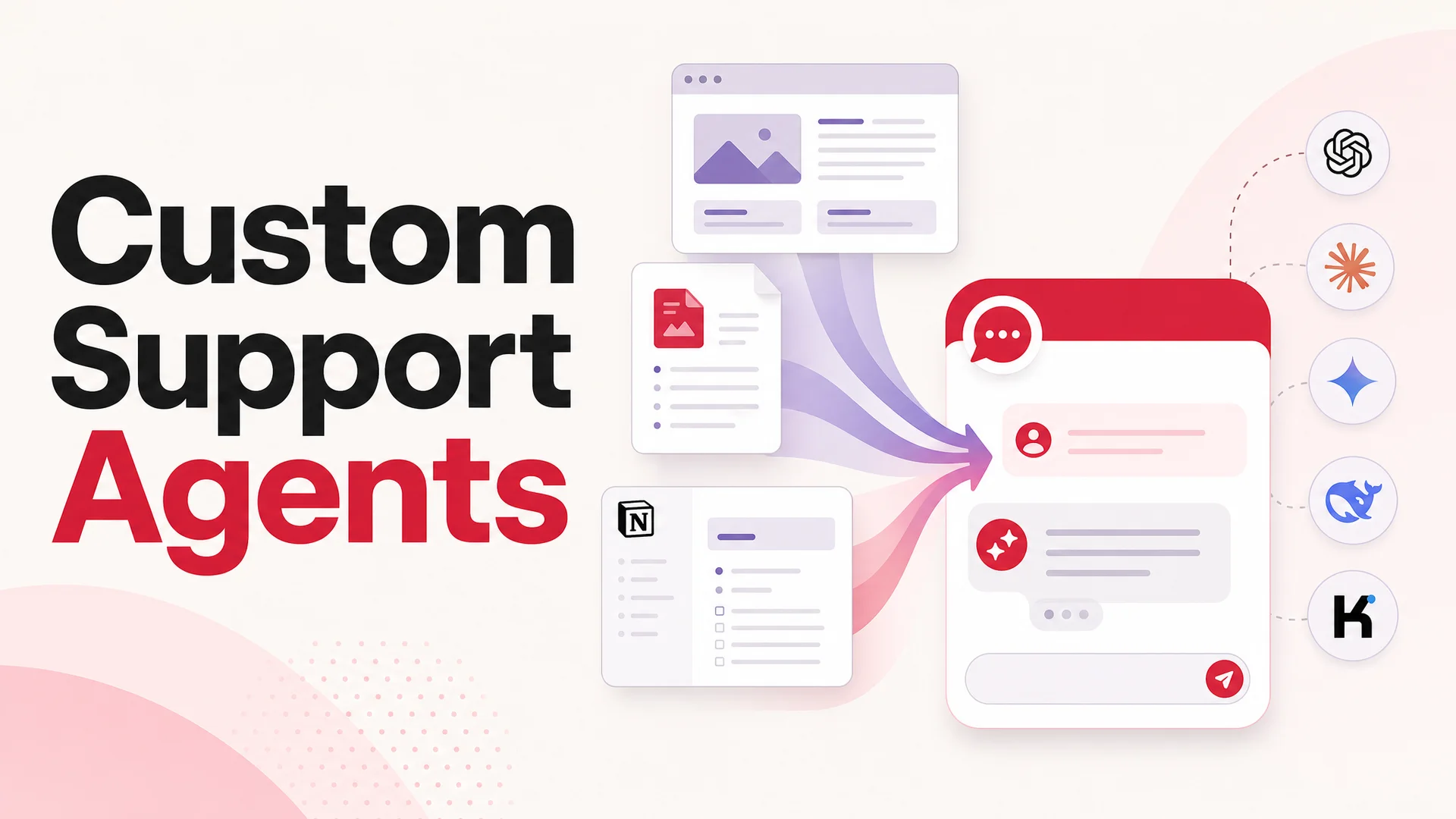
The training step is no longer "label thousands of examples." It is "point the agent at the documents your team already keeps current." Help center, product docs, Notion pages, Google Drive folders, public website, even YouTube transcripts for product walkthroughs - a Berrydesk agent ingests all of them and keeps the index in sync as they change. The ongoing maintenance cost of the bot drops to roughly the maintenance cost of your existing documentation, which you were paying anyway.
4. Brand the widget
The chat widget is part of your product, not a third-party afterthought. Match colors, fonts, voice, and the small details - the empty-state message, the suggested questions, the avatar. A widget that looks like your site converts more visitors into users than a generic floating bubble.
5. Wire up AI Actions
This is the step that turns a chatbot into an agent. Connect the actions the bot needs to actually resolve the request: look up an order in Shopify, refund a charge in Stripe, book a slot in Cal.com, escalate to a human in Zendesk, post to a Slack channel for the on-call engineer. Modern agentic models call these tools reliably; the platform's job is to make wiring them safe (scoped credentials, audit logs, dry-run modes) and fast (no custom backend per integration).
6. Deploy where your customers are
Ship the same agent to your website, Slack, Discord, WhatsApp, and any other surface your audience uses. The model and the knowledge stay the same; only the rendering layer changes. This is also where multi-channel actually pays off - the bot remembers a conversation that started on the marketing site and continued in WhatsApp, instead of treating each channel as a fresh stranger.
7. Measure, then improve
Treat the bot like a teammate on probation. Watch deflection rate, resolution rate, customer satisfaction, and - critically - the categories where it hands off to humans. The handoff log is your best source of training material; every escalation is either a missing document, a missing AI Action, or a model choice that needs upgrading.
What modern context windows changed
For most of GPT's history, the way to teach a model about your business was retrieval-augmented generation: chunk your docs, embed them, search for relevant chunks at query time, and stuff them into the prompt. RAG still works and it's still the right answer at scale, but the calculus has shifted now that 1M-token context windows are standard and 2M-token windows exist on Gemini 3.1 Ultra.
A 1M-token context can hold roughly 750,000 words. For most mid-size businesses, that's the entire customer-facing knowledge base, every product page, the full policy document, recent release notes, and the past month of conversation history - all in a single prompt. RAG becomes a tuning lever rather than a hard requirement. You can run small deployments without an embedding pipeline at all, and only reach for retrieval when the corpus genuinely outgrows the context.
Berrydesk takes advantage of both modes. For long-tail or domain-heavy workloads, retrieval keeps responses grounded and cheap. For agents that need to reason holistically across an entire policy document or an in-flight conversation, long context lets the model see everything at once.
Pitfalls worth avoiding
The technology is good enough to ship, but it is not magic, and several failure modes are common enough to call out.
Hallucinations on private data. The base model does not know your refund policy unless you give it to the model. Without retrieval or long-context grounding, a confident-sounding wrong answer is the default failure mode. Always cite sources, and always have a fallback to "I don't know - let me hand you to a human."
Treating the base model as the product. A naked GPT-5.5 instance with no grounding will confidently invent SKUs, return windows, and discount codes. Always anchor the agent to your actual content via retrieval, long-context grounding, or both.
Skipping the escalation path. Even the best agent will hit a question it shouldn't answer. If the only options are "answer" and "answer wrong," users lose trust fast. A graceful handoff to a human or a structured form is non-negotiable.
Letting the model take action without guardrails. The new wave of agentic models - Kimi K2.6, GLM-5.1, Claude Opus 4.7, Qwen 3.6, MiMo-V2-Pro - can reliably book, refund, and look up. That's a feature when the constraints are clear, and a liability when they aren't. Scope credentials tightly, require confirmation on irreversible actions, and log every tool call.
Over-fitted personas. A bot that tries too hard to be quirky reads as unprofessional within a week. Default to the voice of your best support agent on a calm day: clear, warm, specific. You can layer in personality once the basics work.
Single-model lock-in. Picking one provider and building everything around it felt safe in 2023. In 2026 it leaves real money and real capability on the table. Build on a platform that lets you swap or route, because the leaderboard moves every few weeks.
Privacy and residency. Customer conversations are sensitive data. Pick a deployment posture that fits your jurisdiction - managed cloud for most teams, regional or on-prem for regulated industries. The MIT-licensed open-weight models (GLM-5.1, Qwen3.6-27B, MiMo) make air-gapped deployments genuinely practical now.
RAG vs long context vs fine-tuning
A common question is which of these to use. The honest answer is that they solve different problems and most production agents use a mix.
Use retrieval when your knowledge base is large, changes often, and you want citations. It keeps prompts small, costs predictable, and updates near-instant.
Use long context when the information is bounded but the relationships between sections matter - say, reasoning over an entire policy document end-to-end. With 1M–2M-token windows, this is practical now in a way it was not even a year ago.
Use fine-tuning when you need consistent voice across thousands of replies, when you operate in a domain with private vocabulary the base model gets wrong, or when you need to squeeze a smaller open-weight model into a job a frontier model handles trivially.
Most teams start with retrieval, add long-context grounding for the gnarly tickets, and reach for fine-tuning only when both are exhausted.
How Berrydesk extends a frontier model into a real support agent
ChatGPT, on its own, is a brilliant generalist with no opinion about your business. Berrydesk is the layer that closes that gap. The job of the platform is to take whatever frontier model you choose and graft on three things the model doesn't have out of the box: knowledge of your business, the ability to take action, and a brand-aligned surface to talk to your customers through.
Bring your own knowledge. Point Berrydesk at your help docs, marketing site, Notion workspace, Google Drive folder, or YouTube channel. The platform handles ingestion, chunking, embedding, and re-indexing on a schedule, so the agent stays current without anyone running a script. For long-context-friendly models like Claude Sonnet 4.6 or Gemini 3.1, you can also opt to load entire policy documents directly into the prompt.
Pick the model that fits the workload. Berrydesk supports GPT-5.5 and GPT-5.5 Pro, Claude Opus 4.7 and Sonnet 4.6, Gemini 3.1 Ultra and Pro, DeepSeek V4 Pro and V4 Flash, Moonshot Kimi K2.6, Z.ai GLM-5.1, Alibaba Qwen 3.6, MiniMax M2.7, and others. Routing logic lets you send the easy 80% of traffic to a fast, cheap open-weight model and reserve a frontier closed model for high-stakes escalations. For regulated industries that need on-prem or air-gapped deployments, the MIT- and Apache-licensed weights from GLM-5.1, Qwen 3.6-27B, and MiMo-V2 make that genuinely viable.
Give the agent hands. AI Actions let the agent do, not just say. Look up an order, reschedule an appointment, issue a refund within policy, take a payment, or open a Linear ticket. The newer agentic models handle multi-step tool use far more reliably than the chat-only era allowed, which means actions you'd previously have flagged "demoware" can run in production.
Make it look like yours. Brand the chat widget - colors, avatar, copy - so it reads as a native part of your product. Deploy it to your website, Slack, Discord, WhatsApp, and other channels from a single source of truth.
Stay in control. Conversation logs, escalation queues, evaluation tooling, and analytics all live in one place, so you can spot regressions before customers do.
The shift this enables is bigger than "we added a chatbot." When the underlying model is a current frontier system - GPT-5.5, Claude Opus 4.7, Gemini 3.1 Ultra - and the platform handles grounding, routing, actions, and channels, the agent stops being a deflection tool and starts being the front line of the support function. Tickets get resolved instead of triaged. Costs scale with traffic, not headcount. And the team's time goes to the hard, novel cases the model genuinely can't handle yet.
Where this is heading
GPT chatbots have crossed the line from interesting demo to load-bearing infrastructure. The combination of cheaper inference, agentic tool use, million-token context, and a healthy open-weight ecosystem means that a small team can now ship a support agent that would have been a full-year engineering project in 2023. The constraint is no longer the model. It is whether you have wired the model to your knowledge, your tools, and your channels in a way that actually resolves the request.
If you're trying to develop a real intuition for how ChatGPT works, the path is: read about the transformer architecture, play with the API directly, and try the same prompt against three different frontier models to see how their personalities and failure modes diverge.
If you're trying to use ChatGPT - or any frontier model - to handle support traffic for your business, the path is shorter. Bring your knowledge sources, pick a model, set up your AI Actions, brand the widget, and ship it.
That is the bet behind Berrydesk: pick your model, train on the sources you already maintain, brand the widget, add the AI Actions that close the loop, and deploy everywhere your customers already are. If you'd rather see it than read about it, you can build your first agent for free at berrydesk.com - most teams have a working bot answering live questions before the end of the afternoon.
 Berrydesk
Turn any frontier model into your support agent
- Pick from GPT-5.5, Claude Opus 4.7, Gemini 3.1, DeepSeek V4, Kimi K2.6, and more - without rewriting your stack
- Train on your docs, websites, Notion, Drive, and YouTube, then deploy to web, Slack, Discord, and WhatsApp
Set up in minutes

Chirag Asarpota is the founder of Strawberry Labs, the team behind Berrydesk - the AI agent platform that helps businesses deploy intelligent customer support, sales and operations agents across web, WhatsApp, Slack, Instagram, Discord and more. Chirag writes about agentic AI, frontier model selection, retrieval and 1M-token context strategy, AI Actions, and the engineering it takes to ship production-grade conversational AI that customers actually trust.