Picture a small company shipping a new product and pouring budget into ads. Traffic shows up, the form starts collecting submissions, and within a week the founder has 600 unread emails, a CRM full of half-qualified contacts, and a sales rep manually pinging people on LinkedIn. By the time anyone replies, the prospects have already booked demos with two competitors.
Now run the same scenario through a different system. The instant a visitor lands on the pricing page, an AI agent greets them, answers their questions in their own language, asks the four qualifying questions you would have asked, drops the qualified record into your CRM, sends a personalized follow-up the moment the lead goes cold, and books the demo on your sales rep's calendar - all before anyone on your team has finished their morning coffee.
That second scenario is what an AI-powered sales funnel actually looks like in 2026. The tooling has caught up to the marketing claims, and the cost of running the whole pipeline on top-tier models has dropped by an order of magnitude in the last twelve months. This guide walks through how to build one - section by section, stage by stage - and what to watch for as you put it into production.
We'll cover:
- What an automated AI sales funnel actually does
- The AI tools to use at each stage of the funnel
- How those tools chain together end-to-end
- The real benefits - and the pitfalls - of running the funnel on AI
- Where to start without boiling the ocean
What an automated AI sales funnel actually does
A sales funnel is the path from "stranger on the internet" to "paying customer." Every stage - awareness, interest, qualification, nurture, conversion - used to require human attention. The automated version uses AI to do the parts that don't need human judgment, and to flag the parts that do.
An AI funnel does four things humans used to do badly at scale. It engages every visitor, not just the ones who happen to land during business hours. It qualifies based on real conversation rather than a five-field web form. It personalizes follow-up using the actual content of prior interactions instead of merge tags. And it scores and routes in real time so your sales reps spend their hours on the deals that are actually ready.
The big shift since 2024 isn't the idea - it's that the underlying models can finally hold long conversations, take real actions on behalf of users, and run cheaply enough to be the default front door rather than a premium feature. Open-weight frontier models like DeepSeek V4 Flash now serve a typical lead-qualification turn for a fraction of a cent. Closed frontier models like Claude Opus 4.7 and GPT-5.5 Pro handle complex objections and pricing negotiations with reasoning that genuinely sounds like a senior rep. You don't have to pick one - you route per task.
1. AI agents for lead capture
The top of the funnel is where most companies still leak the most pipeline. A static contact form or a "request a demo" CTA converts a fraction of the people who show real intent. An AI agent embedded on the site engages every visitor in natural conversation, answers product questions instantly, captures email and context as part of the chat, and books the meeting before the visitor's enthusiasm fades.
What to look at:
- Berrydesk - Lets you spin up a branded AI sales and support agent in four steps: pick a model (GPT-5.5, Claude Opus 4.7, Gemini 3.1 Ultra, DeepSeek V4, Kimi K2.6, GLM-5.1, Qwen3.6, MiniMax M2, and others), train it on your docs, website, Notion, Google Drive, or YouTube content, brand the chat widget to match your site, and deploy to web, Slack, Discord, WhatsApp, and more. AI Actions wire it into bookings, payments, and CRM writes so the agent doesn't just talk - it closes the loop. A boutique agency could stand one up in an afternoon to ask visitors about budget, timeline, and team size, then route the qualified ones straight to the right partner's calendar.
- Drift - A long-standing player in conversational marketing, mostly used by mid-market SaaS teams to handle pricing-page conversations and route demo requests. Strong on routing logic, weaker on the model-flexibility story.
- Intercom - Pairs an AI agent with a live-chat product. Useful when your support and sales motions are tightly fused and you want a single inbox for both.
Why it matters: The lead you don't capture in the first thirty seconds is usually gone. An always-on agent makes the cost of "missed window" effectively zero.
The 2026 wrinkle worth knowing about: agents like Berrydesk now run with 1M-token context windows by default when you select Claude Sonnet 4.6 or DeepSeek V4. That means the agent can hold your entire knowledge base, current pricing, every objection-handling doc, and the full conversation history in a single prompt. Retrieval (RAG) is still useful for filtering and freshness, but it's no longer the load-bearing piece of the architecture it was two years ago.
2. AI-powered lead scoring and CRM
Once the conversation captures a contact, the next job is to figure out who's worth a sales rep's time. AI-enhanced CRMs grade leads against patterns of past wins - pages visited, questions asked, time on site, company signals - and surface the prospects that look most like the ones who already paid you.
What to look at:
- HubSpot - AI scoring across web activity, email engagement, and form fills, with workflow automation that can fire personalized follow-ups when a score crosses a threshold. The most accessible option for SMBs that don't want to wire together five tools.
- Salesforce Einstein - Predictive lead and opportunity scoring against your own historical data. Built for sales orgs already living inside Salesforce, with the depth of customization that implies and the implementation cost to match.
- Zoho CRM - Lighter-weight scoring and engagement tracking across email, chat, and social. A reasonable midpoint for teams who want AI signals without a full Salesforce buildout.
Why it matters: Lead scoring is what stops your reps from chasing tire-kickers and missing the prospect who's been quietly opening your pricing page nine times in a week.
The piece that's underappreciated: a Berrydesk agent on the front end can write structured fields back into HubSpot, Salesforce, or Zoho via AI Actions - budget tier, use case, company size, urgency - so your scoring model isn't relying on form-fill stubs. The score gets sharper because the input is richer.
3. AI email and personalized nurture
Most leads aren't ready to buy on the first visit. The job of the middle of the funnel is to keep them warm with content that's actually relevant to what they came for, and to stay quiet when they're not ready to hear from you.
What to look at:
- ActiveCampaign - Behavioral email automation with AI subject-line optimization and send-time tuning. Strong for SaaS trial flows where you want to drip product education over the first two weeks.
- Customer.io - Event-driven messaging with fine control over branching logic, used by product-led teams who want to trigger sequences off real product behavior, not just email opens.
- Reply.io - Multi-channel outbound (email, LinkedIn, phone) with AI-generated follow-up drafts. Useful for B2B teams running outbound on top of their inbound funnel.
Why it matters: A relevant email at the right moment converts. A generic email at the wrong moment gets you marked as spam.
The 2026 upgrade here is that the AI generating these emails is meaningfully better at writing like a human. GPT-5.5 and Claude Opus 4.7 write follow-up sequences that don't read like merge-tag soup, and they can pick up the tone and voice of your existing best-performing emails when you give them a few examples in the prompt. If your email tool lets you bring your own model - or if you wire it to a Berrydesk agent that triggers email actions - you can dramatically lift reply rates without rewriting your whole sequence library.
4. AI scheduling and handoff
Every extra step between "I'm interested" and "I'm on the calendar" costs you conversions. AI scheduling tools collapse that gap to near zero - the moment a lead qualifies, they're picking a time on the right rep's calendar.
What to look at:
- Chili Piper - Inbound lead qualification and instant routing to the right rep's calendar. The default for mid-market and enterprise sales teams who want concierge-level handoff.
- Calendly - Self-service booking with team round-robin logic and CRM integration. The right tool for SMBs and consultancies who don't need full inbound routing.
- Outreach.io - Outbound sequencing across channels, used by reps who are working defined book lists rather than reacting to inbound.
Why it matters: A friction-free booking flow is the difference between a 20% show-rate and a 60% show-rate. Cumulatively, that's the difference between hitting quota and not.
When your top-of-funnel agent can call a scheduling action directly - Berrydesk's AI Actions cover this natively - you skip the "thanks, our team will reach out" black hole entirely. The agent qualifies, the agent books, the rep walks into a meeting with full context. The handoff isn't a handoff anymore; it's a continuation.
5. AI analytics and funnel optimization
The funnel you build on day one will not be the funnel that's working in month six. AI analytics tools tell you where leads are dropping off, what content they engaged with before converting, and which traffic sources are wasting your money.
What to look at:
- Google Analytics 4 - The default for top-of-funnel attribution across paid and organic. Limited as a sales tool, essential as a marketing one.
- Clari - Revenue intelligence and pipeline forecasting against your CRM data. Used by RevOps teams who need to know which deals are actually going to close this quarter.
- Gong - Conversation intelligence over sales calls and emails. Surfaces what your top reps are doing differently and gives you patterns you can train the rest of the team on.
Why it matters: Optimization without data is guesswork. The funnel you can measure is the funnel you can fix.
The version of this story that wasn't possible two years ago: with Gemini 3.1 Ultra's 2M-token context, you can feed an entire quarter of sales conversations, every chat transcript from your AI agent, and your whole CRM export into a single analysis prompt and ask it to find patterns. You don't need a data team to run that query - you just need a clean prompt and a model that can hold it all at once.
How these tools fit into your funnel
Mapped to the funnel stages:
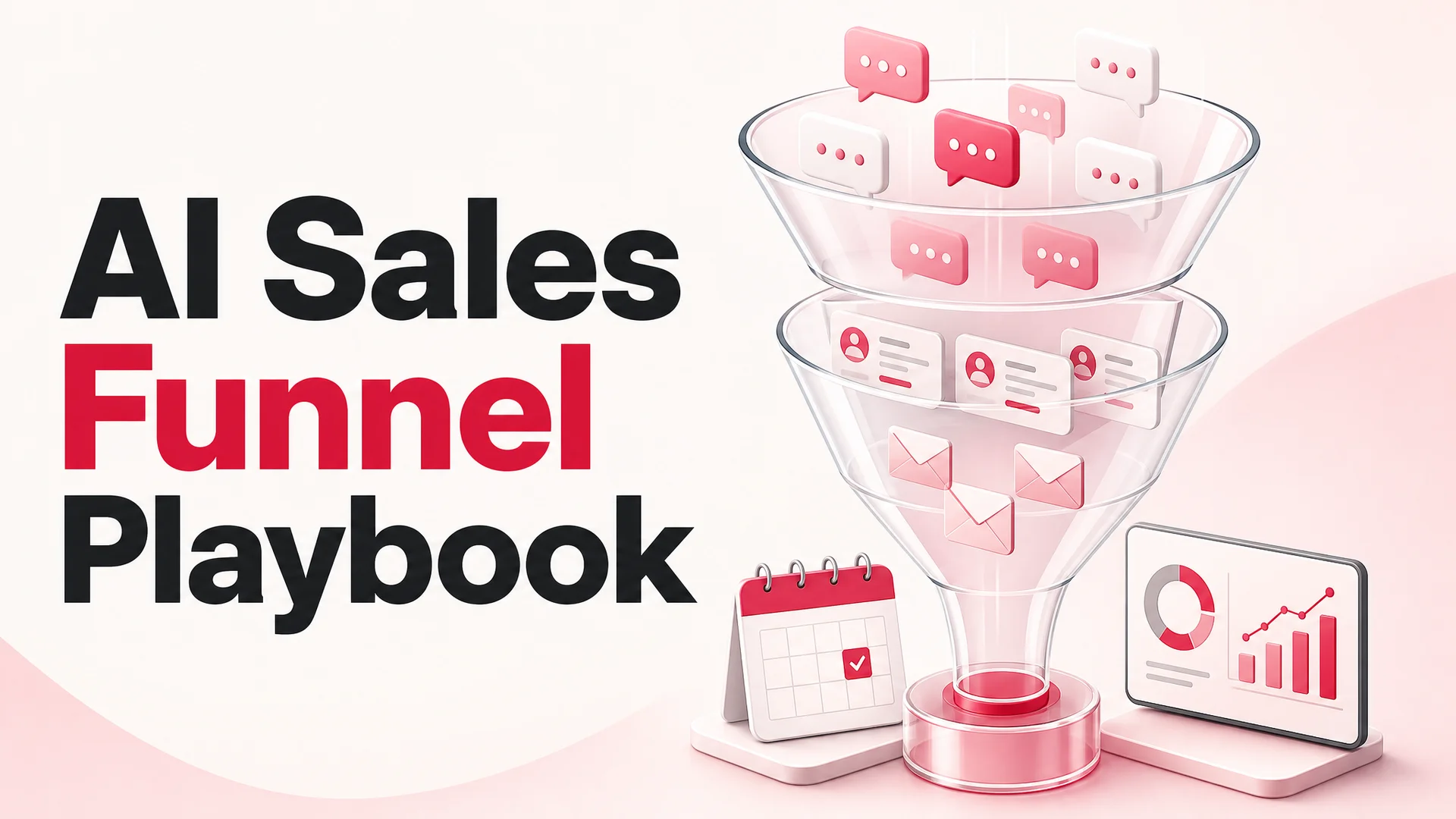
- Attraction. Your AI agent (Berrydesk, Drift, or Intercom) opens the conversation and captures the contact.
- Qualification. Lead scoring (HubSpot, Salesforce, Zoho) ranks the lead against your ideal customer profile and routes accordingly.
- Nurture. Email automation (ActiveCampaign, Customer.io) keeps the warm leads engaged with relevant content.
- Conversion. Scheduling tools (Chili Piper, Calendly) move the qualified ones onto a sales rep's calendar with no friction.
- Optimization. Analytics (GA4, Clari, Gong) tell you what's working and where to invest the next dollar.
The thing that's changed in 2026 is that you don't need five separate vendors stitched together with Zapier to make this work end-to-end. A Berrydesk agent with AI Actions can handle stages one through four directly - capture, qualify, nurture (via triggered email actions), and book - and write structured data back into the analytics layer for stage five. You'll still want a CRM as the system of record, and you'll still want a real email tool for high-volume nurture campaigns. But the integration tax is meaningfully lower than it was even a year ago.
Why the funnel runs better on AI
Less manual work, sharper team focus
The most direct win is the time your team gets back. Reps stop re-typing the same answers to the same pricing questions. SDRs stop manually dispositioning every form-fill. Marketing stops hand-curating which leads to send to which campaign. The repetitive work happens in the background; your team is reserved for the moments where human judgment actually changes the outcome.
More conversions from the same traffic
Personalization at scale used to mean "{first_name} merge tags." In 2026 it means an AI agent that has read the prospect's last six chat messages, knows which docs they viewed, picked up that they're evaluating against a specific competitor, and tailors its next response accordingly. Models like Claude Opus 4.7 and GPT-5.5 Pro reason well enough to handle that nuance live, in conversation. The lift in conversion rate over a static funnel isn't subtle - it's frequently in the double digits.
Scaling without linear hiring
When traffic doubles, an AI funnel just handles more conversations in parallel. The marginal cost of an additional qualified lead doesn't track headcount anymore - it tracks token spend, and even that's collapsing. A typical Berrydesk deployment can route routine qualification turns to DeepSeek V4 Flash at a fraction of a cent each, and reserve the premium models for objection handling and pricing negotiations. You get frontier-model quality on the conversations that matter, and commodity-model economics on the ones that don't.
Real-time, actionable insight
Every conversation, every booking, every drop-off becomes structured data. AI analytics surface where the funnel is leaking and which messages are landing. With long-context models, you can ask sweeping questions across a quarter of pipeline data in a single prompt and get a coherent answer back - no SQL, no dashboards-of-dashboards, no waiting on a data team.
Pitfalls worth avoiding
Most funnel automation projects don't fail because the tech isn't there. They fail in predictable ways.
Over-qualifying. It's tempting to ask the AI agent to grill every visitor with eight qualifying questions. Don't. Mirror the questions a good rep would ask in the first two minutes of a discovery call, and let the rest emerge naturally. An agent that interrogates loses leads it could have converted.
Letting the agent hallucinate pricing or policy. This was the #1 reason early AI sales agents got pulled in 2024. The fix in 2026 is to ground the agent in your actual pricing page, terms, and policy docs as part of its training data, and to use a model that's strong enough to defer to "let me get a human to confirm" on ambiguous edges. Berrydesk's training pipeline pulls in your docs, websites, Notion, Google Drive, and YouTube content so the agent answers from the source of truth, not from the model's general priors.
Skipping the human handoff. AI handles the early funnel beautifully. It does not replace your AE on a six-figure deal. Build the handoff explicitly - when the lead crosses a threshold, the conversation routes to a human, and the agent silently keeps note-taking in the background. Don't let the agent try to close deals it shouldn't.
Not picking the right model per stage. Running Claude Opus 4.7 on every casual web visitor is wasteful. Running DeepSeek V4 Flash on a complex enterprise pricing negotiation is risky. The right move is a routed setup - fast, cheap models for the simple turns, frontier models for the hard ones. Berrydesk lets you make that choice per agent and per use case rather than locking you into a single provider.
Open-weight vs closed-frontier: what to pick
A specific question worth answering: should you run your funnel on closed models like GPT-5.5 and Claude Opus 4.7, or on open-weight frontier models like DeepSeek V4, Kimi K2.6, GLM-5.1, Qwen3.6, MiniMax M2, or Xiaomi MiMo-V2-Pro?
For most teams, the right answer is "both, routed." Closed frontier models still hold an edge on the genuinely hard reasoning - complex objections, multi-step deal structuring, pricing logic that depends on subtle context. Open-weight models have caught up dramatically on benchmark performance - GLM-5.1 hits 58.4 on SWE-Bench Pro, Kimi K2.6 hits 58.6, and these are the same kinds of tool-use and reasoning capabilities that translate directly into agentic sales work - and they're 5-10x cheaper per token. For routine qualification, FAQ answering, and simple booking flows, the open-weight models are the obvious choice.
If you're in a regulated industry - healthcare, finance, defense, regulated consumer markets - the calculus shifts. MIT-licensed open weights from GLM-5.1, Qwen3.6-27B, and MiMo make on-prem and air-gapped deployment a real option, and Berrydesk supports routing to self-hosted models alongside its hosted options.
Getting started without boiling the ocean
If you've never automated any of this before, don't try to automate all of it at once. Start at the top of the funnel - that's where the leverage is highest and the implementation cost is lowest.
Stand up a Berrydesk agent on your homepage and pricing page first. Train it on your existing FAQ, product docs, and pricing. Wire two AI Actions: capture the lead's email and use case into your CRM, and book a meeting on your sales calendar. Watch what happens for two weeks. You'll learn more about your funnel from the conversation transcripts than you will from any analytics dashboard.
From there, layer in the rest in order of return: scoring, then nurture, then optimization. Each stage builds on the data the previous one captured.
The barrier to building an AI sales funnel in 2026 is no longer the technology, the cost, or the integration burden. It's the decision to start.
Ready to put an AI agent at the top of your funnel? Build one with Berrydesk - pick your model, train it on your content, brand the widget, and ship it across your site, Slack, WhatsApp, and Discord in an afternoon.
 Berrydesk
Put an AI agent at the top of your funnel
- Capture, qualify, and route leads 24/7 across web, Slack, WhatsApp, and Discord
- Pick GPT-5.5, Claude Opus 4.7, Gemini 3.1, DeepSeek V4, or Kimi K2.6 - and swap models per use case
Set up in minutes

Chirag Asarpota is the founder of Strawberry Labs, the team behind Berrydesk - the AI agent platform that helps businesses deploy intelligent customer support, sales and operations agents across web, WhatsApp, Slack, Instagram, Discord and more. Chirag writes about agentic AI, frontier model selection, retrieval and 1M-token context strategy, AI Actions, and the engineering it takes to ship production-grade conversational AI that customers actually trust.