The small-business sales math has changed
Sales eats hours. For a four-person consultancy or a two-person SaaS, those hours come straight out of delivery, building, or sleep. The classic answer - hire an SDR, pay commission, layer in a CRM stack - assumes you have payroll headroom you don't have. So you end up with one person running prospecting, pitches, demos, follow-ups, contracts, and onboarding while also doing the work that actually pays the bills. It is a setup that breaks at the seams the moment volume picks up.
Picture a four-person education consultancy. One partner runs delivery, two run engagements, and a fourth handles new business: cold outreach, qualification calls, proposals, contracts, and invoicing. They are good at it, but the funnel only moves as fast as one set of hands can move. Hiring is too expensive. An outsourced SDR firm wants a six-month minimum. The work piles up. Now picture a creator-economy operator running a YouTube channel that ships two videos a week. They want to land sponsors, sell digital products, and license clips to brands. Production already eats most of the week. Researching deck templates, writing pitch emails, and chasing down brand contacts is the part that simply does not happen.
What changed in 2026 is the supply side of AI tooling. Frontier closed models like GPT-5.5, Claude Opus 4.7, and Gemini 3.1 Ultra are an order of magnitude better at reasoning, writing, and multi-step tool use than the GPT-4-era models that powered the first wave of sales SaaS. Open-weight alternatives - DeepSeek V4 Flash at $0.14 per million input tokens, MiniMax M2 at roughly 8% the price of Claude Sonnet, GLM-5.1 under MIT license, Moonshot's Kimi K2.6, Alibaba's Qwen3.6, Xiaomi's MiMo-V2 - have collapsed the unit cost of the per-action sales work that used to be human-only: drafting follow-ups, scoring leads, summarizing calls, generating proposals, answering RFP questions.
The practical upshot for small teams: a one-person sales motion can plausibly look like a six-person team's, if you pick the right tools and let them route work to the right model under the hood. Below are nineteen we'd actually put on a small-business stack today, what each one is for, and where it sits in the broader picture. Read through, pick three, and start there - stacking too many tools at once is the most reliable way to see no return from any of them.
1. Berrydesk
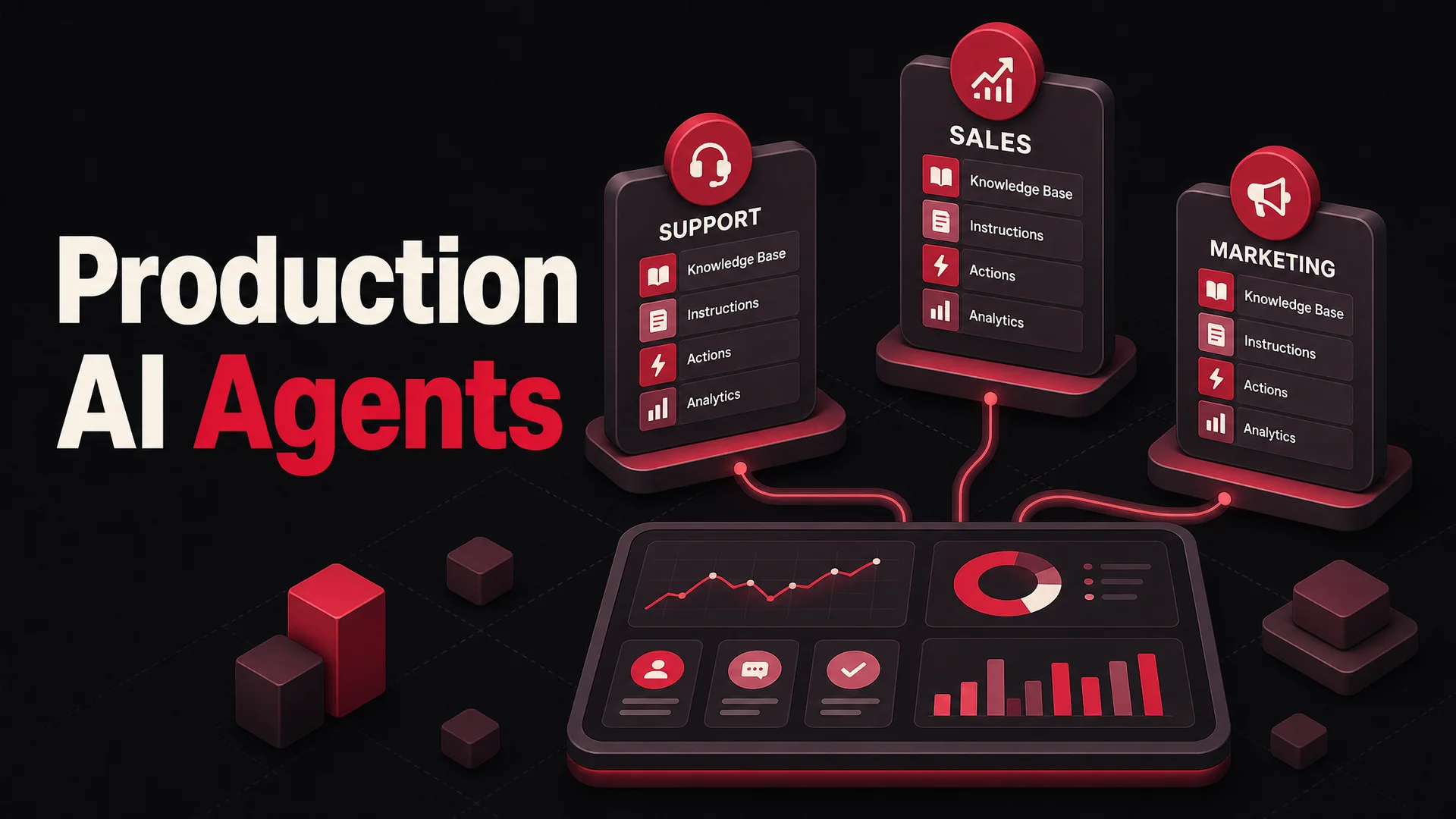
Berrydesk is a no-code platform for spinning up branded AI agents that handle support and sales conversations end to end. You launch a branded agent in four steps: pick the model that fits your budget and accuracy needs (GPT-5.5, Claude Opus 4.7, Gemini 3.1 Ultra, DeepSeek V4, Kimi K2.6, GLM-5.1, Qwen3.6, MiniMax M2, and others), train it on your docs, website, Notion, Google Drive, and YouTube, brand the chat widget, and deploy.
For sales specifically, Berrydesk slots in three ways. First, the embedded chat widget on your site never sleeps; it greets visitors at 2 a.m., qualifies them, captures contact details, and holds the conversation while you're handling delivery. Second, AI Actions turn the chat into a real sales surface - booking demos, taking deposits, processing payments, looking up orders, pushing leads into your CRM, all from inside the conversation. Third, deploying on Slack, Discord, and WhatsApp lets a single agent serve every channel where prospects already are, which is what kills the "we missed a lead in DMs again" failure mode for distributed small teams.
The model layer is where Berrydesk pulls ahead for small businesses. With model routing, you can hand routine traffic to DeepSeek V4 Flash at roughly $0.14 per million input tokens and reserve Claude Opus 4.7 or GPT-5.5 Pro for the small slice of conversations where a deal is on the line. Most teams pay fractions of a cent per resolved chat. For a four-person consultancy, that means the prospect who pinged you on WhatsApp at 9:47 p.m. gets the same qualified, on-brand pitch as the one who showed up on the homepage at 11 a.m. - without anyone losing a weekend.
2. Slidesgo AI Presentation Maker
Slidesgo turns a one-line prompt into a finished, on-brand deck in Google Slides or PowerPoint format. It is built on Freepik's design system, which is what saves the output from looking like every other AI-generated deck - the layouts, iconography, and image choices are designed first, then automated.
For small businesses pitching three or four times a week - a consultancy walking a prospect through a SOW, a freelance designer presenting brand strategy, a founder briefing investors - the tool removes the worst part of the sales cycle, which is hand-laying out slides at midnight when you should already be asleep. Type "Q3 paid acquisition strategy for a Series A SaaS company," and you get a structured deck with title slides, section breaks, supporting visuals, and a logical flow. You still edit, but you start at 70% rather than 0%. The honest assessment: the AI does not replace a senior designer for a Series B investor deck, but it gets a working deck on screen in five minutes instead of two hours, which is exactly the trade small businesses need to make.
3. Clari
Clari is a revenue platform whose forecasting engine is the headline. It pulls from CRM, email, calendar, and call data to predict where the quarter is actually going to land - not where the rep says it will land. For a small business without a head of sales, that second number is genuinely useful, because the rep saying it is the founder, and founders are systematically optimistic.
Beyond forecasting, Clari helps you see pipeline maturity, deal risk, and stalling stages. You can spot the deal that has had no buyer activity in nineteen days before it quietly slips. If you're a two-person team running ten active opportunities, that visibility is the difference between hitting the quarter and missing by 20%. Pricing is custom and scales with company size, which works in a small team's favor - you are not subsidizing a feature footprint built for the enterprise. If your business runs on a handful of large deals rather than a high volume of small ones, Clari pays for itself by surfacing the one that is about to die.
4. SmartReach.io
SmartReach.io is an outbound engine that bundles lead sourcing, multichannel sequencing, and inbox health into a single tool. The AI drafts personalized cold emails and full sequences from a short brief, but the more interesting work happens around deliverability - inbox rotation, automated warmup, and spam-risk scoring so your messages actually reach a primary tab instead of a quarantine folder.
A small team's outbound program lives or dies on deliverability. It does not matter how good the email is if Gmail filed it. SmartReach also reaches over LinkedIn, WhatsApp, SMS, and calls from the same workspace, enriches lead data on the fly, detects reply sentiment, and syncs into HubSpot or Salesforce. For startups running their first outbound motion, this collapses what was a stack of four tools - sequencer, warmup tool, enrichment tool, deliverability monitor - into one bill.
5. ChatGPT
ChatGPT has become the universal scratchpad for small-business sales. The April 2026 release of GPT-5.5 and GPT-5.5 Pro pushed the reasoning ceiling well past anything from the GPT-4 era, with parallel reasoning that meaningfully helps on multi-step sales work - drafting a contract redline, untangling a competitive landscape, building a discovery question list for a vertical you've never sold into.
Where it fits in a small-business stack: anything that needs unstructured writing or thinking but doesn't need to know your private data. Drafting a cold-email template, brainstorming objection-handling responses, turning a transcript into a follow-up email, building a one-pager. ChatGPT does not have access to your CRM or order history out of the box, so for tasks that need that - answering "what did this customer last order" - you want a tool with a knowledge layer like Berrydesk. For everything else, the free tier is more capable than the paid tier was eighteen months ago.
The cost-per-task curve has fallen by roughly an order of magnitude since the GPT-4 days. A small business that once budgeted ChatGPT Pro for one founder can now route bulk work through cheaper open-weight models - DeepSeek V4 Flash, MiniMax M2 - and reserve the frontier model for the hard 5% of turns. That shift is what makes "AI everywhere in the funnel" affordable at five-person scale.
6. Apollo AI
Apollo AI is the prospecting layer most small B2B teams end up relying on, mostly because of the contact graph behind it - north of 275 million people, filterable across more than 65 attributes including title, function, seniority, geography, and tech stack. You can stand up a target list of "Series A SaaS heads of CX in North America using Intercom" in under a minute.
The AI scores leads, drafts hyper-personalized outreach, writes follow-ups in the recipient's tonal register, and books meetings without you in the loop. The realistic flow: you give Apollo your ICP, it returns a working list ranked by fit. You approve a sequence, Apollo runs it, and you wake up to booked calls. There's a free tier with enough features to test the loop end to end; paid plans start around $49 per month. The thing to watch is list quality - Apollo's data is good but not perfect, so cleaning the top 10% of a list before sending still pays off.
7. SiftHub
SiftHub is sales enablement for the part of selling everyone underestimates: the questionnaire. RFPs, RFIs, security questionnaires, vendor due diligence - these documents murder small teams because they are content-heavy, deadline-driven, and require pulling answers from across every system you own.
SiftHub indexes your PDFs, decks, spreadsheets, shared drives, Slack channels, Notion pages, and CRM records into one queryable knowledge base. A rep types a prompt, and the AI returns an on-brand, contextually grounded answer in seconds. With long-context models like Gemini 3.1 Ultra (2M tokens) and Claude Sonnet 4.6 / Opus 4.6 (1M tokens at no surcharge) in the mix, the system can reason over an entire procurement packet in one pass instead of stitching together fragments. Integrations with Gmail, Slack, Salesforce, HubSpot, and Microsoft Teams keep it inside the workflows your team already lives in. If a single 60-page security questionnaire eats a week of your time, SiftHub's payback is immediate.
8. CloudTalk
CloudTalk is a cloud-based call center built for teams that need real telephony without the on-prem baggage. The dialer suite - predictive, power, smart, AI, and click-to-call - is the part that matters for a small sales team trying to push through a call list without burning the rep's afternoon on dial-tones.
Call recording, transcription, and AI-assisted call summarization turn every customer conversation into a searchable artifact. You finish a call, the system writes the recap, flags next steps, and pushes them into your CRM. Number porting and international virtual numbers let a five-person company keep a global presence without a global ops team. Plans start around $25 per user per month, and the free trial is enough to confirm the workflow fits before you commit.
9. Zia
Zia is Zoho's built-in AI assistant, and inside the Zoho ecosystem it punches well above its weight. It pulls customer context off the public web, tracks deals, surfaces real-time anomalies in your pipeline, generates reports and forecasts, and watches your CRM data quality so the obvious mistakes - duplicate accounts, broken email fields, decayed contacts - get caught early rather than late.
The differentiator for small businesses is that Zia is opinionated about workflow automation. It watches what you do repeatedly and offers to take it over. If you always log a follow-up task after sending a proposal, Zia notices and asks once. After that, it just does it. Plans run from about $12 to $45 per user per month - among the cheapest serious sales-AI tools on this list, and the right pick for any team already living inside the Zoho stack.
10. Drift
Drift is conversational marketing on the website itself: a chat widget tuned for buying conversations rather than support tickets. It scores visitors as they browse, routes the high-intent ones to a sales rep in real time, and runs Conversational Landing Pages that replace static lead forms with a live dialogue.
The pitch makes sense for B2B with a high-ticket product where every qualified visitor is worth a hand-off. The honest knock on Drift for small businesses is the price: the SMB-targeted plan still lands around $2,500 a month, which a four-person consultancy will rightly find painful. If that's out of range, a Berrydesk-style agent on your site covers most of the same ground (qualify, route, book) at a fraction of the cost, and you can route the model layer to your budget instead of paying for someone else's compute decisions.
11. Yesware
Yesware is email outreach with telemetry. It tracks opens, clicks, and replies, builds prospecting sequences, and gives you a 100M+ B2B contact database to draw from. The point is to stop guessing whether a prospect is interested - Yesware tells you who actually opened your last email three times this week, which is who to call next.
For a solo founder or two-person sales team, this kills the worst part of outbound: the silence. You stop staring at an empty inbox and start working from a queue of prospects ranked by behavior. The integrations with Gmail, Outlook, Microsoft Teams, and LinkedIn mean it slots into wherever the team already lives. Free trial is enough to test; the paid plan at around $35 per user per month is where most small-business users settle.
12. Outreach
Outreach is a heavier sales-execution platform - sequencing, pipeline management, deal insights, forecasting, and engagement, all in one. It's typically associated with mid-market and enterprise teams, but per-user pricing means a small team can buy in for the seats they actually have.
Where it earns its place in a small-business stack: deal management. If you have ten or fifteen active opportunities and a single rep, Outreach gives you one screen showing every deal's stage, value, recent activity, and predicted outcome. The forecasting nudges you to focus your week on the deals most likely to close, not the ones that are loudest in your inbox. The risk is over-tooling - Outreach assumes a process that a five-person team may not yet have, so adopt it after you've nailed the basics, not before.
13. GetResponse
GetResponse is email and marketing automation with a built-in monetization layer. You can build email sequences, landing pages, and webinars, but you can also sell digital products - courses, ebooks, paid webinars - directly from the platform with built-in checkout.
For small businesses with a content-led growth motion (the consultant who runs a paid workshop, the SaaS founder selling a $99 playbook to seed top-of-funnel), this collapses what would otherwise be a three-tool stack into one. The automation is the strongest part: spin up a funnel that captures a lead from a landing page, drops them into a five-touch nurture sequence, books them onto a webinar, and then pitches a paid product on the back end - without leaving the platform. For a creator monetizing a course or a small consultancy selling a productized offering, that consolidation is worth real money.
14. Lavender
Lavender is the email-coaching layer most outbound teams are missing. It scores your draft on the dimensions that actually correlate with replies - length, personalization, readability, structure - and tells you specifically what to change. The AI also pulls real-time research on the recipient (recent posts, news, role context) so the personalization is grounded rather than guessed.
The reason Lavender works is feedback loops. You write a cold email, get a score of 64, see exactly what's dragging it down, fix it, watch the score climb. Over a month, your average cold-email reply rate moves measurably. For a small team, that's compounding revenue per outbound hour, which is the only metric that really matters when you're trying to grow without hiring.
15. Einstein
Einstein is the Salesforce-native AI layer. Same pitch as Zia for Zoho: if you're already on the platform, you get scoring, predictive forecasting, generated emails, and call summaries without buying a separate tool.
Concretely: a small catering business targeting corporate event work has a list of 400 prospect companies, and no human capacity to research all of them. Einstein analyzes the list against historical close patterns, flags the 40 with the highest odds, drafts a personalized opener for each, and routes them into a sequence. The team spends its calls on the right 40 instead of evenly spreading across all 400. Plans run roughly $25 to $500 per user per month depending on tier, which is wide enough that a small business can find a slot that fits the budget.
16. Hippo Video
Sales outreach is overwhelmingly text. Video changes the texture of the message - it lands as personal in a way that an email signature with a photo does not. Hippo Video makes personalized sales videos at scale: you record once and the platform generates AI-driven variants - your face, your voice, the prospect's name and company swapped in - across thousands of recipients.
The economics are the unlock. Producing 200 hand-recorded videos is impossible for a five-person company; producing one with 200 personalized variants is fifteen minutes of work. For a two-person SaaS pitching mid-market, video outreach typically gets meaningfully more replies than personalized email. The output is no longer obviously AI-generated, which matters - early-generation avatars looked uncanny enough to undercut the personalization gain.
17. Sendspark
Sendspark is in the same neighborhood as Hippo Video - personalized video at scale - with a sharper focus on embedding video into emails and landing pages. You record a base video, tag dynamic fields, and Sendspark generates personalized versions with custom thumbnails, recipient names, and tailored landing pages.
The right choice between Sendspark and Hippo depends on workflow. If video is your primary outbound motion, Hippo's deeper personalization pays off. If video is one channel inside a broader email-led sequence, Sendspark slots in more cleanly. For SaaS founders doing founder-led sales, Sendspark is one of the few tools where the time-to-first-reply gain is obvious within a week of using it. Both beat sending a generic Loom by a wide margin, and both turn a $0 marginal cost into a measurable lift in reply rates.
18. Plus AI
Plus AI is a Google Slides add-on that turns prompts into editable decks. Same category as Slidesgo, different host: if your team lives in Google Workspace, Plus AI is meaningfully less friction because it generates and edits inside the slide deck you're already using, rather than handing you back a separate file.
The features you'll actually use: "rewrite this slide for clarity," "convert this paragraph to a three-bullet slide," "generate a 12-slide pitch deck on [topic]." It supports formats like marketing pitches, product roadmaps, and quarterly business reports, which covers the bulk of what a small-business founder presents in a typical month. Free tier covers basic generation; paid plans start at $10 per month, which is squarely in "expense it without thinking" territory.
19. Tactiq
Tactiq is a real-time meeting assistant for Zoom, Google Meet, and Microsoft Teams. It transcribes the call, surfaces action items, summarizes the conversation, and pushes everything to Slack, Notion, HubSpot, or Google Drive afterward.
The reason this matters more than it used to: meeting-AI quality crossed a threshold in late 2025 and early 2026 where the summaries are usable as the canonical artifact, not just a backup. A consultant or solo SaaS founder running six discovery calls a week reclaims roughly four hours of write-up time, and the action items get pushed to the right tool without anyone copy-pasting. Free tier covers the basics; paid tier unlocks the integrations and longer transcripts.
How to actually pick
Nineteen tools is a survey, not a stack. The point of this list is not to use all of them - it is to find the two or three that compound for your specific motion.
A working approach:
- Start with the bottleneck. If your problem is "I cannot find prospects," pick a sourcing tool (Apollo, Yesware). If it is "I cannot send enough good emails," pick an outbound engine (SmartReach, Lavender). If it is "I lose context between calls," pick a meeting copilot (Tactiq). If it is "I cannot answer questionnaires fast enough," pick SiftHub.
- Add a conversational layer. Once one of the above is working, add an always-on agent on your site and in your support channels. This is where Berrydesk fits - it qualifies, books, and converts traffic that would otherwise bounce, and it keeps working at 2 a.m. when no one on your team is awake.
- One tool per stage. A widget for inbound (Berrydesk), a sequencer for outbound (SmartReach or Apollo), and a meeting assistant for live conversations (Tactiq) is a complete sales stack for a small team. Adding tools before you've maxed out one stage usually produces overhead, not output.
- Resist the urge to stack. Every tool has an integration tax: data piped in, data piped out, a subscription, a monthly check-in. Three tools used well will outperform seven tools used at 30%.
Open-weight vs. frontier: where the cost story actually matters
A meaningful 2026 reality is that you can route AI sales workloads across multiple model tiers depending on the task. Drafting a cold email or summarizing a discovery call does not require Claude Opus 4.7 - DeepSeek V4 Flash will do it for a fraction of the cost. Building a six-page proposal that has to land with a CFO probably does require a frontier model, because the cost of one bad proposal is much higher than the cost of a few thousand high-tier tokens.
This is the architecture pattern most production-grade AI sales stacks are converging on: open-weight models for high-volume drudge work, frontier models for the high-stakes turns, and a routing layer in front that decides which is which. Berrydesk is built on this premise - pick the model that fits the moment, not the model that fits your loudest vendor. The 1M-token context windows on V4 and Opus 4.6 also mean you can keep an entire knowledge base, full conversation history, and policy documents in-context at once, which makes RAG a tuning lever rather than a hard requirement.
Common pitfalls
A few patterns we see fail repeatedly with small teams:
- Buying tools instead of building habits. A tool only works if someone consistently uses it. If you are not going to look at the dashboard, you are paying for nothing.
- Personalization theater. AI-generated "personalized" cold emails that all open with the same fake-handcrafted compliment ("loved your recent post on…") read as more obviously templated than a clean, blunt outreach. Use AI to research; write the first sentence yourself.
- No human in the loop on high-stakes turns. Letting an AI agent close out a refund request without a sanity check is fine. Letting it negotiate the terms of a $40,000 contract is not. Reserve human review for the moments that actually move money.
- Stacking three tools that do the same job. Pick one prospecting tool, one outreach tool, one meeting copilot. Cancel the rest.
- The "AI feature, not AI product" trap. Several tools on this list bolted AI onto a 2018-era product. They work, but they're priced like the AI is doing more than it is. If a tool's AI features feel like a wrapper around a single ChatGPT call, you're probably paying a premium for plumbing you could buy elsewhere for a tenth the price.
- Mind the data model. A tool that doesn't push clean data back into your CRM is generating work for you, not removing it. When you're evaluating any of the nineteen above, ask "where does the data this tool generates live one week from now?"
- Don't over-automate the first conversation. A prospect who feels like they're talking to a wall on the first message will not come back. The job of these tools is not to replace the human conversation - it's to make sure the human only sees the conversations worth their time.
The bigger shift
Sales for a small business has always been a constraint problem: too few hours, too many leads, not enough budget for an SDR. The combination of cheaper open-weight models, longer context windows, and reliably agentic tool use means a five-person company in 2026 can run a sales motion that looked like a fifty-person company in 2023. The leverage is real and asymmetric - the businesses that pick three of these tools and actually use them will out-execute the ones who keep doing it by hand.
If you want a single agent that handles support and sales conversations on your site, Slack, Discord, and WhatsApp - trained on your knowledge, branded as you, capable of booking demos and charging cards - give Berrydesk a try. Free to start, no credit card required, and you'll have a working agent in under ten minutes.
 Berrydesk
Launch your AI sales and support agent in minutes
- Pick from GPT-5.5, Claude Opus 4.7, Gemini 3.1, DeepSeek V4, and more - no lock-in.
- Add AI Actions for booking, payments, refunds, and CRM updates without code.
Set up in minutes

Chirag Asarpota is the founder of Strawberry Labs, the team behind Berrydesk - the AI agent platform that helps businesses deploy intelligent customer support, sales and operations agents across web, WhatsApp, Slack, Instagram, Discord and more. Chirag writes about agentic AI, frontier model selection, retrieval and 1M-token context strategy, AI Actions, and the engineering it takes to ship production-grade conversational AI that customers actually trust.