ChatGPT crossed a billion weekly active users sometime in late 2025, and depending on which leak you believe, OpenAI is now somewhere north of that. It is, by any reasonable measure, the default front door to generative AI for most of the planet.
But "default" and "best for you" are not the same thing. The chatbot market in 2026 looks nothing like it did even a year ago. Anthropic, Google, and OpenAI are still trading the closed-frontier crown back and forth, but the more interesting story is what happened on the open-weight side: DeepSeek V4, Moonshot Kimi K2.6, Z.ai's GLM-5.1, Alibaba's Qwen 3.6 family, MiniMax M2.7, and Xiaomi MiMo-V2 collectively dragged the price of frontier-grade reasoning down by an order of magnitude, and made on-prem deployments realistic for the first time.
That has knock-on effects for what you can use for free. Hosted chat tools either piggyback on these cheaper backbones or have to compete with them, which means generous free tiers, longer context windows, and multimodal features that used to be paywalled are now standard.
Below are 12 ChatGPT alternatives worth a real look in 2026, plus what each one is actually good at, what its free tier really gives you, and where the trade-offs show up. We've also included Berrydesk at the end for readers who want to stop talking to a chatbot and start building one trained on their own data.
1. Claude (Anthropic)
Claude is the alternative most likely to make a ChatGPT loyalist defect. The current free tier runs on Claude Sonnet 4.6, with Claude Opus 4.7 - the model that currently leads SWE-bench Pro at 64.3% - gated behind the Pro subscription.
What Claude does better than almost anyone is long, careful writing. It tends to avoid the rounded-edges, faintly corporate prose that ChatGPT slips into, and it handles long documents with unusual coherence. The Sonnet 4.6 free tier comes with a 1M-token context window at no surcharge, which means you can drop an entire book, a full codebase, or a year of meeting notes into a single conversation and ask questions across all of it.
You also get image and PDF analysis on the free plan, plus Claude's "artifacts" workspace for editable code, docs, and small interactive previews. The trade-off is rate limits - heavy users will hit the message ceiling within an hour or two of focused work and need to wait for the window to reset.
Best for: Long-form writing, research summarization, code review, and any task where you'd rather have one careful answer than three fast ones.
Free tier: Generous daily Sonnet 4.6 access with the 1M context window. Pro at $20/month adds Opus 4.7 and higher rate limits.
2. Google Gemini
Gemini 3.1 has quietly become the model to beat for "I need an answer that's actually current." The Pro tier holds the top score on GPQA Diamond at 94.3%, and the Ultra tier has a 2M-token context window - enough to load both seasons of a TV script and the entire production bible into a single prompt.
The killer feature, though, is its Workspace integration. If you live inside Gmail, Docs, Sheets, Calendar, and Drive, Gemini reads from and writes back to those tools natively. Asking it to summarize last week's threads, build a budget pivot, or schedule three meetings around your existing calendar is a one-shot prompt rather than a dance of copy-paste.
Gemini is also natively multimodal across text, image, audio, and video - not just "understands images" but understands a 40-minute video with audio in a single context window. For research and visual reasoning that's genuinely hard to match.
Best for: Live-information research, visual and video understanding, Workspace-heavy teams.
Free tier: Gemini access with strong daily limits and multimodal in. Advanced plans unlock Ultra and longer context.
3. Berrydesk
Berrydesk is a different kind of alternative - and the right tool when "I want to chat with an AI" turns into "I want my customers, employees, or community to chat with one I built."
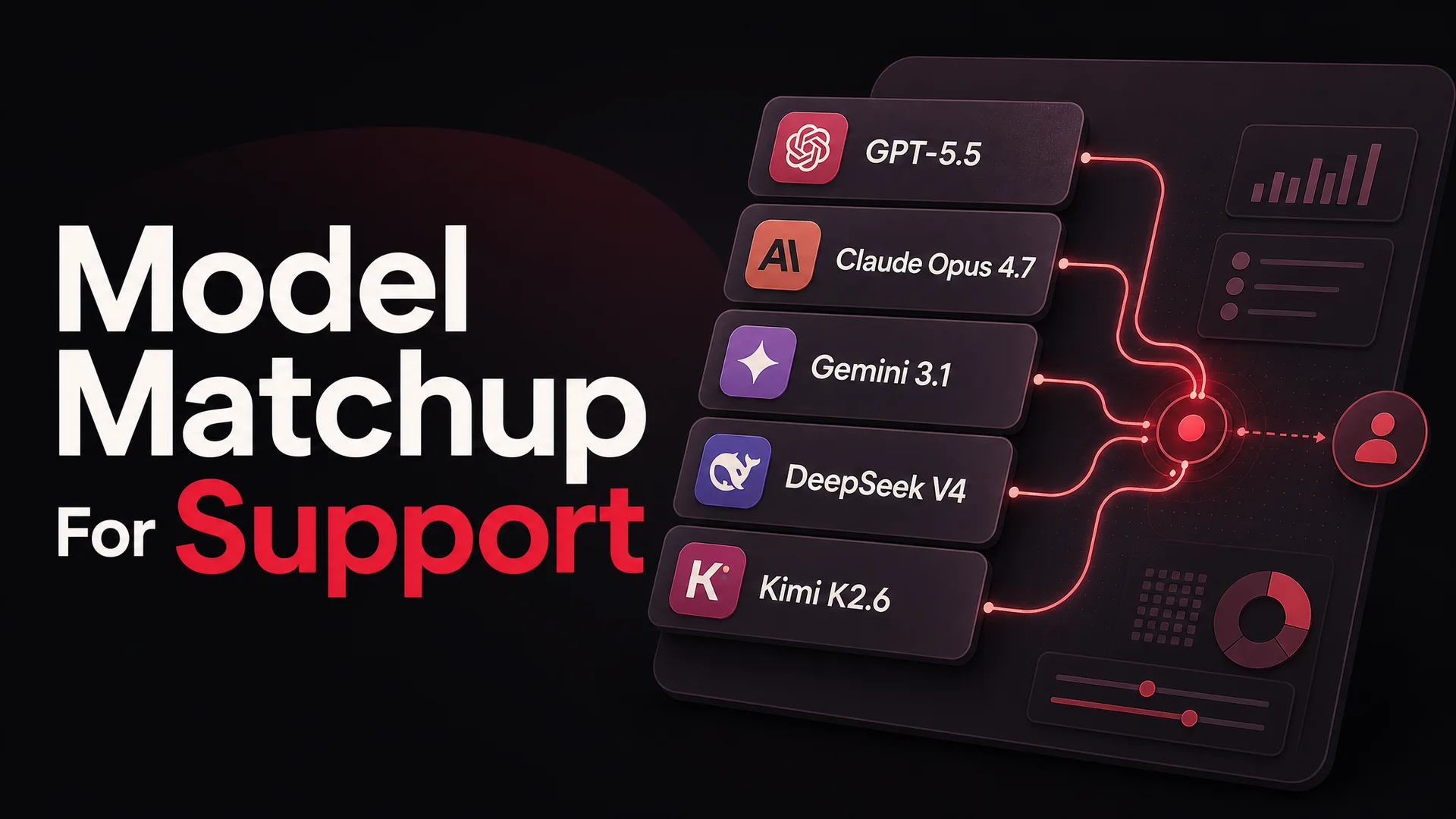
Instead of being a single chatbot you talk to, Berrydesk is an AI agent platform. You pick the model (GPT-5.5, Claude Opus 4.7, Gemini 3.1, DeepSeek V4, Kimi K2.6, GLM-5.1, Qwen 3.6, MiniMax M2.7, and others), train it on your sources - docs, websites, Notion, Google Drive, YouTube transcripts - brand the chat widget, wire up AI Actions for things like bookings or refunds, and deploy to your site, Slack, Discord, WhatsApp, and beyond.
The model-choice angle matters more in 2026 than it used to. With DeepSeek V4 Flash priced at $0.14 / $0.28 per million input/output tokens and MiniMax M2 running at roughly 8% the cost of Claude Sonnet at twice the speed, you can route routine support traffic through ultra-cheap open-weight models and keep Claude Opus 4.7 or GPT-5.5 in reserve for the genuinely hard escalations. That kind of cost control is impossible if your only option is a hosted chatbot's default model.
Best for: Companies that want a customer-facing or internal-facing AI built on their own data, with full control of model, branding, and where it shows up.
Free tier: Free plan to build and ship a working agent, with paid plans that scale with usage.
4. Microsoft Copilot
Copilot rides on the GPT-5.5 stack and is, for many users, the easiest way to get free access to OpenAI's frontier model. It comes with live web search baked in, free image generation, and image understanding - capabilities that ChatGPT's own free tier still meters more aggressively.
The bigger story is Microsoft 365 integration. Copilot inside Word, Excel, PowerPoint, Teams, and Outlook becomes a genuinely useful collaborator: rewriting an email thread, generating a deck from a doc, building a forecast model from raw data. Most of that lives in the paid Copilot Pro tier, but the free standalone chat is already strong enough to replace ChatGPT for a wide range of everyday tasks.
The catch is the surrounding UX - Copilot lives in Bing's product surfaces and inside Windows itself, which is convenient if you live in that ecosystem and slightly disorienting if you don't.
Best for: Free GPT-5.5-class answers with live web data, free image generation, and Microsoft Office users.
Free tier: Free with multimodal and web search. Copilot Pro at $20/month for 365 integration and priority access.
5. Perplexity
Perplexity remains the cleanest "answers with receipts" experience on the market. Every response cites the web pages it pulled from, which makes it the obvious choice for research, fact-checking, and any answer you might need to defend in a meeting.
In 2026, Perplexity acts more like an orchestration layer than a single-model product. You can pick which underlying model - GPT-5.5, Claude Opus 4.7, Gemini 3.1, DeepSeek V4, others - handles your query, and Perplexity wraps it with live web search, structured source extraction, and a "Spaces" workspace for grouping related research threads.
The new "Comet" agent mode, available on Pro, can run multi-step browsing tasks autonomously: comparing prices across vendors, pulling regulatory filings, building a competitor matrix. Free users still get a strong everyday research tool, just without the autonomous-agent extras and with a cap on advanced-model queries per day.
Best for: Research, fact-checking, citations, and anyone who finds undated, unsourced AI answers stressful.
Free tier: Daily usage with model rotation. Pro at $20/month for unlimited Pro Search and the Comet agent.
6. Mistral Le Chat
France's Mistral has stayed on the map by doing two things well: shipping fast, capable models, and not nickel-and-diming the free tier. Le Chat runs on Mistral's latest models, and is notably permissive about how much you can throw at it without hitting a wall.
Le Chat's strengths are math, multilingual reasoning, and concise European-style writing - fewer hedging caveats, less filler. It is also one of the faster chat experiences in raw token-per-second terms, which matters more than people admit when you're iterating on a draft.
For European teams there's also a sovereignty angle: Mistral hosts in the EU under EU law, which simplifies a lot of data-residency conversations.
Best for: Multilingual work, math and reasoning, EU-based teams, and anyone tired of strict free-tier message caps.
Free tier: Free with generous daily usage.
7. DeepSeek Chat
DeepSeek's hosted chat surface is interesting precisely because the model under it is so cheap to run. V4 Flash, the lighter of the two new V4 variants, is a 284B-parameter MoE with 13B active and a 1M-token context window - and its API pricing is $0.14 / $0.28 per million tokens. The free chat experience inherits all that capability.
DeepSeek's reasoning mode is genuinely strong: it leans into chain-of-thought style responses, shows its work, and tends to outperform expectations on math, code, and structured logic. The downside is that, like other Chinese-hosted services, the data-handling story is its own conversation; many enterprise users prefer to consume DeepSeek through a third-party host or self-deploy the open weights.
Best for: Math, code, reasoning, and a free taste of frontier-class output without queuing.
Free tier: Free chat access; open weights for self-hosting.
8. Moonshot Kimi (K2.6)
Kimi K2.6, released in April 2026, is the most aggressively agentic model in the open-weight pack - built for long-horizon tasks rather than one-shot answers. It can run 12-hour autonomous coding sessions, coordinate swarms of up to 300 sub-agents across 4,000 steps, and handles native video input.
For a chat user, that translates into something subtler: K2.6 is unusually good at multi-step requests where the answer requires planning, using tools, and stitching together sub-results. Ask it to research a topic, draft an outline, write each section, and reconcile contradictions across sources, and it will actually do all four in one go rather than stopping after step one.
The hosted Kimi chat is free in most regions, with a long context window that comfortably swallows full PDFs and codebases.
Best for: Multi-step tasks, agentic workflows, video input, and long-running research.
Free tier: Free hosted chat; open weights.
9. Z.ai Chat (GLM-5.1)
Z.ai (formerly Zhipu) released GLM-5.1 in April 2026 - a 754B-parameter MoE under an MIT license that posts 58.4 on SWE-Bench Pro, beating both GPT-5.4 and Claude Opus 4.6 on that specific benchmark. It was trained entirely on Huawei Ascend 910B silicon, with no Nvidia in the loop, which is a quietly significant data point about where the supply-chain story is going.
The hosted Z.ai chat is a clean, Western-friendly surface on top of GLM-5.1. The model is engineering-leaning - it shines on code, structured output, and an 8-hour autonomous plan-execute-test-fix loop that's essentially a junior dev in a box.
Best for: Coding, agentic engineering tasks, and teams evaluating MIT-licensed models for self-hosting.
Free tier: Free hosted chat; open weights under MIT.
10. Qwen Chat (Alibaba)
Alibaba's Qwen 3.6 family has quietly become one of the most respected open-source lineups for everyday use. Qwen3.6-27B (dense, Apache 2.0) outperforms several 397B-parameter MoE rivals on agentic coding benchmarks, and Qwen3.6-35B-A3B is a strong open MoE option that runs comfortably on a single high-end workstation.
The hosted Qwen Chat surface gives you free access to the proprietary Qwen3.6-Plus and a preview of Qwen3.6-Max - Alibaba's top-tier coding-focused models that sit in the top six on most coding benchmarks. The chat UI itself supports document upload, image understanding, and image generation, all in the free tier.
Best for: Coding, multilingual work (especially Asian languages), and anyone evaluating models for a future on-prem deployment.
Free tier: Free hosted chat; open weights for the 27B and 35B-A3B variants.
11. Pi (Inflection)
Pi remains the outlier - the chatbot built less to be the most powerful and more to be the most pleasant to talk to. It's tuned for warm, conversational back-and-forth, asks thoughtful follow-ups, and resists the impulse to dump a 12-bullet list when a paragraph would do.
That makes Pi unexpectedly useful for thinking out loud: brainstorming, talking through a hard decision, or untangling a stuck feeling. It is not the right tool when you need a code review or a citation. It is the right tool when you want a calm interlocutor at 11 p.m.
Best for: Brainstorming, journaling, talking through problems, and anyone who finds other chatbots clinical.
Free tier: Completely free.
12. Poe (Quora)
Poe is a meta-platform: instead of one model, it gives you a unified chat surface to talk to dozens, including GPT-5.5, Claude Opus 4.7, Gemini 3.1, Mistral, DeepSeek V4, Kimi K2.6, and a long tail of community-built bots. You can switch models mid-conversation and even run the same prompt against multiple models side-by-side.
For someone trying to figure out which model fits which task, Poe is the cheapest evaluation harness on the market. The free tier rotates daily message budgets across the major models, and Poe's bot directory is full of niche specialists - for code, image generation, role-play, study help - built on top of those underlying models.
Best for: Comparing models, experimenting with niche bots, and staying on top of new releases without signing up everywhere.
Free tier: Daily quotas across many models; subscription for unlimited.
How to actually pick one
Reading a list like this is the easy part. Picking is harder. A few rules of thumb that hold up in 2026:
- For day-to-day writing and analysis: Claude (Sonnet 4.6 free, Opus 4.7 paid) is the safest default.
- For research where currency matters: Gemini 3.1 or Perplexity - Gemini if you want generation depth, Perplexity if you want citations.
- For free GPT-5.5 access: Microsoft Copilot, full stop.
- For coding and agentic work: Claude Opus 4.7 if you can pay; Kimi K2.6, GLM-5.1, or Qwen 3.6 if you want open and free.
- For "I want to talk to it": Pi.
- For "I want to compare them all": Poe.
- For building something other people will use: Berrydesk.
A few things to watch out for
The 2026 free-tier landscape is generous, but it's not a free lunch. A few traps worth flagging:
Free tiers move. Today's "unlimited" is tomorrow's 50-message-per-day cap. If a workflow becomes load-bearing, plan for the day the free tier tightens - either by paying, by switching providers, or by routing through an API you control.
Data handling varies. Some free chatbots train on your conversations by default. Most let you opt out, but the toggle is usually buried. If you're pasting in anything sensitive - customer data, code under NDA, internal strategy - read the data settings before you start.
Open-weight ≠ neutral. "Open" tells you about the license, not the training data. Several frontier open-weight models from China have well-documented topical avoidances. That's fine for a coding assistant; less fine for a journalism tool. Match the model's biases to the work.
Benchmarks lie at the edges. A model that leads on SWE-Bench Pro is not necessarily the best at writing your support emails. Run your own three or four representative prompts across the shortlist before committing.
The shift worth noticing
The honest story of 2026 isn't "ChatGPT has competitors" - it has had those for years. It's that the gap between the best free tool and the best paid tool has closed dramatically, and the gap between Western closed-frontier models and Chinese open-weight ones has closed even more.
For an end user, that means you can probably get most of what you need without paying anyone. For a builder, it means the question has shifted from "which model is best?" to "which combination of models, routed by which logic, fits my product?"
That second question is what Berrydesk exists to answer. If you've been using ChatGPT to draft support replies and you're ready to put a real agent in front of your customers - one trained on your docs, branded as you, running on the model that fits each query, taking actions like booking and refunds on its own - start building one for free at berrydesk.com. Pick your model, point it at your knowledge base, drop the widget on your site, and you'll be live before lunch.
 Berrydesk
Build a branded AI support agent on the model of your choice
- Pick from GPT-5.5, Claude Opus 4.7, Gemini 3.1, DeepSeek V4, Kimi K2.6, GLM-5.1, Qwen, MiniMax and more
- Train on your docs, brand the widget, and deploy to web, Slack, WhatsApp and Discord in one afternoon
Set up in minutes

Chirag Asarpota is the founder of Strawberry Labs, the team behind Berrydesk - the AI agent platform that helps businesses deploy intelligent customer support, sales and operations agents across web, WhatsApp, Slack, Instagram, Discord and more. Chirag writes about agentic AI, frontier model selection, retrieval and 1M-token context strategy, AI Actions, and the engineering it takes to ship production-grade conversational AI that customers actually trust.