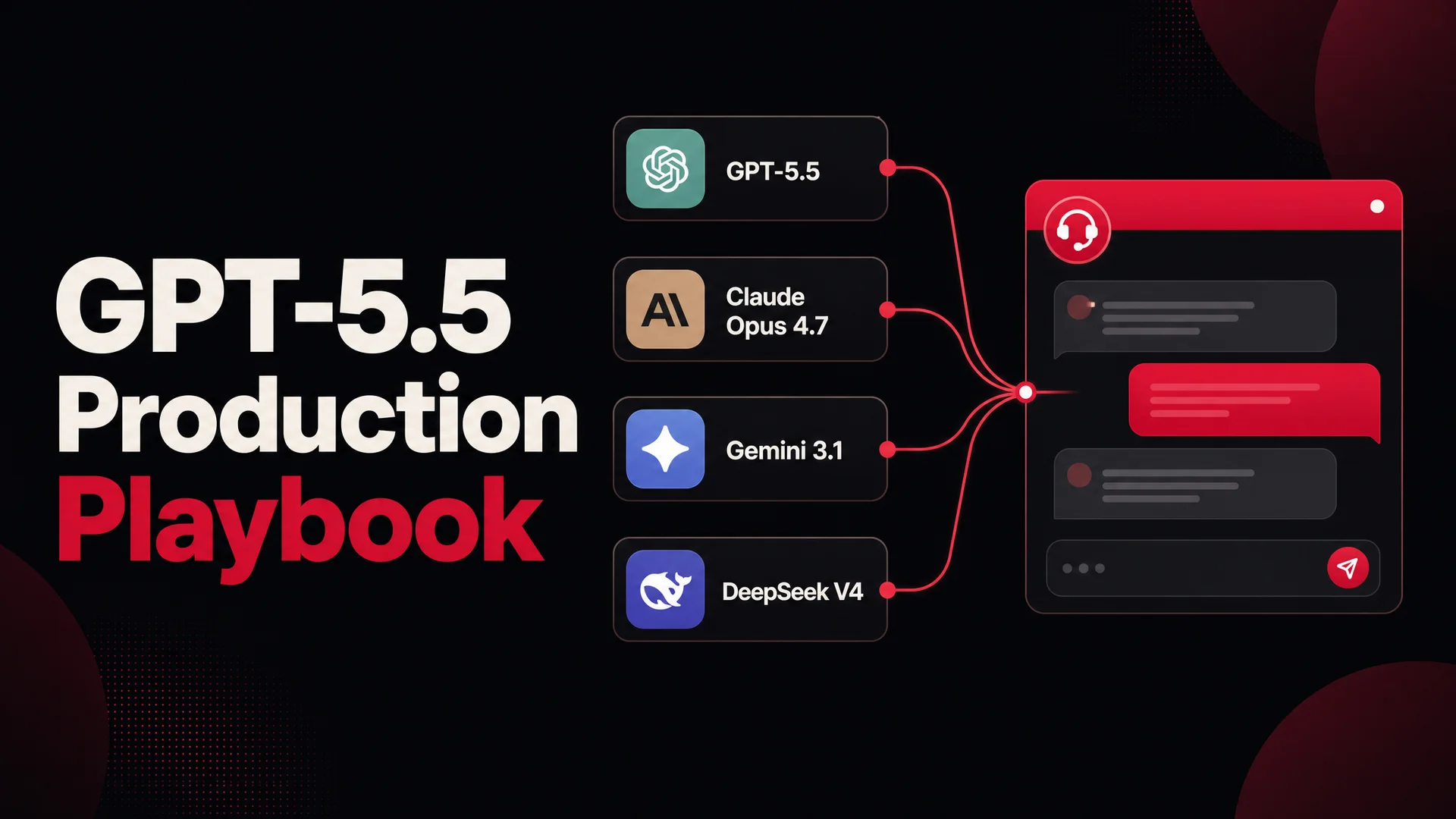
OpenAI's GPT family is no longer one model - it is a small product line with very different jobs.
There is a flagship for hard reasoning, a parallel-reasoning variant for multi-step agentic work, a coding-tuned stack underneath Codex, and a steady drumbeat of smaller siblings tuned for cost. If you run a support team, the question is no longer "should we use GPT?" - it is "which GPT, when, and against which alternative?"
This guide walks the current lineup as of May 2026, sketches how we got here, and shows how GPT compares against the Claude, Gemini, and the open-weight frontier you will inevitably weigh it against. We end with the part most articles skip: how to actually pick a model for production support without drowning in benchmark charts.
How we got to GPT-5.5
It is hard to make sense of the current OpenAI lineup without a quick look at how it arrived.
The pre-GPT-4 era - GPT-3 and GPT-3.5 - was the moment language models stopped being a research curiosity and started showing up in product roadmaps. GPT-3.5 Turbo, in particular, became the default first chatbot for thousands of companies because it was cheap, fast, and good enough to reword help-center articles in a friendly tone.
GPT-4, released in early 2023, was the first model that could reliably reason its way through a multi-step support case rather than pattern-match to one. It was slow and expensive, so most teams used it sparingly, falling back to GPT-3.5 for the bulk of traffic. The pattern of "expensive smart model + cheap fast model" was set right there, and it has only deepened since.
GPT-4 Turbo and GPT-4o softened that tradeoff. Turbo dropped costs roughly 3x while keeping the intelligence; 4o made the model natively multimodal across text, images, and audio, and dropped latency far enough that you could run a real-time voice agent without it sounding like a long-distance call. GPT-4o Mini followed as the budget tier, and OpenAI began branching the lineup with reasoning-focused o-series models tuned for math, code, and structured analysis.
The GPT-5 generation - 5.0 through 5.4 - pushed the frontier on long-context reasoning and tool use. GPT-5.4 is what most production teams ran through the back half of 2025, and it is still in service in plenty of stable deployments. The leap to GPT-5.5, released April 2026, is less about raw IQ and more about how the model thinks: in parallel, with tools, over hours instead of seconds.
GPT-5.5: what April 2026 actually changed
GPT-5.5 is the current flagship as of writing. The headline change is parallel reasoning: rather than producing a single chain of thought, the Pro variant explores multiple reasoning branches concurrently and reconciles them, which is most visible on multi-step problems where the first plausible answer is often wrong.
For support workloads, the practical wins look like this:
- Long, messy conversations stay coherent. GPT-5.5 holds context across a full support thread - including agent escalations, attached order data, and prior tickets - without the "wait, what were we talking about?" drift that earlier GPTs hit around the 50th turn.
- Tool calls are more deliberate. When the model decides to look up an order, refund a payment, or escalate to a human, it does so with fewer spurious calls and better recovery when a tool fails. This matters more than benchmark scores for any agent that runs AI Actions.
- Multimodal inputs are first-class. Customers paste screenshots of broken checkouts, error states, or PDFs of receipts, and the model treats them as part of the conversation rather than a side channel.
OpenAI has not published a parameter count, and frankly it does not matter. The number to compare against is Claude Opus 4.7's 64.3% on SWE-bench Pro, which leads complex coding, while GPT-5.5 holds the top of OpenAI-internal evals and several reasoning leaderboards. For pure agentic engineering tasks, GLM-5.1 (58.4) and Kimi K2.6 (58.6) have closed the gap dramatically - more on that below.
GPT-5.5 Pro
GPT-5.5 Pro is not a "longer thinking" toggle; it is a different inference path that runs multiple reasoning streams in parallel and then merges them. The cost is real - Pro is meaningfully more expensive per query and slower to first token - and it is wasted on simple intent classification or polite rephrasing of a help article.
Where it earns its keep:
- Triage cases where the answer depends on combining policy, account state, and the customer's actual question.
- Refund and dispute decisions where a wrong answer is expensive and a right answer is non-obvious.
- Internal copilots for senior support agents who want a second opinion on a complex case before they reply.
In a routed support stack, Pro is your escalation tier, not your default.
Codex on the GPT-5 stack
Codex sits on top of the GPT-5 stack and is OpenAI's coding-tuned variant. It is not directly relevant to most support deployments, but it matters indirectly: when your engineering team builds the integrations that feed your support agent - the order-lookup function, the refund tool, the CRM webhook - Codex (alongside Claude Opus 4.7 and Kimi K2.6) is what is increasingly writing that glue code. Faster, more reliable integration code means faster feature shipping for your support stack.
The smaller GPT-5.5 tier
Not every conversation needs a frontier model. OpenAI has continued to ship smaller, cheaper variants in the GPT-5.5 family aimed at high-volume traffic - the FAQ-style questions, the "where is my order?" pings, the simple intent routing. For these jobs, you want a model that responds in well under a second and costs cents per thousand interactions, not dollars.
The pattern most production support teams settle on is a two-tier setup: a small model handles the long tail of routine questions and only escalates to the flagship when it is uncertain or the conversation gets complicated. This is the same shape Anthropic encourages with Sonnet 4.6 (which now ships with a 1M-token context at no surcharge, by the way) and the open-weight world has taken even further.
How GPT-5.5 compares to the rest of the frontier
A guide that only covers GPT in 2026 is a guide that ignores the actual decision support teams have to make. Here is the honest comparison.
GPT-5.5 vs Claude Opus 4.7 and Sonnet 4.6
Anthropic's Claude Opus 4.7 currently leads SWE-bench Pro at 64.3%, which translates in practice to a model that is unusually careful about getting the details right on complex tasks. For support, this shows up as fewer fabricated policy details, better adherence to nuanced tone instructions, and a noticeably lower rate of confidently-wrong answers on edge cases.
Claude Sonnet 4.6 and Opus 4.6 ship with a 1M-token context window at no surcharge, which is a quiet but enormous deal: you can stuff your entire help center, every product changelog from the last two years, the customer's full ticket history, and your internal escalation playbook into the prompt and still have room. Retrieval-augmented generation becomes a tuning lever for performance, not a hard architectural requirement.
GPT-5.5 wins on parallel reasoning depth and on the ecosystem of tools and integrations around the OpenAI platform. Claude wins on long-context comfort and on the kind of careful, hedged answers that regulated industries prefer. Most teams running both end up routing by case type rather than picking one winner.
GPT-5.5 vs Gemini 3.1 Ultra and Pro
Google's Gemini 3.1 Ultra has a 2M-token context and is natively multimodal across text, image, audio, and video - meaning it actually watches a video clip of a customer's broken UI and reasons about what is happening, rather than transcribing audio and stitching things together. Gemini 3.1 Pro leads GPQA Diamond at 94.3%, which is a fancy way of saying it is very good at PhD-level reasoning across domains.
For support agents that handle screen recordings, voice messages, or video tutorials inside the conversation, Gemini's native video handling is the cleanest experience on the market. For text-and-screenshot support - still the bulk of CX traffic - GPT-5.5 and Claude are stronger.
GPT-5.5 vs the open-weight frontier
This is the biggest shift since the last time anyone wrote a "GPT models guide." The open-weight world has, in roughly twelve months, gone from "useful for hobbyists" to "directly competitive on the workloads that drive your bill."
- DeepSeek V4 (April 2026) ships in two sizes: V4 Pro is a 1.6T-parameter MoE with 49B active, V4 Flash is 284B with 13B active. Both have 1M-token context. V4 Flash is priced at $0.14 per million input tokens and $0.28 per million output tokens - roughly an order of magnitude cheaper than GPT-5.5 for many traffic patterns. It is open source.
- Moonshot Kimi K2.6 (April 2026) is a 1T-parameter MoE built agentic-first. It can run 12-hour autonomous coding sessions, coordinate up to 300 sub-agents and 4,000 steps, and scores 58.6 on SWE-Bench Pro. Open weights. For complex multi-step support automations - the kind where the agent needs to investigate, decide, act, verify, and follow up - Kimi punches well above its price tier.
- Z.ai's GLM-5.1 (April 2026) is a 754B-parameter MoE under MIT license that scores 58.4 on SWE-Bench Pro, beating GPT-5.4 (57.7) and Claude Opus 4.6 (57.3). It runs an 8-hour autonomous plan-execute-test-fix loop and was trained entirely on Huawei Ascend 910B chips - relevant for any team thinking about supply-chain risk on their AI vendor.
- Alibaba Qwen 3.6 ships a dense 27B model under Apache 2.0 that beats 397B-parameter MoE rivals on agentic coding benchmarks, plus a 35B-A3B open MoE and proprietary Plus and Max-Preview tiers. The 27B variant is the cleanest local-deploy story on the market right now.
- MiniMax M2.7 is a 230B / 10B-active open MoE priced at roughly 8% the cost of Claude Sonnet at 2x the speed, hitting 56.22% on SWE-Pro and 57.0% on Terminal Bench 2. Self-evolving agent model.
- Xiaomi MiMo-V2-Pro (open-sourced under MIT in April 2026) is over 1T total parameters with 42B active and 1M context, reasoning-first and agentic.
The headline isn't that any one of these dethrones GPT-5.5. It is that for routine support traffic, you can route to an open-weight model at a small fraction of the cost and reserve GPT-5.5 (or Claude Opus 4.7, or Gemini 3.1 Ultra) for the cases that actually need a frontier model. That is the cost story that is reshaping support deployments in 2026.
Pricing math for a real deployment
Let's make this concrete. Assume a mid-sized SaaS support operation: 100,000 conversations per month, average 8 turns per conversation, around 2,000 tokens in and 600 tokens out per turn.
If you route every conversation to a frontier model, your monthly token bill lives in the high four to low five figures. If you route 80% of traffic to DeepSeek V4 Flash or MiniMax M2.7 - the easy "where is my order, when do you ship to Canada, how do I reset my password" cases - and only the remaining 20% to GPT-5.5 or Claude Opus 4.7, your bill drops by something like 60-80%, and the 20% that goes to the frontier model gets a richer prompt because you can spend the savings on more context.
This is why model-routing is no longer optional infrastructure for serious support teams. It is the difference between an AI agent that pays for itself and one that quietly inflates your COGS.
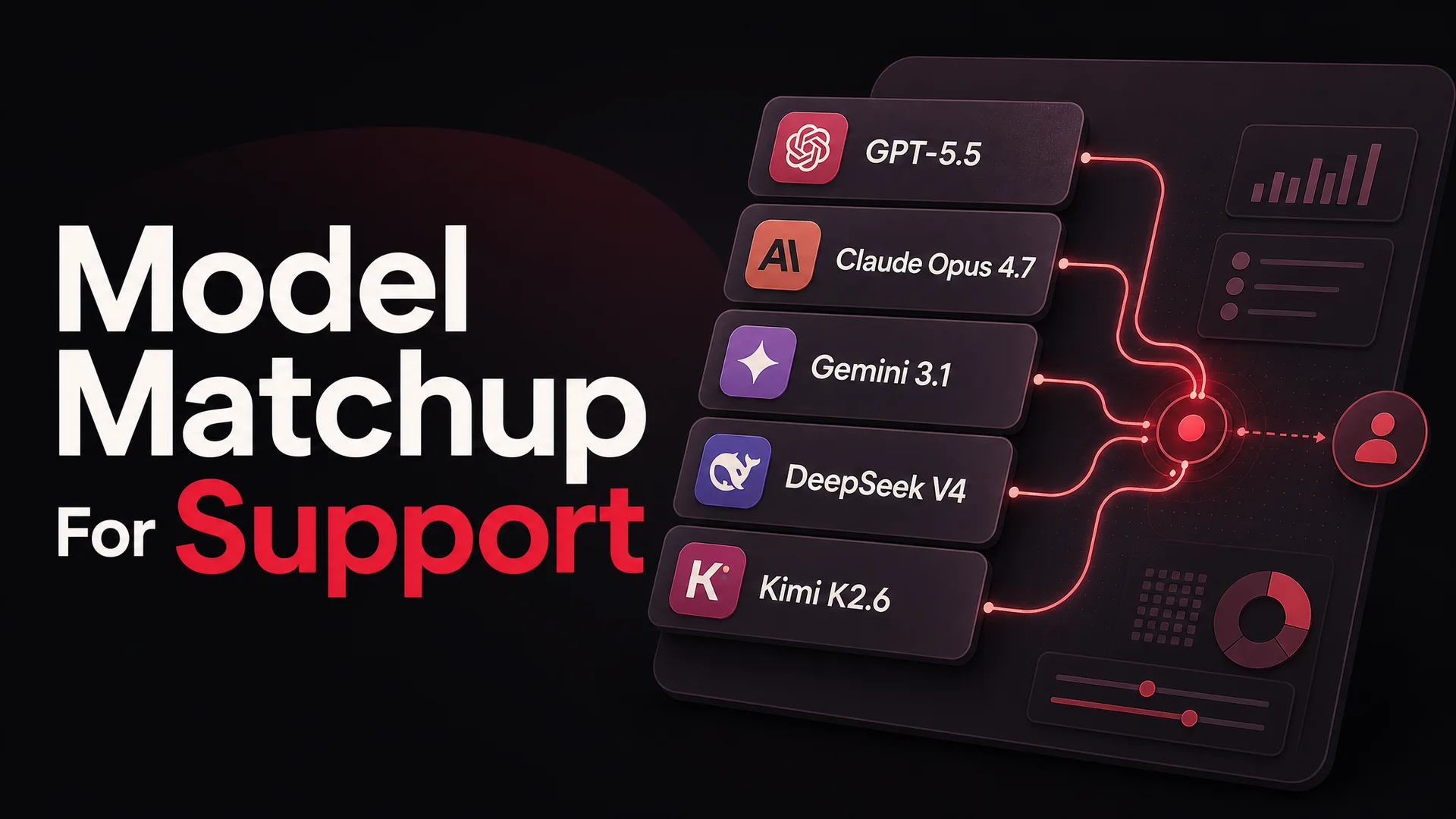
Choosing the right model - by job, not by name
The temptation is to pick a single model and call it a day. The teams running the best AI support today don't do that. They pick by job:
Intent classification and routing
Cheap, fast, local-friendly. Qwen 3.6-27B or DeepSeek V4 Flash do this well at very low cost. You don't need GPT-5.5 to decide whether a message is a billing question or a shipping question.
FAQ and "where is my order" traffic
Same tier. The model has to read the question, look up the answer in your knowledge base or via a tool call, and respond in a friendly tone. DeepSeek V4 Flash, MiniMax M2.7, and the smaller GPT-5.5 variants all handle this beautifully.
Multi-step agentic work - refunds, bookings, cancellations
Now you want a model that is good at tool use. GPT-5.5, Claude Opus 4.7, Kimi K2.6, and GLM-5.1 are the strong picks. Kimi and GLM in particular have been built for this; they recover gracefully when a tool returns an unexpected error and they don't fabricate fields when the schema is missing data.
Hard escalations and sensitive cases
The frontier tier. GPT-5.5 Pro, Claude Opus 4.7, or Gemini 3.1 Ultra. Use parallel reasoning, long context, and the most careful tone instructions. These are also the cases where you most want a human in the loop, and a smart model is the difference between a clean handoff and a confused customer.
Multimodal cases - screenshots, video, voice
Gemini 3.1 Ultra for video-heavy workloads. GPT-5.5 or Claude Opus 4.7 for screenshot and audio. Don't try to bolt vision onto a text-only model in 2026; the natively multimodal stacks are meaningfully better.
On-prem or air-gapped deployments
If you cannot send data to a third-party API - health, defense, finance, certain regulated EU workloads - you are looking at the open-weight world. Qwen 3.6-27B (Apache 2.0), GLM-5.1 (MIT), and MiMo-V2-Pro (MIT) are the cleanest on-prem stories. The Apache and MIT licensing matters: you can ship them inside your product without legal review the size of a small novel.
Common pitfalls when picking GPT (or anything else)
A few traps we see often:
Picking the smartest model for everything. Frontier models are overqualified for 80% of support traffic and you pay for it on every turn. Route.
Picking the cheapest model for everything. The flip side - running every escalation through a cheap model and watching CSAT collapse on the cases that actually mattered. Route in both directions.
Treating context as free. A 1M-token context window doesn't mean you should stuff a million tokens into every prompt. You pay per token, and very long prompts measurably slow first-token latency. Use long context for the cases that need it, not as a default.
Benchmark-shopping. SWE-Bench Pro is a coding benchmark. GPQA Diamond is a science benchmark. Neither tells you how a model handles "I was double-charged and I want a refund and I'm angry." Test on your traffic, with your tone instructions, against your actual policies.
Ignoring tool reliability. A model that scores 60 on agentic benchmarks but fails 5% of your refund-tool calls is worse for your business than one that scores 55 and fails 0.5%. The tail of failures is what determines whether your AI Actions ship.
Locking in a single vendor. The frontier moves every few weeks. The model you pick today is unlikely to be the right model in six months. Build a routing layer and treat the model choice as a tuning knob, not a commitment.
How Berrydesk handles this
Berrydesk is built around the assumption you'll want to switch and mix models. When you launch an agent, you pick from GPT, Claude, Gemini, DeepSeek, Kimi, GLM, Qwen, MiniMax, and several others - not as a one-time choice, but as a routing decision you can revisit at any time.
You train the agent on your docs, websites, Notion, Google Drive, or YouTube content; brand the chat widget; wire up AI Actions for bookings, refunds, payments, and order lookups; and deploy to your website, Slack, Discord, WhatsApp, or wherever your customers live. The model behind it is a setting, not an architecture decision - which means when GPT-5.6 ships, or when the next open-weight release outperforms your current default, you flip a switch instead of refactoring.
If you've been holding off on AI support because the model landscape moves too fast to commit to one, that's the gap Berrydesk is built to close. Build a free agent at berrydesk.com and you can have GPT-5.5 (or any of the alternatives above) answering your customers in the time it takes to read this article twice.
 Berrydesk
Ship a GPT-powered support agent without juggling model APIs
- Pick GPT-5.5, Claude Opus 4.7, Gemini, DeepSeek V4, Kimi K2.6, or any of nine model families per use case.
- Train on your docs, route by intent, and deploy to web, Slack, WhatsApp, and Discord in minutes.
Set up in minutes

Chirag Asarpota is the founder of Strawberry Labs, the team behind Berrydesk - the AI agent platform that helps businesses deploy intelligent customer support, sales and operations agents across web, WhatsApp, Slack, Instagram, Discord and more. Chirag writes about agentic AI, frontier model selection, retrieval and 1M-token context strategy, AI Actions, and the engineering it takes to ship production-grade conversational AI that customers actually trust.