OpenAI's GPT-5.5 and GPT-5.5 Pro shipped in April 2026 with parallel reasoning, deeper tool-use, and a sharper coding profile than anything that came before them on the OpenAI stack. Most teams either can't tell which tier they actually need, overpay for Pro when standard handles the workload, or under-provision and end up rate-limited at the worst possible moment.
This guide walks through every meaningful way to reach GPT-5.5, what each tier costs, where GPT-5.5 genuinely wins, where it loses to Claude Opus 4.7 or Gemini 3.1 Ultra, and how to wire it into a production customer support agent in roughly the time it takes to drink a coffee.
What you'll get out of it:
- A clear breakdown of free, Plus, Pro, Team, Enterprise, and API access.
- A direct comparison of GPT-5.5 against the rest of the May 2026 frontier - Claude Opus 4.7, Gemini 3.1 Ultra, DeepSeek V4, GLM-5.1, Kimi K2.6, and Qwen 3.6.
- The use cases where GPT-5.5 is the right answer, and the ones where you're better off routing elsewhere.
- A concrete blueprint for shipping a GPT-5.5-powered support agent on Berrydesk.
What GPT-5.5 actually is
GPT-5.5 is OpenAI's flagship reasoning model as of April 2026. The headline feature is parallel reasoning: instead of producing a single chain of thought, the model can fan out across multiple lines of attack, evaluate them, and converge on the strongest one. The Pro variant pushes that further with longer rollouts and more aggressive verification, which is the difference between "it usually gets the right answer" and "it gets the right answer on the kind of question that used to need a senior engineer."
The other change worth understanding is the unification of OpenAI's product lineup. Codex, ChatGPT, and the assistants API all sit on top of the GPT-5 stack now. You no longer have to pick between a chat-tuned and a coding-tuned model - the routing is internal, and it picks reasoning depth based on the request.
Three modes are exposed to end users:
- Auto - fast responses for everyday queries, the default for free and Plus users.
- Thinking - extended deliberation for complex reasoning, available on Plus and above.
- Pro - parallel reasoning at full strength, for the hardest scientific, mathematical, and engineering work. Pro-tier subscription only.
If you've used the older GPT-5.0 through 5.4 line, the practical upgrade is in three places: more reliable tool use inside agentic loops, better calibration on when to think harder, and significantly cheaper inference at the standard tier than the previous generation offered.
How to access GPT-5.5
GPT-5.5 reaches you through five different surfaces. Most teams end up using two or three of them at once.
Free access via ChatGPT
You can use GPT-5.5 in Auto mode for free at chatgpt.com or via the iOS and Android apps. It's a real production model, not a stripped-down preview, but the rate limits bite quickly - usually within a dozen messages during peak hours, and OpenAI publishes the exact numbers reluctantly and changes them often.
The free tier is fine for occasional drafting, search, and quick code questions. It's not enough to build a workflow around. If you find yourself opening ChatGPT more than a couple of times a day, the math points at Plus.
ChatGPT Plus ($20/month)
Plus is the sweet spot for individual professional use. You get materially higher message limits, priority routing during peak hours, access to Thinking mode, image and file uploads, voice mode, and the agent features that OpenAI rolls out to consumer subscribers first. For most knowledge workers - writers, analysts, marketers, mid-level engineers - Plus is enough. You're not running batch jobs or building products; you're using GPT-5.5 as a co-pilot.
ChatGPT Pro ($200/month)
Pro is for people who hit Plus limits weekly. You get effectively unlimited GPT-5.5 access, the GPT-5.5 Pro model with its full parallel reasoning rollouts, the longest context windows OpenAI offers on the consumer surface, real-time voice, and the strongest research-grade tools. If you're a senior engineer, a researcher, a quantitative analyst, or anyone whose default question to the model is hard, Pro pays for itself the first time it untangles a problem that would have eaten an afternoon.
The honest tradeoff: most users do not need Pro. If you're spending $200/month and Plus would have done the job, you're paying for headroom you don't use. The way to know is simple - try Plus for a month and see how often you bounce off its ceiling.
ChatGPT Team and Enterprise
Team starts at around $25–$30 per seat per month and gives you a shared workspace, admin controls, and the assurance that your conversations and uploads aren't used for training. Enterprise adds SSO, SCIM, audit logs, longer context windows, custom data residency, and the procurement-friendly contracts that legal departments need. If you're rolling out GPT-5.5 across more than a handful of people, Team or Enterprise is the only reasonable path - Plus or Pro on individual cards is a compliance liability waiting to happen.
API access
For anyone building products on top of GPT-5.5 - including support agents, internal tools, and developer assistants - the API is the only access path that matters. Sign up at platform.openai.com, generate a key, and you're hitting chat/completions and the responses endpoints with whichever GPT-5.5 variant fits your traffic and budget. Pricing is per token, and the model lineup is tiered so you can match cost to task complexity.
No-code access via Berrydesk
If your goal is to stand up a GPT-5.5-powered support agent rather than to write code, Berrydesk handles the plumbing. You pick GPT-5.5 from the model selector, point the agent at your docs, websites, Notion workspaces, Google Drive, or YouTube content, brand the widget, wire up AI Actions for booking and payments, and deploy to your site, Slack, Discord, or WhatsApp. No prompt engineering scaffolding, no vector store config, no auth glue.
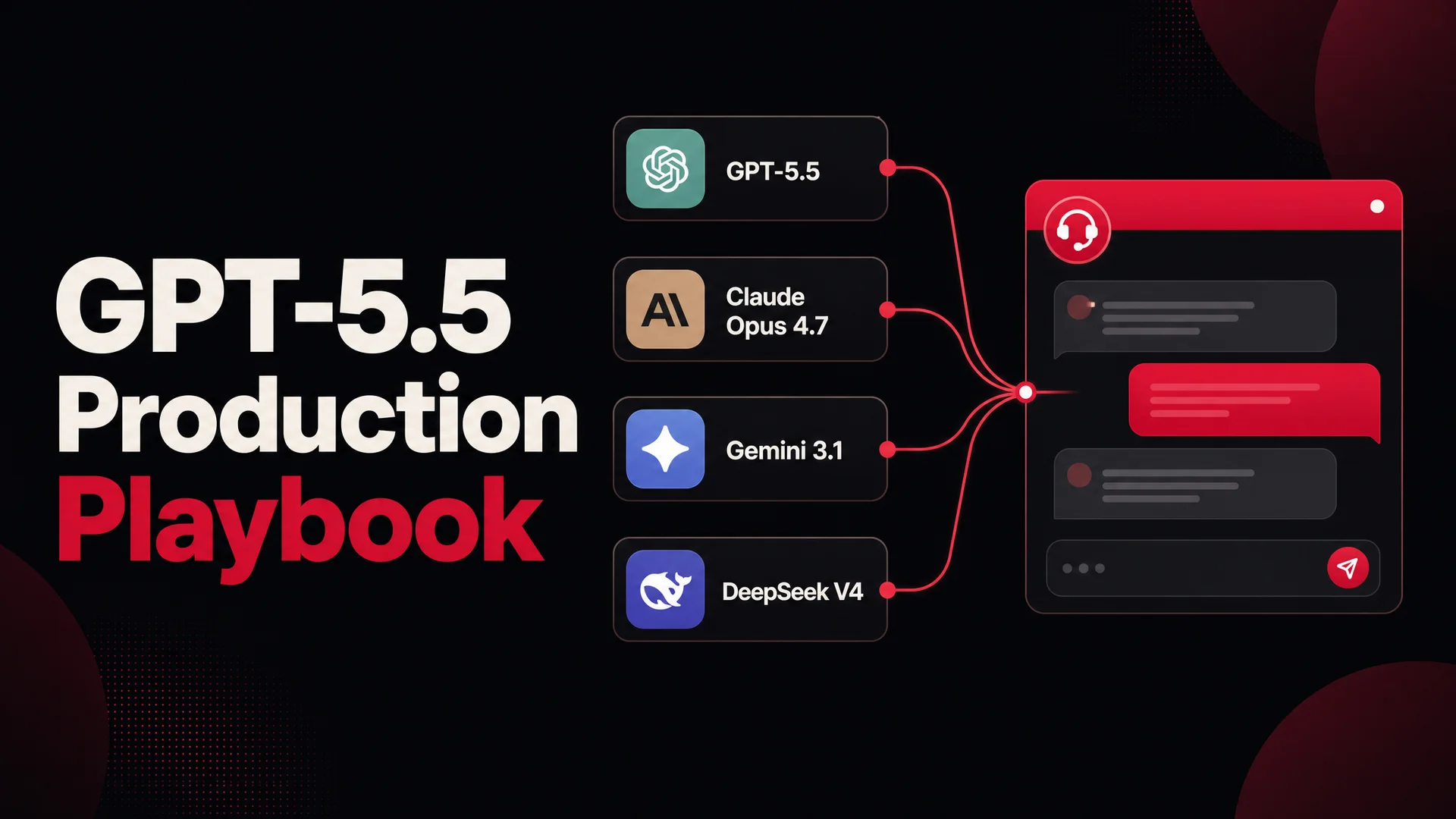
The same setup also lets you run GPT-5.5 alongside Claude Opus 4.7, Gemini 3.1, DeepSeek V4, Kimi K2.6, GLM-5.1, Qwen, or MiniMax - useful if you want to route routine traffic to a cheap open-weight model and reserve GPT-5.5 Pro for escalations.
GPT-5.5 API models compared
OpenAI exposes three GPT-5.5 variants through the API. The right choice depends on whether you're optimizing for capability, balance, or cost per resolution.
GPT-5.5 / GPT-5.5 Pro (frontier tier)
The full reasoning model with parallel rollouts on the Pro variant. This is what you reach for when the task involves nontrivial code, multi-step planning across tools, or analysis that has to be right rather than approximate. It's the most expensive option per token, but it's also the one that finishes hard work in a single pass instead of forcing you to retry.
GPT-5.5 mini
A smaller, faster, cheaper sibling that handles the long tail of general-purpose tasks - chat, summarization, basic Q&A, light coding, content generation. It loses some ground on the hardest reasoning problems but stays close enough that for most production agents it is the workhorse, with the full model held in reserve for escalations.
GPT-5.5 nano
Designed for high-volume, low-complexity tasks: classification, intent detection, lightweight extraction, routing decisions, and the kind of millions-of-calls-per-day workloads where every fraction of a cent matters. You should not point nano at anything that requires real reasoning. You should point it at everything that doesn't.
A practical pattern: nano routes incoming messages to an intent, mini handles the conversation, and full GPT-5.5 (or GPT-5.5 Pro) gets called only when the ticket actually needs deep reasoning or a complicated tool sequence. On Berrydesk this is a single config change, not a rebuild.
Where GPT-5.5 is the right model
Coding and engineering work. GPT-5.5 is competitive with Claude Opus 4.7 on most coding tasks and edges ahead on others, particularly anything involving the broader OpenAI tooling stack - Codex, the responses API, and the official agents framework. Pro's parallel reasoning is the single biggest improvement for hard debugging, where a chain of thought that goes down a wrong path early can waste an entire response.
Long-context analysis. With context windows that comfortably absorb a full product spec, the past month of support tickets, and your entire policy library at the same time, GPT-5.5 turns retrieval into a tuning lever rather than a hard requirement. For support, that means an agent that can answer "what's the status of order 4421 given the conversation in this thread and our refund policy?" without a brittle vector pipeline in the middle.
Multimodal reasoning. GPT-5.5 handles images, files, and voice in the same conversation, with strong adherence to instructions about how to use them. Gemini 3.1 Ultra is still the leader on native multimodal across video and audio, but GPT-5.5 is more than capable of interpreting screenshots, parsing receipts, reading charts, and walking through diagrams.
Tool use inside agentic loops. This is where parallel reasoning actually pays off in production. When an agent has to call three or four tools in sequence - look up an order, check return eligibility, calculate a refund, create the ticket - GPT-5.5 Pro is markedly more reliable than the previous generation at not getting confused halfway through.
Where GPT-5.5 is not the right model
Hardest-of-the-hard coding. Claude Opus 4.7 currently leads SWE-bench Pro at 64.3%, with Kimi K2.6 at 58.6, GLM-5.1 at 58.4, and MiniMax M2.7 at 56.2. If your workload is dominated by complex software engineering tasks, Opus 4.7 is the safe default and Kimi K2.6 is the open-weight alternative worth testing.
Pure scientific Q&A. Gemini 3.1 Pro tops GPQA Diamond at 94.3%. For graduate-level science questions, Gemini still has the edge.
Cost-per-resolution at scale. This is where the open-weight frontier rewrites the economics. DeepSeek V4 Flash runs at $0.14 / $0.28 per million input/output tokens - roughly an order of magnitude below GPT-5.5 - and MiniMax M2 lands around 8% the price of Claude Sonnet at twice the speed. For routine support traffic where the answer lives in your docs, you do not need a frontier reasoning model. You need a cheap, fast, capable model with a 1M-token context window. DeepSeek V4 Flash, MiniMax M2.7, and Qwen 3.6 all fit.
Air-gapped or fully on-prem deployments. GPT-5.5 is API-only. If you're in a regulated industry that needs the model running inside your own VPC, the move is GLM-5.1 (MIT license, 754B-param MoE), Qwen 3.6-27B (Apache 2.0, dense), or Xiaomi MiMo-V2-Pro (MIT, 1T+ params, 1M context). All three are real frontier-quality models with permissive licenses.
Creative and emotional registers. GPT-5.5 is trained hard for accuracy and tool use. It's not the most natural-sounding model for warm, empathetic, or persuasive copy. Claude Sonnet 4.6 still tends to win on tone, and for support replies that need to feel human, Sonnet is often the better routing target even when it's not the cheapest option.
How GPT-5.5 fits into a model strategy
The May 2026 picture is a real plurality, not a one-horse race. A sensible production support agent in 2026 routes work across three or four models rather than betting on one:
- Routine deflections, FAQs, intent classification: DeepSeek V4 Flash, MiniMax M2.7, or Qwen 3.6-27B. Cents per thousand resolutions, 1M context.
- Standard customer conversations, drafting, summarization: GPT-5.5 mini or Claude Sonnet 4.6. The middle of the stack, where price and quality both matter.
- Hard escalations, complex reasoning, multi-step AI Actions: GPT-5.5 Pro, Claude Opus 4.7, or Gemini 3.1 Ultra depending on the workload profile.
- On-prem and air-gapped: GLM-5.1 or Qwen 3.6, both running on your own infrastructure with no data ever leaving the perimeter.
The reason this matters for support is straightforward. A typical mid-market team handles tens of thousands of conversations a month. The cost difference between routing every one of them through GPT-5.5 Pro and routing them through a smartly tiered stack is the difference between a model bill that's a rounding error and a model bill that lands on the CFO's desk.
Common pitfalls when shipping GPT-5.5
A few patterns we see go wrong:
Treating GPT-5.5 Pro as the default. Pro's parallel reasoning is genuinely useful for hard problems and meaningfully wasteful on easy ones. If 80% of your traffic is easy, putting Pro on every request is throwing money at the wrong layer.
Skipping the long-context play. With 200K+ token context windows now standard, a lot of teams still build elaborate retrieval pipelines for content that would just fit in the prompt. RAG is still useful for huge corpora and for evidence-grounded answers, but for a typical support knowledge base, long-context plus a small reranker beats a heavyweight vector pipeline on both quality and operational complexity.
Ignoring tool-use evals. GPT-5.5's biggest production failure mode is not bad answers - it's tool sequences that go off-script. Before you ship an agent that can issue refunds, run it through a real eval suite of multi-turn, multi-tool conversations. The hour you spend on this saves you the incident review later.
Locking in to a single provider. OpenAI, Anthropic, and Google all have outage windows and rate-limit pressure during major launches. A production agent should be able to fail over to a second model with no code change. This is the entire reason Berrydesk exposes a model picker rather than hardcoding one provider.
Building a GPT-5.5-powered support agent on Berrydesk
The four-step version, using GPT-5.5 as the brain:
- Pick GPT-5.5. Open the model selector in Berrydesk and choose GPT-5.5 (or GPT-5.5 Pro, or any of the others - Claude Opus 4.7, Gemini 3.1, DeepSeek V4, Kimi K2.6, GLM-5.1, Qwen, MiniMax). You can change this later, including per-conversation routing rules.
- Train it on your knowledge. Upload PDFs and docs, point it at your help center URL, connect Notion, Google Drive, or a YouTube channel. Berrydesk handles the chunking, indexing, and refresh cadence. The 200K+ token context window on GPT-5.5 means most knowledge bases live entirely in-context per request.
- Brand the widget and add AI Actions. Match colors, copy, avatar, and tone to your brand. Wire up AI Actions for the workflows that matter - booking demos, processing refunds, looking up orders, taking payments, escalating to a human. With GPT-5.5's tool-use reliability, these run end-to-end without hand-holding.
- Deploy. Drop the embed snippet on your site, or push the agent into Slack, Discord, WhatsApp, Messenger, and the rest. Same brain, every channel.
For most teams, the entire setup takes under an hour. The agent goes live with GPT-5.5 answering questions on day one, and you can layer in routing - cheap open-weight models for routine traffic, GPT-5.5 Pro for escalations - once you have data on what your conversations actually look like.
If you'd rather try this than read about it, start a free Berrydesk agent and have it answering questions on your docs in the next ten minutes.
 Berrydesk
Ship a GPT-5.5 support agent without writing glue code
- Pick GPT-5.5 or any frontier model in one click - switch any time
- Train on docs, sites, Notion, and Drive; deploy to web, Slack, WhatsApp
Set up in minutes

Chirag Asarpota is the founder of Strawberry Labs, the team behind Berrydesk - the AI agent platform that helps businesses deploy intelligent customer support, sales and operations agents across web, WhatsApp, Slack, Instagram, Discord and more. Chirag writes about agentic AI, frontier model selection, retrieval and 1M-token context strategy, AI Actions, and the engineering it takes to ship production-grade conversational AI that customers actually trust.