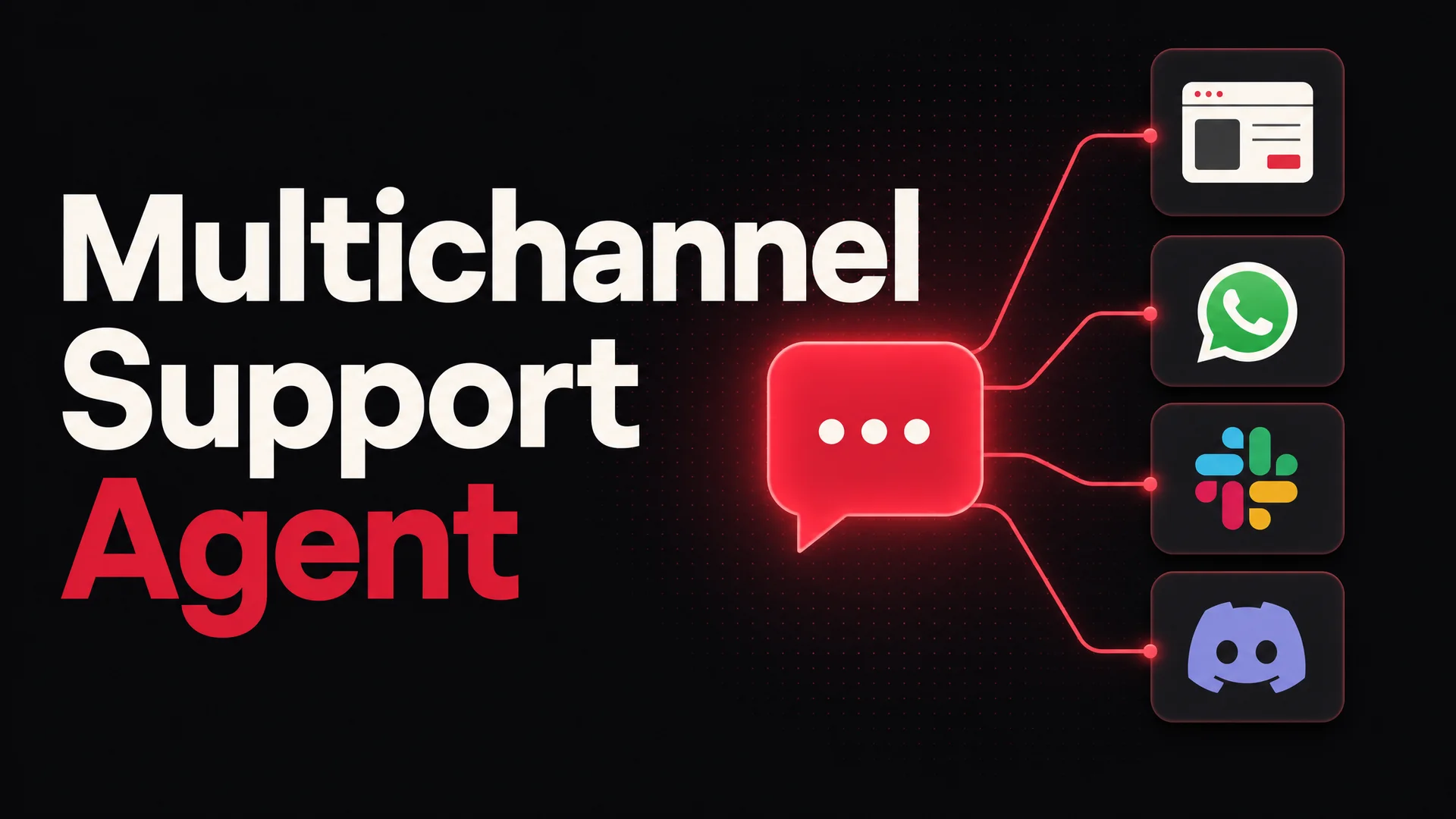
When we started building Berrydesk, we kept hearing the same frustration from support leaders. They had spent months training a chatbot on their help center, only to discover that most of their customers had never opened the help center in the first place. They were on WhatsApp. They were tagging the brand in a Discord server. They were pinging a Slack channel a partner team had set up two years ago and forgotten about.
A great agent that lives in only one place is a great agent that misses most of the conversation. So multichannel deployment is not a side feature for us - it is the point. This piece walks through why a multichannel strategy has become non-negotiable for support teams in 2026, which channels are actually worth wiring up, and what changes when you put a modern frontier model behind every one of them.
Why a single-channel agent is a liability in 2026
Customers do not think in terms of channels. They think in terms of problems. A buyer who is looking at your pricing page at 9am, asking your agent a question on WhatsApp at noon, and tagging your brand in a community Discord at midnight is - to them - having one continuous conversation. If your support stack treats that as three disconnected sessions, with three different answers and three different latencies, you are losing the thread the customer never lost.
The economics have shifted, too. The cost of inference for routine traffic has collapsed since 2025. Open-weight frontier models like DeepSeek V4 Flash now run at $0.14 per million input tokens and $0.28 per million output tokens, and MiniMax M2 lands at roughly 8% of the price of comparable closed models at twice the speed. That makes it economically reasonable to keep an always-on agent across half a dozen surfaces - the marginal cost of an extra channel is not the model bill, it is the integration work. Berrydesk takes the integration work off your plate so the math actually clears.
There is also a quieter shift in customer expectations. WhatsApp has become the default support channel across Europe, Latin America, the Middle East, and large parts of Asia. Discord is now where SaaS, gaming, and crypto communities live full-time. Slack Connect channels have replaced shared inboxes for B2B vendor relationships. If you are not present in those rooms, you are not in the consideration set when a question gets asked.
The channels that actually earn their keep
There is no shortage of integrations you could build. The honest list of channels that deliver real return on the engineering and ops effort is shorter than most vendors will admit. Here is how we think about each of the big ones.
Website chat
The browser widget is still the workhorse. It is where high-intent traffic lands, where you can A/B test conversation flows against conversion outcomes, and where you have the richest signal - page URL, account state, cart contents, plan tier. A Berrydesk widget on your site can read those signals and route the conversation to the right model: a fast, cheap one for "where is my order", a reasoning-heavy one like Claude Opus 4.7 or GPT-5.5 for a complex billing dispute, and a multimodal one like Gemini 3.1 Ultra when a customer pastes a screenshot of an error.
The widget is also the channel where you have the most control over the experience. Custom CSS, branded colors, your own avatar, your own tone of voice, and full control over when the agent escalates to a human. That is why we treat the widget as the canonical surface and the other channels as derivatives of it.
WhatsApp crossed two billion monthly active users some time ago and is still climbing. For any business with customers outside the United States, it is usually the highest-volume support channel by a wide margin once it is turned on. The format is forgiving - short messages, voice notes, image attachments - and customers tolerate slightly longer response times because they think of WhatsApp as asynchronous.
That tolerance is exactly what makes it ideal for a routed AI agent. You can hand the bulk of WhatsApp traffic to a low-cost model like DeepSeek V4 Flash or MiniMax M2 and still hit the response-time bar customers expect. When the agent detects a high-stakes intent - refund, churn risk, complaint about a specific human - it can quietly upgrade to a frontier model for that one turn, then drop back down. Berrydesk handles that routing for you, so the WhatsApp number behaves like a single agent from the customer's side and a tuned cost structure from yours.
Slack
Slack outgrew internal communications years ago. Today it is where customer success teams run shared channels with their largest accounts, where vendors keep open lines with their partners, and where a surprising amount of internal-tool support happens - engineers answering "where is the dashboard for X" all day instead of building. A Berrydesk agent in Slack can absorb most of that traffic. Trained on your runbooks, internal docs, and Notion workspace, it answers the routine questions, files the rest as tickets, and lets engineers go back to engineering.
Slack also unlocks an interesting pattern: the same agent can be customer-facing in a Slack Connect channel and internal-facing in a private channel, with different permissions and different tool scopes. That is harder to do with channels like WhatsApp, where the surface is inherently customer-facing, and it is where Berrydesk's per-channel configuration earns its keep.
Discord
Discord is where modern communities live. If your product has any kind of power-user base - developer tooling, design software, gaming, fintech, crypto, education - there is a strong chance the most engaged conversation about you is happening in a Discord server, not on your help center. A bot that joins that server, watches for support intents, and answers in-channel is one of the highest-leverage moves you can make for community-led products. It also captures the kind of long-tail questions that never make it to a support ticket but that quietly shape opinion.
And the rest
Email, SMS, in-app mobile SDKs, custom REST endpoints, Microsoft Teams, even voice - there is a long tail of channels where deploying makes sense for specific business models. The right way to think about them is the same as the four above: only turn on a channel when you can commit to the same answer quality there as everywhere else. A half-baked SMS agent that contradicts the website widget is worse than no SMS agent at all.
What modern models change about multichannel
A multichannel agent in 2023 was largely a copy-paste exercise. The same retrieval pipeline, the same prompt, the same model, repackaged for each surface. Three things have changed since then, and they reshape what is possible.
The first is context length. Claude Opus 4.6 and Sonnet 4.6 both ship with a one-million-token context window at no surcharge. Gemini 3.1 Ultra goes to two million tokens natively. DeepSeek V4 Flash and Kimi K2.6 also sit at one million. That means your agent can hold the full knowledge base, the entire conversation history with this customer across every channel, and your refund and escalation policies in-context, all at once. RAG becomes a tuning lever rather than a hard architectural requirement, and consistency across channels gets noticeably easier.
The second is reliable tool use. Models like Kimi K2.6, Z.ai's GLM-5.1, Claude Opus 4.7, Alibaba's Qwen3.6, and Xiaomi's MiMo-V2-Pro have crossed the threshold where multi-step tool calls are dependable rather than aspirational. GLM-5.1 scores 58.4 on SWE-Bench Pro, ahead of GPT-5.4 and Claude Opus 4.6 on that benchmark, and is engineered for long agentic loops. Kimi K2.6 can coordinate up to 300 sub-agents and 4,000 steps in a single autonomous run. The customer-facing implication is that AI Actions - booking a meeting, processing a refund, looking up an order, charging a card, escalating to a human with full context - work in production now. They are not demoware. That elevates a multichannel agent from a question-answering bot to something that can resolve cases end-to-end on whatever surface the customer happens to be on.
The third is the cost curve on open-weight models. DeepSeek V4, MiniMax M2.7, Qwen3.6, and the MiMo family are good enough for the bulk of routine customer support traffic and are an order of magnitude cheaper than frontier closed models. That makes routing economically interesting in a way it was not even a year ago. Send 80% of the traffic to a cheap open-weight model, route the hard 20% to Claude Opus 4.7 or GPT-5.5 Pro, and you keep frontier-quality answers on the cases that matter without paying frontier prices on the rest. Berrydesk lets you configure that routing per channel, so your high-stakes web checkout flow can default to the strongest model while your Discord community bot quietly runs on something far cheaper.
Common pitfalls when going multichannel
Most multichannel deployments do not fail because the integration breaks. They fail because of mismatches the team did not see coming.
The first is inconsistent answers across channels. If the website widget cites your refund policy one way and the WhatsApp agent cites it another, customers notice - and they screenshot. The fix is to keep a single source of truth for knowledge, train one agent on it, and only diverge in tone or surface, not in substance. Berrydesk's training pipeline is built around that constraint: you train the agent once and it answers identically across every channel you connect.
The second is formatting. A reply that looks fine in a website widget can be unreadable in WhatsApp, where rich markdown does not render, or noisy in Slack, where every long response pings everyone in the channel. The agent needs to know what surface it is on and adapt - short paragraphs and emoji on WhatsApp, threaded replies in Slack, embed-style cards on Discord. The model can do this on its own if you tell it the channel in the system prompt; the failure mode is forgetting to.
The third is handoff. The moment your agent reaches its limits, the handoff to a human has to be clean. A customer who has been talking to an AI for ten minutes and then gets dropped into a queue with no context will churn. Pipe the full conversation, the channel, and the customer record into your help desk, so a human picks up exactly where the agent left off. This is one of the things Berrydesk takes seriously - every escalation carries the full transcript and the actions the agent already attempted.
The fourth is privacy and data residency. WhatsApp messages, Slack conversations, and Discord DMs are subject to different regulatory regimes depending on the customer's jurisdiction. For regulated industries - healthcare, finance, public sector - that is a real constraint. The good news is that MIT and Apache-licensed open-weight models like GLM-5.1, Qwen3.6-27B, and the MiMo family make on-prem and air-gapped deployments viable. You can keep customer data in your own VPC and still run a frontier-class agent on top of it.
One agent, many faces - or many agents?
A common question we get is whether you should run one agent across every channel or spin up a dedicated agent per channel. Our honest answer is: one knowledge base, multiple agent instances, configured per surface. The brain is the same. The voice, the allowed tools, the escalation rules, and the model choice can vary by channel. A consumer-facing WhatsApp agent might be chatty and cheap. The same brand's Slack Connect agent for enterprise customers might be terse, run on Claude Opus 4.7, and have access to a billing tool the WhatsApp version does not. Berrydesk lets you configure all of that without forking your knowledge.
That model also gives you a clean evaluation story. You can compare resolution rate, deflection rate, and customer satisfaction across channels and see which surfaces are pulling their weight, which ones need a different prompt, and which ones might benefit from a different underlying model entirely.
Where this goes next
Multichannel deployment is not a finished problem. New surfaces will keep appearing - voice, AR, agentic browsers, embedded copilots inside other people's apps - and the right channel mix five years from now will not be the right mix today. What stays constant is the underlying job: meet your customers where they already are, answer them with the same quality everywhere, and let the agent take real action when an answer alone is not enough.
If you are building toward that, Berrydesk is the fastest way to get there. Pick a model, train it on your docs, brand the widget, wire up your channels, and let one agent handle the conversation wherever it happens.
 Berrydesk
Ship one agent to every channel that matters
- Connect web, WhatsApp, Slack, Discord, and more from a single dashboard
- Train once on your docs and let the same brain answer everywhere
Set up in minutes

Chirag Asarpota is the founder of Strawberry Labs, the team behind Berrydesk - the AI agent platform that helps businesses deploy intelligent customer support, sales and operations agents across web, WhatsApp, Slack, Instagram, Discord and more. Chirag writes about agentic AI, frontier model selection, retrieval and 1M-token context strategy, AI Actions, and the engineering it takes to ship production-grade conversational AI that customers actually trust.