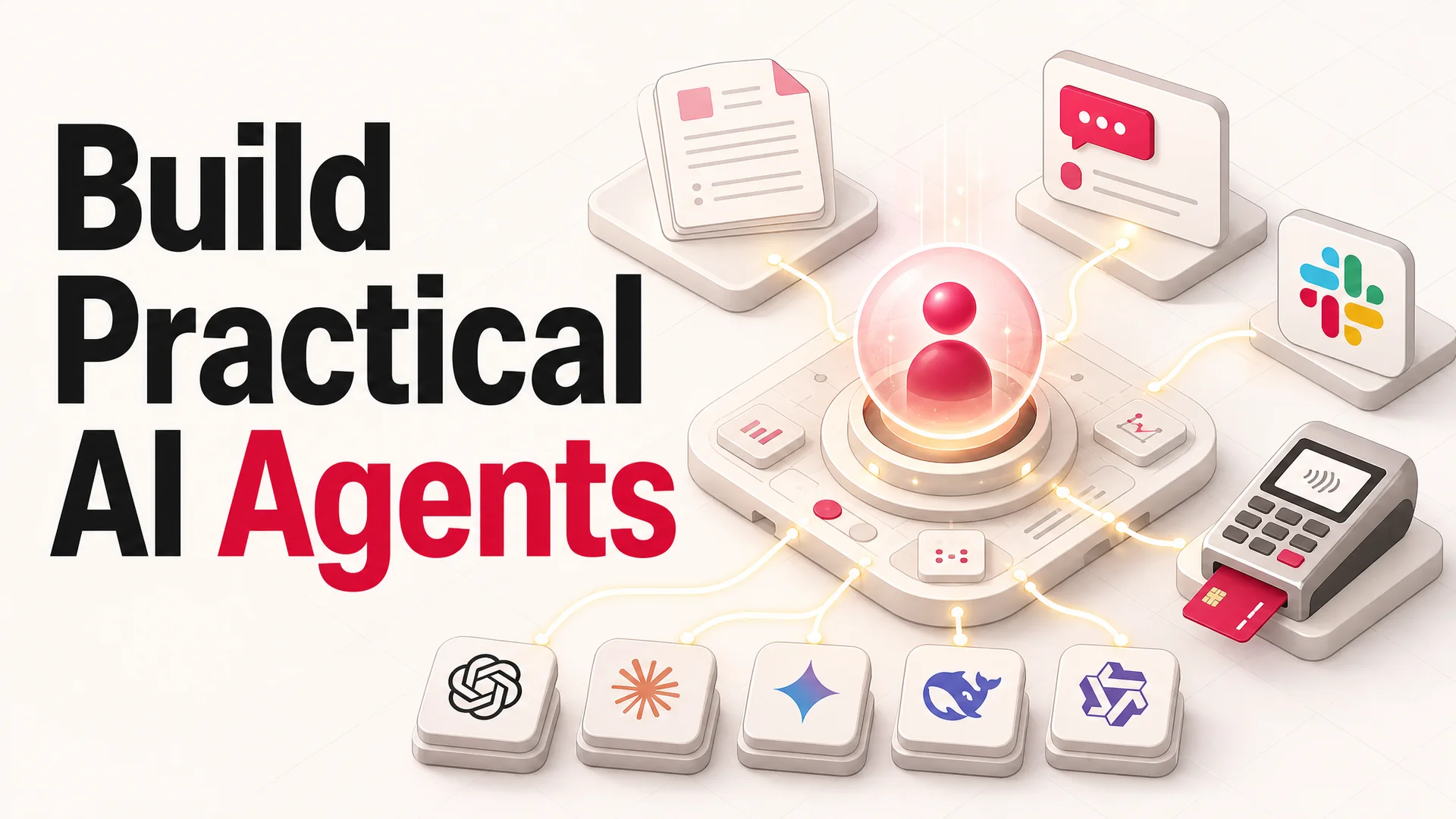
Every founder, marketer, and head of support is shipping "AI agents" right now. Very few can describe what those agents do once you take away the slide deck. So here is a working framework - the same one Berrydesk customers use to automate their full funnel, from first-touch marketing through post-purchase support, without writing a single line of code or wiring up a separate orchestration stack.
The chatbot era is over. The agents that customers actually meet in 2026 do not just answer - they retrieve account data, write to systems of record, hand off to humans with full context, and feed structured signal back to product, marketing, and revenue teams. The shift is less about better dialog and more about a workflow surface that happens to speak natural language.
This guide walks through what makes "agentic" finally meaningful in 2026, the four building blocks behind every Berrydesk agent, the four agent archetypes most teams actually deploy first, three ship-this-week blueprints, and how to pick a model in the new open-weight + closed-frontier landscape without overpaying or underdelivering.
Why "agentic" is finally a meaningful word
For most of the last few years, "agent" was marketing. An agent was a chatbot with a slightly fancier prompt. That is no longer true, and the change is not subtle.
Three things shifted between late 2025 and spring 2026.
Frontier reasoning got reliable at multi-step tool use. OpenAI's GPT-5.5 and GPT-5.5 Pro, Anthropic's Claude Opus 4.7 (leading SWE-Bench Pro at 64.3%), and Google's Gemini 3.1 Ultra (with a 2M-token context) became dependable at calling an API, reading the response, and deciding what to do next.
Agentic-first open-weight models showed long-horizon planning is no longer the exclusive domain of closed labs. Moonshot Kimi K2.6, Z.ai's GLM-5.1, Alibaba's Qwen 3.6 family, MiniMax M2.7, and Xiaomi's MiMo-V2-Pro all ship as open-weight, agentic-first models. GLM-5.1 runs an 8-hour autonomous plan-execute-test-fix loop. Kimi K2.6 holds 12-hour coding sessions and coordinates swarms of up to 300 sub-agents across 4,000 steps.
Context windows grew to a point where most knowledge-base problems become tractable. Claude Opus 4.6 and Sonnet 4.6 ship 1M tokens at no surcharge, Gemini 3.1 Ultra carries 2M, and DeepSeek V4 Flash and Pro both deliver 1M. RAG is now a tuning lever, not a hard requirement.
The implication for support and revenue teams is straightforward: the bottleneck has moved from "can the model talk" to "what tools have you given it, and which model do you route each conversation to."
The foundation: workflows, not replies
The biggest misunderstanding about AI agents in 2026 is that they automate tasks. They don't. They automate workflows. A task is "answer this question." A workflow is "answer this question, check the customer's order in Shopify, look up the refund policy, decide if it qualifies, issue the refund through Stripe, log the case in Zendesk, and notify the human owner if anything is unusual."
Every Berrydesk agent - whether it greets a visitor on a marketing page, qualifies a lead on the pricing page, or handles a Tier-1 ticket at 3 a.m. - is built from the same four building blocks.
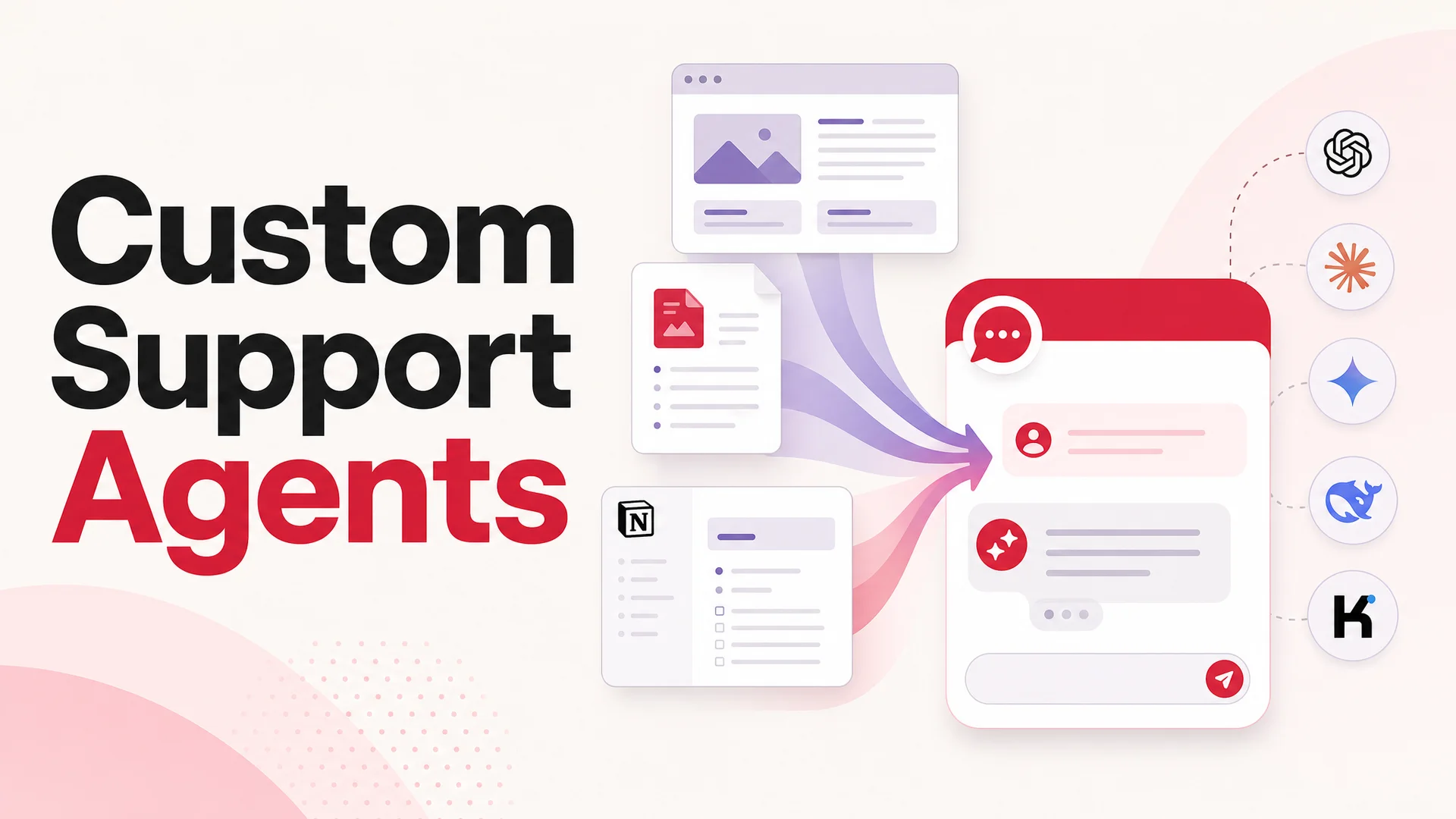
Knowledge. What the agent actually knows. Sourced from your help docs, sitemap-crawled pages, Notion workspace, Google Drive, YouTube transcripts, or raw uploads. The agent can pull from any of these in real time, and with today's context windows you can hold an entire knowledge base, a long conversation, and your policy documents in-context simultaneously.
Behavior. The instructions, persona, and guardrails. This is where you tell the agent how to talk, what it must never do, when to escalate, and what to ask for before it tries to act. Behavior is also where you choose the underlying model. Picking the right one matters more than most teams realize: Claude Opus 4.7 leads SWE-bench Pro at 64.3% and is the strongest at multi-step reasoning, but routing every routine FAQ through it is the customer-support equivalent of using a forklift to carry groceries.
Action. The integrations the agent can fire. This is the line that separates a chatbot from a real agent. AI Actions in Berrydesk let the agent book on Cal or Calendly, look up an order, issue a refund, push a record to your CRM, post to Slack, or call any custom webhook. The reason this works in production now and not two years ago is that agentic tool-use models - Claude Opus 4.7, Kimi K2.6, GLM-5.1, Qwen3.6, MiMo-V2-Pro - are reliable enough at structured tool calls to be trusted with real money and real records.
Feedback loop. The analytics that retrain the agent over time. Without this, your agent calcifies on day one. With it, every conversation becomes signal: where the agent fell back to "I'm not sure," which questions are surging, which escalations turned into revenue, which sources are stale.
Mix the four blocks correctly and you stop building a chatbot - you start building an AI teammate.
The four agent archetypes worth building first
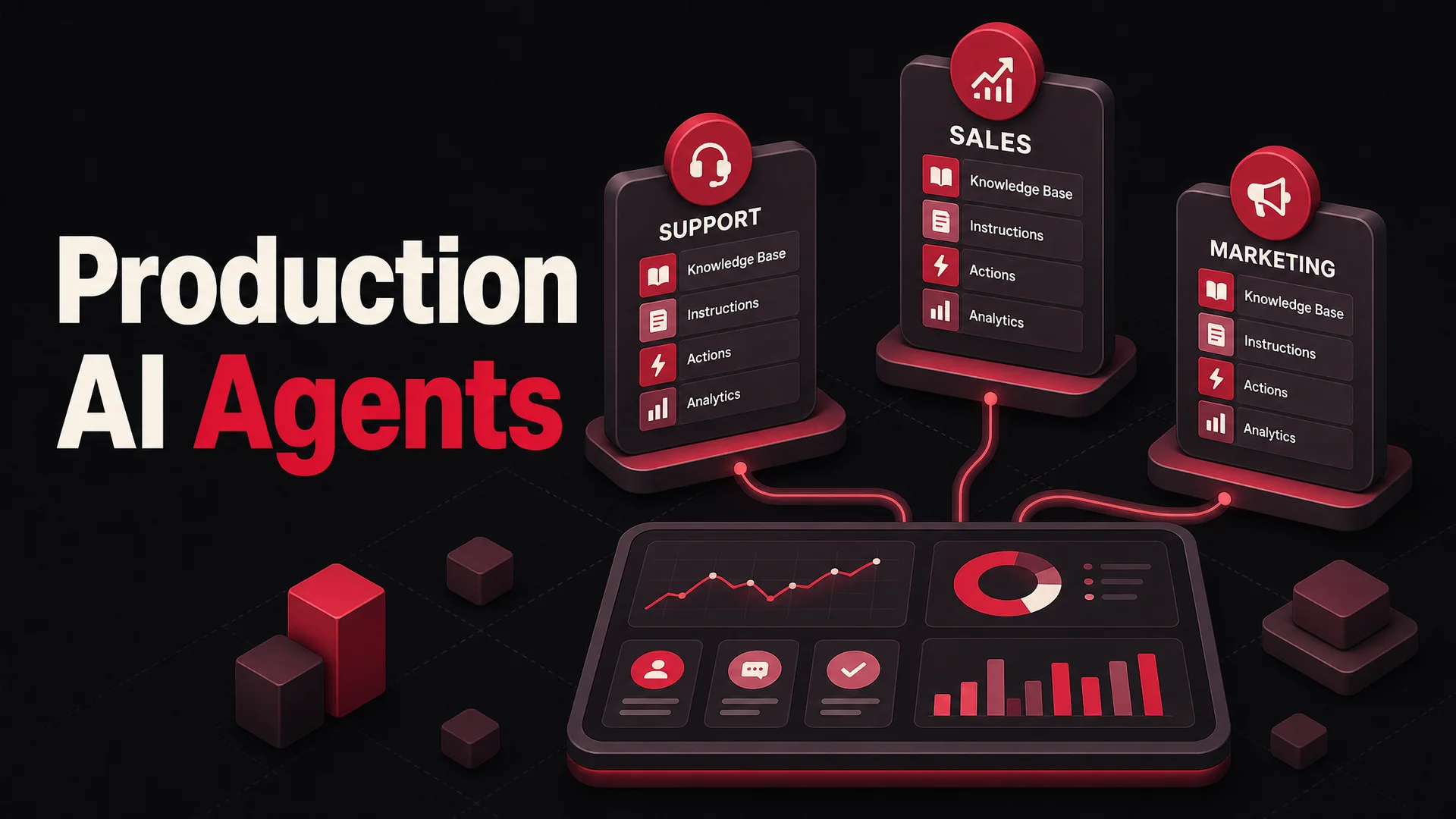
Across hundreds of Berrydesk deployments, four agent shapes account for the vast majority of measurable ROI. You can build them in isolation, but the real leverage comes from layering them - the support agent feeds the insights agent, which informs the content agent, which keeps the support agent fresh.
A) The customer support agent
Goal: Deflect repetitive tickets, give instant answers grounded in your real policies, escalate the rest with full context attached, and pull account-specific data for verified users.
Why it changed in 2026. A support agent in 2024 was mostly an FAQ retriever with a polite tone. A support agent in 2026, when wired to a tool-use-capable model like Claude Opus 4.7, GPT-5.5, or an open-weight agentic model like Kimi K2.6 or GLM-5.1, can independently decide whether to look up an order in Stripe, search the knowledge base, ask a clarifying question, or hand the ticket to a human with a written summary. The same model can be cost-tuned: route the 80% of "where is my order" questions to DeepSeek V4 Flash at $0.14 / $0.28 per million input/output tokens and reserve Opus 4.7 for the angry-customer escalations.
How to build it on Berrydesk:
- Create a new agent and label it "Support."
- Train it on your help center URL, your Notion docs, and any policy PDFs. Berrydesk's crawler keeps the site fresh; Notion stays in sync automatically.
- Connect your helpdesk and your billing system as integrations so the agent can read order, subscription, and ticket state.
- Enable the Collect Leads AI Action on conversations from anonymous visitors so prospects do not get lost.
- Deploy the widget to your site, and add Slack, Discord, and WhatsApp as channels.
- Use Identity (HMAC-signed contacts) to gate any action that exposes customer data behind a verified user.
A real scenario. A customer messages a mid-sized DTC brand at 11 p.m.: "Hey, I want to return the boots I ordered last week, they don't fit." The Berrydesk agent recognizes the intent, looks up the order in Shopify, confirms it is inside the 30-day return window, generates a return label through the carrier integration, emails it to the customer, posts a note in Slack #returns for the ops team's morning review, and replies in the chat in under fifteen seconds with the label attached and a friendly note about size exchanges. No human touched it. The next morning, ops sees a clean Slack digest of overnight returns. That is a workflow, not a reply.
What to watch out for. Tool-use reliability still varies by model. If you wire a refund flow, test it against the agentic-first models in the lineup - Claude Opus 4.7, Kimi K2.6, GLM-5.1, Qwen3.6 - before assuming a smaller general-purpose model is up to the job. Your AI Actions are only as good as the worst path through them.
Result. In typical Berrydesk deployments, 70-85% of repetitive Tier-1 traffic resolves without human intervention. Your team handles the genuinely hard work - the angry, the unusual, the high-stakes - and the analytics keep telling you exactly where to invest the next training cycle.
B) The sales and lead-gen agent
Goal: Qualify, nurture, and convert leads inside the conversation, then sync everything cleanly into your CRM and calendar so your AEs only see warm, ready-to-talk pipeline.
Why it changed in 2026. Booking flows used to be the demo that broke. Models hallucinated time zones, double-booked the calendar, or forgot which calendar to write to. With the current generation of tool-use models - and a properly defined AI Action that wraps the booking endpoint - that class of failure largely disappears. The other shift: agentic models are good enough at multi-turn qualification that you can have one agent run discovery, scoring, booking, and CRM enrichment in a single conversation, instead of stitching together three separate tools.
How to build it on Berrydesk:
- Spin up a "Sales" agent and feed it your pricing page, ICP description, and any battlecards or competitor comparisons you want it to internalize. The 1M-token context windows on Claude Opus 4.6, Sonnet 4.6, and DeepSeek V4 mean the entire sales kit can sit in-context.
- Set tone and instructions: ask qualifying questions naturally - company size, use case, timeline, current stack - and surface the right plan based on the answers, not push the most expensive one. Configure when to ask for an email (after the visitor has gotten value, not before) and when to offer a call.
- Wire a calendar booking AI Action - Berrydesk supports the major scheduling tools out of the box, and a Custom Action can hit any internal scheduling endpoint.
- Add a Slack action that pings your
#saleschannel the moment a high-intent conversation is detected. - Connect your CRM (HubSpot, Salesforce, Attio, Pipedrive) so qualified leads - with their conversation transcripts - land in the right pipeline.
A real scenario. A founder lands on the pricing page of a mid-market analytics tool at 2 a.m. local time. The Berrydesk agent opens with "Want me to show you how the Pro plan compares to Business, or skip to a quick demo walkthrough?" The visitor says they have a 40-person data team and need SSO. The agent confirms SSO is on Business and above, walks through the relevant case study, asks if they want a 20-minute call with a solutions engineer, and books it directly through Cal at 9 a.m. the next morning. By the time the AE logs in, the calendar invite, the full transcript, the company enrichment, and a one-line "what they care about" summary are already in HubSpot.
What to watch out for. Qualification logic should live in the agent's system prompt and tool definitions, not in a separate router service that sits in front of the model. The whole point of the modern agent stack is that the LLM decides - fragmenting that decision across multiple services usually hurts conversion.
Result. Your pricing page stops being a wall and starts being a conversation. Lead forms turn into discovery calls. The meetings your AEs take are with people who already understand your product, because they just spent fifteen minutes talking to it.
C) The marketing and content agent
Goal: Turn every conversation into structured insight about what your audience cares about, what language they use, and what you should be saying differently. Keep your help center honest and continuously expand a curated Q&A bank so future customers get a better experience than the last cohort did.
Why it changed in 2026. Long-context models flipped the unit economics of knowledge management. With a 1M-token context on Claude Sonnet 4.6 or DeepSeek V4 Flash, you can stuff an entire help center into a single prompt and ask the model to find contradictions, gaps, or stale references. Combined with the Q&A capture loop in Berrydesk, the content agent becomes a self-improving system rather than a quarterly cleanup project.
How to build it on Berrydesk:
- Include your website, campaign pages, product marketing copy, positioning docs, and the latest launch materials. The point is not for the agent to repeat your marketing - it is to interpret incoming questions in the context of how you currently talk about your product.
- Configure the agent to analyze user questions for patterns, sentiment, and intent. Tag conversations by topic, surface unusual phrasing, and flag mismatch between what visitors ask about and what your site emphasizes. Models like Gemini 3.1 Pro, which leads GPQA Diamond at 94.3%, are particularly strong at this kind of nuanced classification.
- In Activity, browse recent conversations. When the agent gave a particularly good answer that is not yet in your docs, click Improve / Revise and save it as a Q&A pair.
- Add Q&A entries manually for tone-sensitive topics where you want exact phrasing - refund policy, security posture, regulatory disclaimers.
- Push tagged insights into a Notion database your marketing team reviews weekly. Send a Slack digest every Monday with the top five trending topics, the biggest week-over-week shifts, and any conversations where visitors used product language you don't yet use on the site.
- Pull in YouTube transcripts of your product walkthroughs so the agent can answer "how do I…" questions with the same examples your customers see.
A real scenario. A B2B SaaS marketing team notices their Berrydesk agent has flagged "team pricing" as the fastest-growing topic over the last three weeks, with a high fallback rate because the public site only shows individual seats. Sentiment on those conversations is mixed-to-negative. The team adds a clear team pricing block to the pricing page on Wednesday. By the following week the fallback rate on those queries drops, the conversation-to-trial rate on visitors asking about teams more than doubles, and a chunk of paid traffic that used to bounce from the pricing page starts converting.
What to watch out for. Avoid the temptation to load every file you have. Quality of sources matters more than volume; a contradictory or out-of-date doc poisons retrieval. Audit your sources monthly, and lean on long-context recall as a tuning lever rather than a substitute for clean inputs.
Result. You stop guessing what your customers care about and you stop running surveys to find out. The agent gives you a live, continuous, qualitative read on the voice of the market - in your customers' actual words.
D) The listening and customer insights agent
Goal: Treat every conversation as structured market research - cluster chats into topics, score sentiment, surface emerging issues before they hit your weekly meeting, and export the lot to product and marketing in a format they will actually open.
Why it changed in 2026. The combination of cheap inference (DeepSeek V4 Flash, MiniMax M2 at roughly 8% the cost of comparable closed models at 2x the speed) and frontier reasoning (Gemini 3.1 Pro leading GPQA Diamond at 94.3%) means clustering and sentiment analysis are no longer cost-prohibitive on high-volume traffic. You can run nightly topic models over millions of messages without flinching at the bill.
How to build it on Berrydesk:
- Open the Analytics tab on any agent and enable Topics and Sentiment.
- Filter by date range to isolate a launch week, a campaign, or a known incident window.
- Click into individual topics to read the source conversations - context matters when you are deciding whether "pricing confusion" means "lower the price" or "rewrite the pricing page."
- Export to CSV, JSON, or PDF and route it to product and marketing on a weekly cadence.
What to watch out for. Sentiment scores are a starting point, not a verdict. A spike in negative sentiment on a topic might mean a real problem or it might mean one large enterprise customer ran into one bad day. Always check the underlying conversations before acting.
The Berrydesk building blocks
If you want to mix and match these archetypes - or invent your own - these are the primitives:
- Sources. Files (PDF, DOCX, TXT, Markdown), website crawl, Notion workspaces, Google Drive folders, YouTube transcripts, raw text snippets, and curated Q&A pairs. Retrain instantly when you make changes; the diff is handled for you.
- AI Actions. Built-ins for scheduling, payments, lead capture, web search, Slack alerts, and human handoff, plus Custom Actions that let you wrap any internal API in a few lines of JSON. Authentication, parameter validation, and response shaping are part of the Action definition.
- Integrations. Helpdesks, CRMs, billing platforms, ecommerce backends, automation platforms (Zapier-style), and the major messaging surfaces - Slack, Discord, WhatsApp, Messenger, Instagram.
- Identity and Contacts. HMAC-verified user identity for any action that touches private data, plus a Contacts store so the agent remembers a returning customer's history without you wiring a separate CRM lookup.
- Embeds and API. Drop-in widget, iframe, or full Berrydesk API for custom UIs and headless deployments.
- Analytics. Topics, sentiment, conversation volume, resolution metrics, escalation rates, action conversion rates, exports to CSV / JSON / PDF.
- Whitelabel. Host on your own subdomain, strip Berrydesk branding, and ship a fully branded experience.
- Models. Pick per agent - and per route within an agent. The current Berrydesk model lineup includes GPT-5.5 and GPT-5.5 Pro, Claude Opus 4.7 and Sonnet 4.6, Gemini 3.1 Ultra and Pro, DeepSeek V4 Pro and V4 Flash, Moonshot Kimi K2.6, Z.ai GLM-5.1, the Qwen 3.6 family, MiniMax M2 and M2.7, and Xiaomi MiMo-V2-Pro and Flash.
Choosing the model stack: don't default to one
The biggest mistake teams make in 2026 is wiring all four agents to a single frontier model and calling it a day. The cost story has changed, and the right answer is almost always a routed stack. A few rules of thumb:
- Default workhorse for support traffic: DeepSeek V4 Flash or MiniMax M2. Both are open-weight, cheap, fast, and good enough for the long tail of "where is my order" and "how do I reset my password" questions.
- Hard escalations and nuanced reasoning: Claude Opus 4.7 (best-in-class on SWE-Bench Pro at 64.3%, excellent at structured tool use) or GPT-5.5 Pro with parallel reasoning enabled.
- Massive context jobs (full knowledge base in-prompt, long policy documents): Gemini 3.1 Ultra at 2M tokens, or Claude Sonnet 4.6 at 1M with no surcharge.
- Agentic, multi-tool workflows: Kimi K2.6 or GLM-5.1 if you want open weights and long-horizon autonomy; Claude Opus 4.7 if you want the closed-frontier ceiling.
- Regulated industries with on-prem or air-gapped requirements: the MIT-licensed open Chinese models - GLM-5.1, Qwen3.6-27B, MiMo-V2 - are the realistic path. GLM-5.1 was trained entirely on Huawei Ascend 910B chips, which matters for some procurement reviews.
The trade-off most teams miss: open-weight frontier models are not just cheaper - they remove an entire class of vendor-risk and data-residency arguments. The trade-off they do make is operational: you are now responsible for the inference path. Berrydesk handles that for you on the hosted side; if you want to bring your own inference, the same Action and Source primitives work over a self-hosted endpoint.
In Berrydesk you can pick the model per agent, per intent, or per turn. Most production deployments end up with two or three models in rotation, which is how you get great answers at a price that doesn't make finance flinch.
Three blueprints you can ship this week
Blueprint 1 - Customer Insights Dashboard
- Setup. Enable Topics and Sentiment in Analytics. Set a weekly export to CSV that lands in your product team's shared drive.
- Process. Every Monday, the cross-functional product/support sync starts with the previous week's topic shifts. Topics that grew more than 25% week-over-week get an owner.
- Outcome. Faster iteration on real customer pain. One mid-market SaaS team using this loop reported cutting onboarding-related ticket volume by roughly half in two months because they were reading what customers actually asked, not what they assumed customers would ask.
Blueprint 2 - Support Deflection plus Smart Escalation
- Setup. Load FAQs, policy docs, and your help center into Sources. Connect your helpdesk and billing system. Enable Collect Leads. Route the agent's default model to DeepSeek V4 Flash; route conversations tagged "billing" or "cancellation" to Claude Opus 4.7.
- Process. Routine questions are resolved in-chat with order or subscription context pulled live. Anything ambiguous, angry, or financially material is escalated to a human with a generated summary, the relevant Stripe invoice, and the suggested resolution attached to the ticket.
- Outcome. Lower ticket volume on the support team, higher first-contact-resolution rate, and human reps who walk into every ticket already 80% briefed.
Blueprint 3 - Lead Capture and Instant Booking
- Setup. Train a "Sales" agent on your pricing page and ICP description. Add a calendar booking Action and a Slack alert action. Connect your CRM.
- Process. Visitors who hit pricing-related pages or ask qualifying questions get triaged into "qualified" or "research-mode." Qualified leads book a meeting on the spot; research-mode visitors are nurtured with relevant content links and a captured email.
- Outcome. Faster pipeline, warmer leads at booking time, and far fewer no-shows because the meeting was booked at the moment of intent rather than three days later.
How to measure whether it is working
A handful of metrics matter more than the rest:
- Resolution rate. Of conversations the agent handled end-to-end, what fraction did not require a human? Watch this by topic - a flat overall number can hide the fact that one segment is failing badly.
- Escalation quality. When the agent does escalate, does the human actually save time? Survey your reps once a month: "did the agent's summary speed you up, slow you down, or have no effect?"
- Action conversion rate. For each AI Action - bookings, refunds, lead capture - what fraction of attempts succeed? A 60% booking success rate is a tooling problem worth fixing immediately.
- Topic and sentiment movement. Which topics are growing, and which way is sentiment going on each? This is your weekly product signal.
- Cost per resolved conversation. With routed model selection, this number can fall by an order of magnitude versus a single-model deployment. Track it.
Common pitfalls to avoid
A few patterns we see kill otherwise-good agent rollouts.
Picking one model and treating cost as a fixed line item. If you are running every routine FAQ through Opus 4.7 or GPT-5.5 Pro, you are quite literally lighting money on fire. Route routine traffic to V4 Flash or M2 and reserve frontier models for the hard escalations.
Treating the knowledge base as a one-time upload. Every product change, policy update, and pricing tweak needs to flow into the agent. Berrydesk auto-recrawls websites and Notion on a schedule precisely because manual sync rots fast.
Skipping behavior tuning. A great model with bad instructions will still produce bad answers. Spend real time on the system prompt. Define escalation criteria. Decide explicitly what the agent must never do.
Ignoring the analytics. Most agent failures look like a 5% dip in a metric you weren't tracking. Set up a weekly review. Look at fallbacks. Read the conversations the agent escalated.
Forgetting deployment surface. The agent that lives only on your website is missing a chunk of the traffic. Berrydesk deploys to your site, Slack, Discord, WhatsApp, and your own custom surfaces from a single source of truth.
Over-loading sources. Quality beats quantity; one stale doc can poison retrieval for an entire topic.
Under-defining actions. A vague Custom Action with loose parameter validation is a refund-the-wrong-customer waiting to happen. Treat Action schemas like API contracts.
Skipping identity verification. If your agent reads private data, HMAC-verified contacts are not optional.
Treating analytics as reporting instead of input. Topics and sentiment exist to change what you build next, not to fill a slide.
How they connect: one system, four faces
The deeper point, the one most teams miss: support, sales, marketing, and insights agents are not four separate products. They are one system showing different faces depending on where the visitor lands.
A user starts as a marketing-page visitor - the agent answers a positioning question and tags the topic. They click through to pricing - same agent, now in sales mode, qualifies them and books a call. They sign up, then file a support question two months later - same agent, now in support mode, has the full history in context and resolves it without re-asking who they are. The knowledge base is shared. The analytics are shared. The behavior shifts based on intent and context.
This is the part that turns AI agents from a clever demo into actual leverage. You stop automating replies and start automating workflows. The agents learn from every conversation, the analytics close the loop, and the underlying system gets a little smarter every week without anyone having to retrain anything.
That is the difference between an AI chatbot and an AI agent. The chatbot answers. The agent gets work done.
The takeaway
AI agents in 2026 are not here to replace your team. They are here to absorb the work your team should never have been doing in the first place - the tenth answer to the same FAQ, the manual lookup of an order ID, the lead that fell out of an inbox. With the current generation of frontier and open-weight models, plus a platform that gives you Sources, Actions, Integrations, Identity, Embeds, and Analytics as first-class primitives, the bottleneck for most companies is no longer model quality. It is configuration courage.
Build the agent. Wire the actions. Pick the models. Measure what changes.
Ready to ship one? Start at berrydesk.com - pick a model, point it at your knowledge, turn on the actions that matter, and put it in front of your customers this week.
 Berrydesk
Launch your AI agents in minutes
- Choose any frontier model - GPT-5.5, Claude Opus 4.7, Gemini 3.1, DeepSeek V4, Kimi K2.6
- Train on docs, websites, Notion, or Drive and ship to your site, Slack, or WhatsApp
Set up in minutes

Chirag Asarpota is the founder of Strawberry Labs, the team behind Berrydesk - the AI agent platform that helps businesses deploy intelligent customer support, sales and operations agents across web, WhatsApp, Slack, Instagram, Discord and more. Chirag writes about agentic AI, frontier model selection, retrieval and 1M-token context strategy, AI Actions, and the engineering it takes to ship production-grade conversational AI that customers actually trust.