Retail is not the same business it was three years ago. Shoppers move between TikTok, Instagram DMs, your storefront, and your help center inside a single buying decision, and they expect every surface to know who they are and what they bought last month. The brands that sit still - store hours on a contact page, a ticket queue measured in hours, a chat widget that only routes to humans during business hours - keep losing margin to the ones that don't.
AI agents are now the default way retailers close that gap. Not the scripted decision-tree bots of 2019, and not the GPT-4 wrappers of 2024. The current generation runs on frontier models with million-token context windows, real tool use, and a unit economics curve that finally makes "answer every question, every time" affordable. This guide walks through what retail chatbots are good at in 2026, how to build one that actually moves revenue, what platforms are worth a serious look, and the traps to avoid along the way.
Why retailers can't ignore chatbots anymore
Modern shoppers have been trained by Amazon, Shein, and DoorDash to expect three things at all times: an answer in seconds, a recommendation tailored to them, and a self-service path that doesn't end at a phone tree. Traditional support models - a Zendesk queue staffed 9-to-5, a knowledge base that nobody reads, a chat widget that goes dark at night - fail every one of those expectations. The cost shows up as cart abandonment, repeat refund requests, and a slow erosion of repeat-purchase rates that no marketing budget can outrun.
A modern retail agent inverts that pattern. It is on every channel the shopper already uses - site, app, Instagram, WhatsApp, Slack for B2B accounts - and it answers in the second the question is asked. It pulls from product data, order history, and policy documents the moment a customer asks "where is my order" or "is this dress true to size," and it executes - not just describes - actions like exchanges, address changes, and reorders. The result is shorter time-to-resolution on the support side and meaningfully higher conversion on the storefront side, because the friction that used to push shoppers away now gets dissolved in conversation.
There is a second-order effect that is easy to underrate. When a chatbot handles the routine 70%, your human team spends their day on the cases that actually need human judgment - escalations, VIPs, edge-case fraud, the angry email from a long-time customer. Agent quality goes up because the work is more interesting, attrition goes down because nobody is reciting tracking numbers all afternoon, and the customers who do reach a human reach one who has the time and context to fix the problem properly.
What's different in 2026: the model layer matured
Three model-layer changes turned retail chatbots from "nice to have" into table stakes.
Million-token context windows changed what an agent can know. Claude Opus 4.6 and Sonnet 4.6 ship with a 1M-token context window at no surcharge, DeepSeek V4 and Kimi K2.6 match it, and Gemini 3.1 Ultra extends to 2M. In practice that means your entire product catalog, return policy, sizing guides, and the customer's full conversation history can sit in-context at once. RAG (retrieval-augmented generation) is still useful for very large catalogs, but it is now a tuning lever rather than a hard architectural requirement. The agent stops "forgetting" what it was told two messages ago.
Open-weight frontier models collapsed the cost of running production traffic. DeepSeek V4 Flash is priced at roughly $0.14 per million input tokens and $0.28 per million output tokens - fractions of a cent per resolution at retail message lengths. MiniMax M2 is open-weight and runs at about 8% the price of Claude Sonnet at twice the speed. Z.ai's GLM-5.1 (MIT licensed, 754B-parameter MoE) and Alibaba's Qwen3.6-27B (Apache 2.0) make on-prem deployment realistic for retailers in regulated categories like pharmacy, alcohol, and financial services. The economics of "answer every question" finally pencil out.
Agentic tool use stopped being demoware. Claude Opus 4.7 leads SWE-bench Pro at 64.3%, Kimi K2.6 runs 12-hour autonomous coding sessions with up to 300 sub-agents, and GLM-5.1 sustains an 8-hour plan-execute-test-fix loop. For retail, the equivalent is an agent that can actually look up an order in Shopify, initiate a return through your 3PL, charge a deposit through Stripe, and book a fitting in your appointments system - in one conversation, without dropping the thread. That is what separates a chatbot from an agent.
The practical takeaway: route routine traffic to a cheap open-weight model like DeepSeek V4 Flash or MiniMax M2, and reserve Claude Opus 4.7, GPT-5.5, or Gemini 3.1 Ultra for the harder escalations and high-value flows. Berrydesk lets you pick the model per agent or per route, so you don't pay frontier prices for "where is my order."
Where retail chatbots actually pay back
Retail is broad - a luxury watch brand, a fast-fashion DTC, a Shopify food startup, and a 200-store appliance retailer all have different shapes of demand. The use cases below show up in nearly every one.
24/7 customer support that doesn't feel like a script
The baseline use case, and still the highest-volume one. A modern agent answers product questions ("does this bag fit a 16-inch laptop"), handles shipping and return policy questions, troubleshoots common issues like wrong size or missing items, and escalates the long tail to a human with full conversation context attached. A mid-size apparel brand running 4,000 tickets a week typically sees 60–75% of those handled end-to-end without a human, with the rest landing in the queue pre-tagged and pre-summarized. That is not a 10% efficiency gain - it is a different operating model.
Personal shopping at scale
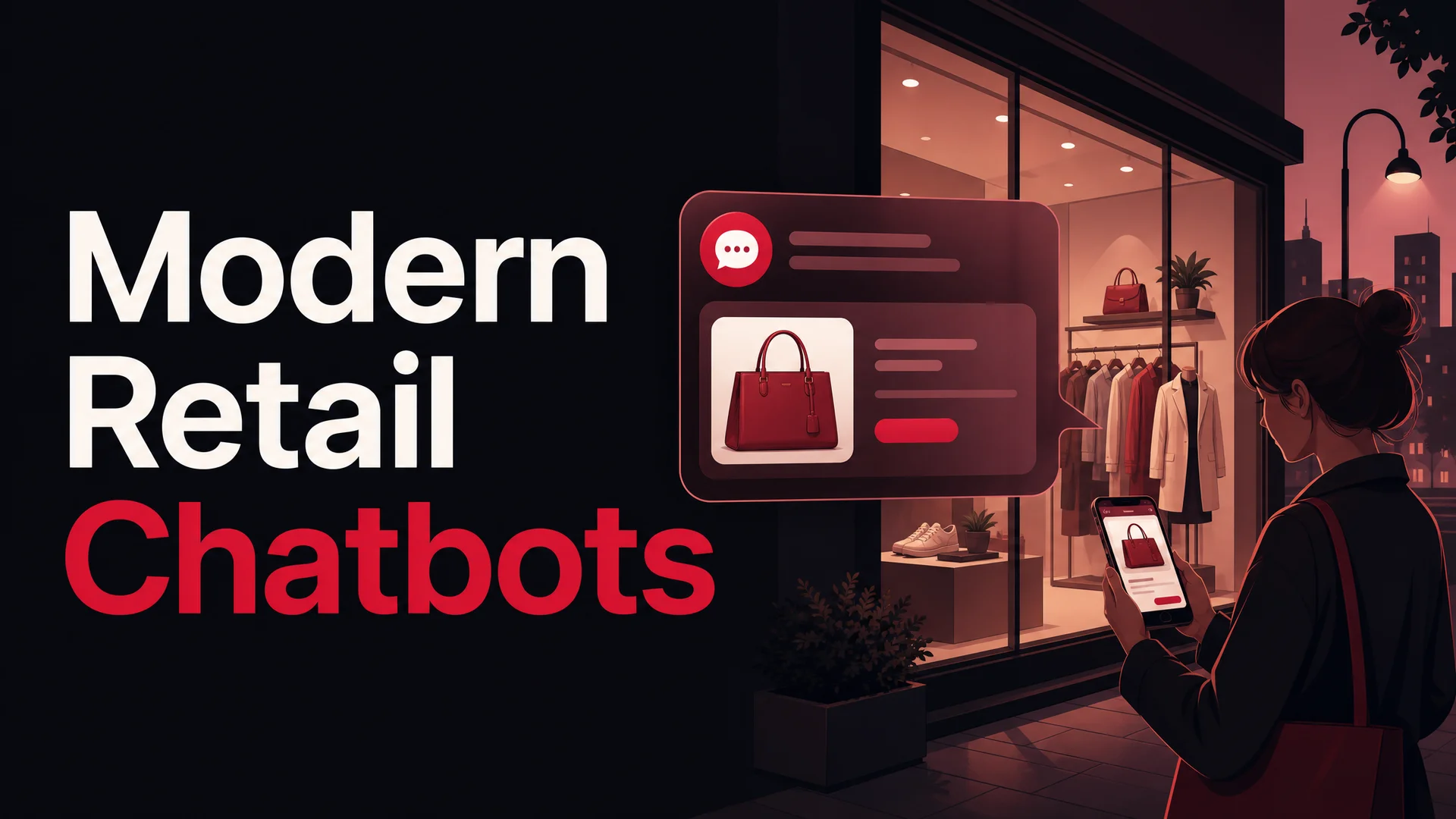
This is the use case that turns a support cost center into a revenue line. A virtual stylist agent that knows your catalog, the shopper's purchase history, the items they've added to a wishlist, and the things they've returned can recommend a cross-sell with the precision of an in-store associate. Browsing trail running shoes? The agent can suggest a moisture-wicking sock, a hydration vest, and remind the shopper that their last pair was a half size up. The conversion lift on personalized recommendations is well documented; what changed in 2026 is that long-context models can hold the entire shopper history without an expensive embedding pipeline.
Order management without a ticket
Customers should not need to email "where is my order" in 2026. The agent looks up the order, returns the carrier status, and offers an action - reschedule delivery, change the address, file a lost-package claim - in the same message. Berrydesk's AI Actions wire directly into Shopify, WooCommerce, BigCommerce, and most major 3PLs, so the agent doesn't just describe what to do, it does it. The downstream effect on contact volume is sharp: order-status questions, the single largest ticket category for most retailers, drop by half or more once they stop entering the queue at all.
Lead qualification on storefront and social
For higher-consideration purchases - furniture, appliances, B2B wholesale, made-to-order goods - the agent acts as a qualification layer. It engages a visitor on the product page or an Instagram DM, asks a few light qualifying questions (use case, timeline, budget, size of the order), and either closes the sale itself or hands a hot lead to a sales rep with a summary. Compared to a contact form that collects a name and an email and dies in a CRM, this is a step change in conversion.
Appointment booking for stores with a physical footprint
For brands with showrooms, fitting studios, optical shops, beauty counters, or in-home consultations, the agent books appointments directly in your calendar system. AI Actions handle the booking flow end-to-end: read availability, reserve the slot, take a deposit if needed, send the confirmation. No back-and-forth, no scheduling tool the customer has to learn, no double-bookings.
Loyalty and lifecycle messaging
Once the agent knows the customer, it can run lifecycle work that used to require a separate platform. "Your points expire in 14 days, here are three items you'd actually use them on." "You bought this conditioner six weeks ago - typical reorder window is now." "Your tier upgrade unlocks free returns, here's what's eligible from your wishlist." This is where chatbot lines blur into CRM and email, and that is the right outcome - the conversation is the channel.
Virtual try-on and visual fit
In fashion, beauty, and eyewear, agents pair with on-device AR or image generation to let shoppers visualize a product before buying. Multimodal models (Gemini 3.1 Ultra is natively multimodal across text, image, audio, and video; Kimi K2.6 ships native video input) make it possible for a shopper to send a photo and ask "would this jacket work with what I'm wearing?" and get a real answer. The downstream impact is fewer fit-related returns, which is the single largest cost line in apparel ecommerce.
Post-purchase feedback and review collection
A short, conversational survey two days after delivery beats a long form survey ten days later. The agent asks how it went, surfaces a problem if there is one (and fixes it before it becomes a chargeback), and routes happy customers to a review prompt. The data quality is dramatically higher than a 5-star rating block in an email.
Promotional and merchandising assistance
The agent is also a marketing surface. New collection drops, flash sales, restock alerts, segment-specific offers - all delivered in a channel the customer already opted into. The line between support and marketing blurs, and that is fine, as long as the agent stays useful and is not just blasting promotions.
How to build a retail chatbot that actually works
Most retail chatbot projects fail not because the model is bad, but because the rollout is sloppy. The steps below are the ones that consistently separate the projects that ship from the ones that quietly die.
1. Define what success looks like, in numbers
"Better customer experience" is not a goal. "Cut order-status tickets by 50% in 90 days" is. "Lift recommendation-driven AOV by 8%" is. "Recover 15% of abandoned carts via proactive chat" is. Pick two or three metrics, baseline them honestly, and decide what trade-offs you'll accept - for example, willingly absorbing a small CSAT dip on the AI channel in exchange for halving median first-response time.
2. Map the customer, not the org chart
Spend a week reading your last 500 tickets, then another week reading the chats from your highest-AOV customers. The patterns that show up are almost never the ones the support team thinks dominate. Tools like Apify and the analytics already inside your help desk are useful here, but the real work is reading the actual conversations and noticing what shoppers actually want help with.
3. Pick a platform that matches the work
Most retail teams don't need to glue together a custom stack. They need a platform that gets out of the way. The shortlist below covers the realistic options.
Berrydesk is built for this exact use case. You launch a branded support agent in four steps: pick a model from GPT-5.5, Claude Opus 4.7, Gemini 3.1 Ultra, DeepSeek V4, Kimi K2.6, GLM-5.1, Qwen3.6, MiniMax M2, or others; train it on your docs, website, Notion, Google Drive, or YouTube; brand the chat widget to match your storefront; add AI Actions for order lookups, bookings, and payments; and deploy to your site, Slack, Discord, and WhatsApp. Per-agent model choice means the cheap models handle the cheap traffic and the frontier models handle the hard cases, which is where the cost story really lives.
Google Dialogflow CX still has strong NLU and decent integrations, but the design surface assumes you'll build flows by hand, which is not how the modern category works. Most teams who stand up a Dialogflow project in 2026 end up wishing they had picked a model-native platform.
Amazon Lex is sensible if your stack is already deep in AWS and you want IAM, VPCs, and CloudWatch as first-class citizens. The trade-off is that the conversational quality lags the model-native platforms, and you'll spend engineering hours on glue code that a vertical platform would have shipped on day one.
Open-source frameworks (Rasa, LangChain-based stacks) make sense if you have an in-house ML team, an existing data platform, and a real reason to own the layer end-to-end - typically regulated industries with strict on-prem requirements. Otherwise the total cost of ownership is higher than it looks, and the time-to-value is months, not days.
For most retailers, the honest answer is: pick a platform that handles widget, model routing, AI Actions, and analytics in one product, and put your engineering hours into the integrations that are actually unique to your store.
4. Design conversations that recover gracefully
Conversation design in 2026 is less about scripting flows and more about defining the agent's job, its tools, its tone, and - crucially - its escalation rules. Tell the agent what it can do, what data it can access, what it should never do (don't promise refunds outside policy, don't speculate on stock that isn't confirmed), and exactly when to hand off to a human. Always give the customer a one-click path to a person; the agents that try to trap users in chat lose trust quickly.
5. Train on the right data, not all the data
The instinct is to feed the agent everything. Don't. Train it on a curated set: current product data, current policies, the top 200 historical conversations that resolved well, the FAQ that the support team actually trusts. Then expand. Retraining cadence matters: products change, policies change, return windows shift around peak season - the agent has to keep up. Berrydesk re-syncs your sources automatically; if you're rolling your own, build that pipeline before launch, not after.
6. Plan the handoff like a feature, not an afterthought
When the agent escalates, it should pass the human everything: the full transcript, the customer's order history, the products they were looking at, the actions the agent already took, and a one-line summary of what is being asked. The handoff is where customer trust is won or lost. Done well, the customer feels like they got handed off to someone who already understood the situation. Done badly, they have to explain everything from scratch and immediately resent the bot they just spent ten minutes with.
7. Launch, then measure, then tune
Watch the live conversations for the first two weeks. Note where the agent hesitates, where it hands off when it shouldn't, where it confidently says something wrong. Tag those, fix the underlying source data or system prompt, redeploy. The first month is most of the quality improvement; the platforms that show you the right metrics out of the box (resolution rate, deflection, CSAT, escalation reasons, action success rate) save you from building a homegrown analytics pipeline.
8. Take privacy and security seriously, especially at the model boundary
Retail agents handle order data, payment metadata, addresses, and sometimes loyalty-program PII. Three things to lock down before launch: which models can see which data (open-weight self-hosted is the answer for the most sensitive cases), how long conversation logs are retained, and whether your processing is compliant with GDPR, CCPA, and any vertical regulations (HIPAA-adjacent for pharmacy, PCI for any payment surface). Berrydesk supports per-agent data residency and on-prem deployment for the open-weight models in the landscape, which matters for any retailer who has been bitten by a data-handling audit.
Common pitfalls - and how to avoid them
A few of the patterns we see most often in retail chatbot projects that go sideways.
Treating the chatbot as a deflection tool. Optimizing only for "tickets avoided" trains the agent to bury the human-handoff path, which kills CSAT. The right metric is resolution - did the customer get what they needed - and the human escalation is part of resolution, not its enemy.
Choosing one model for everything. A frontier model on every interaction is expensive; a cheap model on every interaction misses the nuance of the hard ones. Route by intent, complexity, and customer value. This is where a platform that supports per-route model selection earns back its cost in a quarter.
Skipping the integrations. A chatbot that can describe your return policy but cannot actually start the return is a strictly worse version of your help center. AI Actions - order lookup, refund initiation, address change, appointment booking, payment capture - are what turn the conversation into resolution.
Underinvesting in the launch period. The first two weeks of live traffic are where most of the improvement happens, because that is when you find out what your customers actually ask. Plan for it. Allocate someone to read transcripts, tag failure modes, and ship fixes daily. The agents that get better fast got better because someone was watching.
Letting the data go stale. Products, prices, policies, and promotions change. An agent quoting last quarter's return window is worse than no agent at all. Automate the sync, don't rely on someone remembering to re-upload the PDF.
What real retailers are doing
Sephora's chatbot has matured from a basic FAQ tool into a beauty advisor that handles personalized recommendations, books in-store appointments, supports loyalty queries, and runs on-skin shade matching through multimodal models. The conversation is now a real part of the buying funnel, not a sidebar.
H&M's assistant builds style profiles per customer and uses them to drive outfit-level recommendations rather than single-item ones, which lifts both conversion and AOV. The shift from "you might like this shirt" to "this shirt with these jeans for the vacation you mentioned" is the kind of move that long-context models made cheap.
Domino's continues to refine its conversational ordering experience, which now spans web, app, voice, WhatsApp, and Apple Messages for Business. The same agent flow works across every surface, which is the architectural pattern most retailers should be aiming for: one agent, many channels, consistent state.
Beyond the brand-name examples, the more interesting story is what mid-market retailers are doing. A 15-store boutique chain in Southern Europe routes 80% of order-status traffic to a DeepSeek V4 Flash agent for under $40 a month in inference cost. A regional appliance retailer uses a Claude Opus 4.7 agent for high-stakes warranty conversations and a cheaper model for everything else. A specialty foods DTC runs a Kimi K2.6 agent that does long-running flows like building custom gift baskets and following up across multiple sessions. The technology has gotten cheap and capable enough that the playbook is no longer reserved for retailers with eight-figure CX budgets.
Wrapping up
Retail chatbots in 2026 are not a category for early adopters. The model economics, the agentic capabilities, and the integration ecosystem all crossed the line where doing nothing is the expensive choice. The retailers winning are not the ones with the fanciest model - they are the ones who picked the right tool for each job, integrated it deeply with their commerce stack, designed the human handoff with care, and treated the launch as the start of the work rather than the end.
If you want to see what a modern retail agent feels like in your own store, you can build one on Berrydesk for free. Pick a model, point it at your catalog and policies, plug in the AI Actions for order lookups, returns, and bookings, and ship the widget to your site or your DMs in an afternoon. The first conversation that closes itself end-to-end is usually the moment the rest of the team starts paying attention.
 Berrydesk
Launch a retail support agent that actually closes the loop
- Trained on your catalog, policies, and order data in a single afternoon
- AI Actions for order lookups, returns, bookings, and payments - not just FAQs
Set up in minutes

Chirag Asarpota is the founder of Strawberry Labs, the team behind Berrydesk - the AI agent platform that helps businesses deploy intelligent customer support, sales and operations agents across web, WhatsApp, Slack, Instagram, Discord and more. Chirag writes about agentic AI, frontier model selection, retrieval and 1M-token context strategy, AI Actions, and the engineering it takes to ship production-grade conversational AI that customers actually trust.