A shopper steps into your store and asks if a sweater comes in a medium. You check the back, confirm it's gone, then offer to ship one from the warehouse to her door for free. Five minutes later, someone else walks up holding a candle she received as a gift - no receipt, no card, just a hopeful look. You swap it for store credit and a small bonus discount. Meanwhile, your inbox pings: an online order is two days late, the buyer is annoyed, and they want to know whether they should just cancel the whole thing.
That, in three small scenes, is retail customer service. It is rarely one big moment. It is a constant rhythm of small decisions: answering questions, fixing screw-ups, smoothing out frustration, and quietly re-earning trust each time someone reaches for their wallet. It happens at the counter, in the fitting room, in your DMs, in the chat widget on your product page, in the WhatsApp thread your loyal customers use to ask "is the new drop in yet?". And in 2026, it happens with an AI agent in the loop more often than not.
This guide walks through what retail customer service really is now, how it has shifted in the last year as the underlying AI models have gotten dramatically better and cheaper, and the concrete tactics and skills that separate stores customers love from stores customers tolerate.
What retail customer service actually means in 2026
Retail customer service is the full arc of how a brand treats a person before, during, and after a purchase - across in-store, online, and the increasingly fuzzy space in between. It is the salesperson who notices a confused look and walks over without being summoned. It is the returns clerk who reads the room and decides this is a "no questions asked" moment. It is the help center page that answers the right question on the first scroll. It is the chat widget that handles a sizing question at 1 a.m. without forcing the shopper to wait until tomorrow.
In a physical store, it shows up as the warmth of a greeting, the speed of the checkout line, and the patience shown to someone who can't decide between two pairs of jeans. Online, it shows up as how quickly a return label appears, how clearly product specs are written, and how a refund is communicated when something goes wrong. The two are no longer separate functions. A customer who buys in person and asks a question over Instagram an hour later expects you to know who they are. If your in-store team and your digital team are still operating like two different companies, your customers can feel it.
The other thing that has changed is who, or what, is delivering service. The frontline used to be your store associates and a small support inbox. In 2026, the frontline is also an AI agent that handles tracking, returns, swaps, and product questions on your site, in your apps, and across messaging platforms - escalating to a human when judgment, empathy, or authority is required. The job of a retail leader is no longer "hire enough humans to cover every channel." It is "design a system where humans and AI each do what they're best at, and the customer never has to think about which one they're talking to."
Underneath all of it, the work has not changed: you are creating trust, repeatedly, across thousands of micro-moments. Get that right and people come back. Get it wrong and they buy from whoever ranks above you in search next month.
How to actually improve retail customer service
The fundamentals - courtesy, follow-through, knowing your products - still carry most of the weight. But modern expectations are higher than they were even a year ago. Shoppers have been trained by Amazon, by their favourite DTC brand, and by the AI assistants on their phones to expect instant, accurate, slightly clever help. Meeting that bar requires both a mindset shift and the right systems behind the counter.
Below are the changes that move the needle most.
1. Use AI to absorb the repetitive load
AI is not replacing human support staff in retail. It is freeing them. Roughly 60–80% of inbound retail support questions are some variation of five things: where is my order, what is your return policy, do you have this in [size/color], can I change my address, and is this in stock at my local store. None of that requires a person - but until recently, AI couldn't reliably handle them either. That has changed, hard, in the last twelve months.
The frontier of what an AI support agent can do today is shaped by a handful of model families. Closed-source leaders like GPT-5.5, Claude Opus 4.7 (which leads SWE-bench Pro at 64.3%), and Gemini 3.1 Ultra (with a 2M-token context window) handle nuanced reasoning, multilingual support, and complex policy interpretation. On the open-weight side, DeepSeek V4 Flash runs at $0.14 per million input tokens, MiniMax M2.7 hits roughly 8% the cost of Claude Sonnet at twice the speed, and Z.ai's GLM-5.1 ships under an MIT license with strong agentic-coding chops. For a retail brand, the practical implication is that you can route routine traffic - order lookups, simple returns, FAQ answers - to a cheap, fast open-weight model, and reserve the premium models for the trickier cases where mistakes are expensive.
A platform like Berrydesk lets you assemble this stack without writing infrastructure. You pick the model that fits the moment (or let it route automatically), point it at your knowledge sources, and the agent handles things like:
- Order tracking. "Where's my order?" is no longer a ticket. The agent looks up the carrier status, summarizes it in plain English, and offers proactive next steps if the package is delayed.
- Returns and exchanges. The agent confirms eligibility, generates a label, and starts the swap - all inside the chat - using AI Actions to call your commerce backend.
- Product recommendations. When something is out of stock, the agent suggests close alternatives based on the original item's category, price, and attributes, instead of dead-ending the conversation.
- Ticket triage. When the issue is clearly outside its remit (a damaged product, a billing dispute, a VIP), the agent collects the relevant details and hands a fully prepped ticket to a human, so nothing has to be re-explained.
- Appointments and consultations. For categories like beauty, optical, or home goods, the agent books in-store fittings, virtual consults, or service appointments directly into your calendar.
The win is not just deflection. It is consistency. A well-built AI agent answers the 500th "how long is shipping?" with the same clarity as the first, in any of the languages your customers speak, at 3 a.m. on a Sunday, while your team sleeps.
2. Treat policy as a starting point, not a wall
Most customer service horror stories are not about a missing item or a broken product. They are about a person being told, with a polite smile, that the rules don't allow them to be helped - when, in fact, the rules absolutely could allow it if anyone was willing to think.
Policies exist to protect the business and create a fair baseline. They are not meant to be hidden behind. A customer who shows up sixteen days into your fourteen-day return window with an unworn item and the original tags is not a fraud risk. They are a normal person who got busy. The "no" answer there saves you maybe forty dollars on the books and costs you a customer for life - plus, in 2026, very likely a public review.
Empower your frontline - including your AI agent - to use judgment. With a tool like Berrydesk, you can encode that judgment directly into the system prompt and AI Actions. For example, you might give the agent latitude to extend a return window by up to seven days for a customer in good standing, issue a $10 goodwill credit for a delayed order without escalation, or auto-approve a price match when a competitor's link is provided. None of this is risky if the rules are clear and the limits are enforced. It just means your service feels human, even when it's automated.
The customer-first mindset also means being proactive. If a shipment is going to be late, the customer should hear about it from you before they have to ask. A short note - "your order is running a day behind, here's a 10% credit for the inconvenience" - does more for loyalty than any post-purchase email campaign you could design.
3. Listen properly - and close the loop visibly
Most retailers think they listen to customers because they read NPS surveys once a quarter. That is not listening. That is a report.
Real listening lives in the texture of everyday interactions:
- The same product question asked thirty times a week (your product page is unclear).
- The same complaint about checkout shipping costs (your threshold for free shipping is wrong).
- A pattern of returns citing "smaller than expected" (your photography or sizing chart is misleading).
- The hesitation in a customer's reply when you mention "store credit only" (your return policy is hurting you more than it's saving you).
In 2026, the cheapest way to find these patterns is to point an AI at your conversation logs. With long-context models - Claude Opus 4.6 and Sonnet 4.6 ship with a 1M-token context window at no surcharge, and Gemini 3.1 Ultra goes up to 2M - you can feed in months of chat transcripts and ticket data and ask qualitative questions like "what are the top five recurring sources of frustration?" or "where do customers usually drop off?" The model will surface themes a human reviewer would take weeks to find.
Listening also means closing the loop in public. When customers see you act on their feedback - "you told us the size guide was confusing, so we just rewrote every page with measurements in inches and centimeters" - they feel like part of the brand. That is loyalty earned cheaply.
4. Make self-service the fastest path, not a maze
Plenty of customers do not want to talk to anyone. They want to get an answer in twenty seconds and get on with their day. Your job is to make that possible.
Strong self-service in 2026 looks like:
- A help center with short, scannable answers - not 800-word essays optimized for Google. The reader is already on your site. They want the answer, not the SEO.
- Visual step-by-step guides for the things people genuinely struggle with - returns, exchanges, account changes, gift card redemption.
- A search bar that actually understands intent, ideally backed by an embedding-based retriever rather than keyword match.
- A chatbot that can answer instantly when self-service is not enough, and that knows when to hand off to a human.
The trap a lot of retailers fall into is making self-service a dead end. The customer reads the FAQ, doesn't find what they need, opens a chat - and is asked to re-explain everything from scratch. That is the worst experience in the stack: it costs the customer twice. With a well-built AI agent, the conversation continues with full context. The agent already knows what page the customer was on, what they searched for, what their order history looks like, and what they have already tried. The handoff to a human, when it happens, hands over all of that context, too.
This matters more than it sounds. Long-context and tool-use capable models - Kimi K2.6 with its 12-hour autonomous coding sessions, Qwen3.6, MiMo-V2-Pro - make this kind of stateful, context-aware behaviour reliable. AI Actions for booking, payments, refunds, and order edits used to be demoware. In 2026, they are production-ready, which means the FAQ deflection rate that used to plateau around 40% is now plausibly 70–80% for a well-tuned retail agent.
5. Show up wherever your customer is
Your customer base does not stand in a single line at a single counter. One person is messaging your Instagram about whether a coat runs small. Another is replying to your shipping confirmation email asking to change the address. A third is in your store right now, scanning a QR code on a shelf to read reviews. A fourth is on WhatsApp because that is the only channel they use.
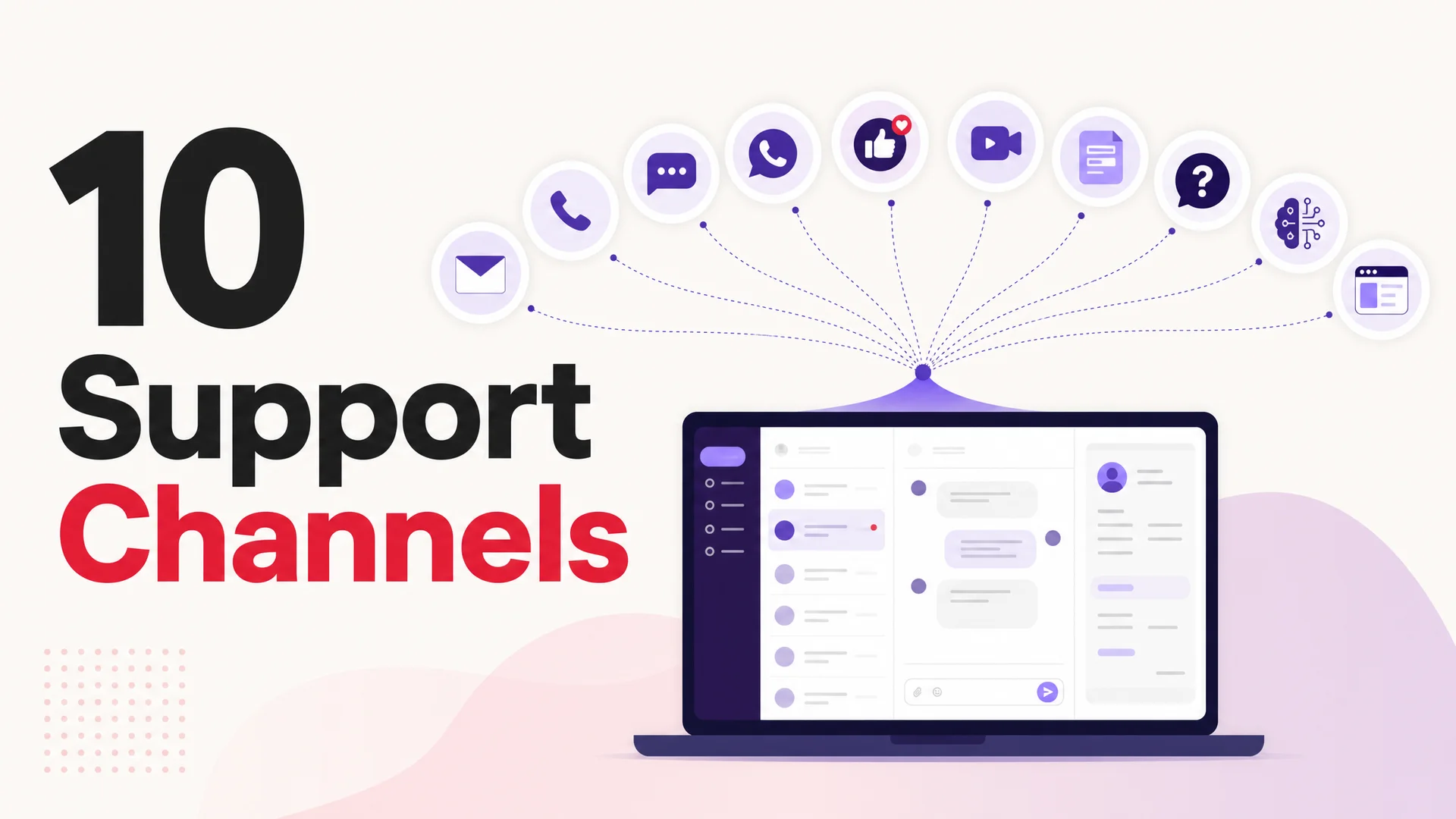
In 2026, omnichannel is the floor, not the ceiling. The brands that win are the ones where service feels like a single conversation regardless of where it started. Berrydesk's deployments cover web chat, Slack, Discord, WhatsApp, Instagram and more, all routed through one agent with one memory of the customer. That means a shopper can ask a question on your site, get distracted, follow up on Instagram an hour later, and pick up exactly where they left off - without having to repeat their name, their order number, or the problem.
The mechanics matter. Behind the scenes, this requires:
- A unified customer record that links email, social handle, order history, and conversation logs.
- An agent that can read and write to your commerce backend (Shopify, your custom OMS, whatever) via AI Actions.
- Channel-specific UX (a long product description renders fine on web but should be summarized on WhatsApp).
- Clean handoff to human agents on whichever channel the customer prefers - not "please email us" when they messaged you on Instagram.
Get this right and you stop hearing the most damning sentence in retail support: "I already explained this to someone else."
Skills that still separate great retail service from average
Tools amplify what your people are already good at. They do not replace the human ability to read a face and adjust. The same is increasingly true of AI agents - the model is only as good as the personality, knowledge, and judgment you encode into it. Whether you are training new hires or writing the system prompt for your AI agent, these are the qualities to design for.
1. Empathy
Empathy is not "saying nice things." It is reading the emotional state of the person in front of you and meeting them where they are. A shopper holding a wedding gift that arrived damaged isn't asking about your return policy. They are asking, "can you help me not look bad in front of my friend?" The right response leads with that - "let's get a replacement out today so you have it before the wedding" - and treats the policy details as plumbing.
For an AI agent, empathy translates into tone calibration. Berrydesk lets you tune the agent's voice - terse and efficient for a hardware store, warm and conversational for a beauty brand - and keep it consistent across thousands of conversations. Modern models are dramatically better at this than the GPT-3.5-era bots customers rightly hated. They detect frustration, escalate appropriately, and avoid the robotic "I understand your concern" language that signaled a bot from a mile away.
2. Communication
Good communication in retail is mostly about restraint. Fewer words, in the right order, addressing the actual question. A customer asking about the difference between two moisturizers does not need a feature dump. They need to be asked what their skin type is and what they are trying to fix. Then a clear, two-sentence recommendation.
Train your team - and your agent - to ask one clarifying question before launching into an answer when the request is ambiguous. It saves time on both sides and produces better outcomes.
3. Product knowledge
Confidence is contagious. A customer asking about a hiking pack wants to hear, "we've got two that fit your spec - this one is lighter for trail use, this one carries a 16-inch laptop better. Want to compare them side by side?" They do not want, "let me check on that for you," followed by silence.
This is where AI dramatically levels the playing field for smaller retailers. With Berrydesk, you can train the agent on your full catalog, supplier sheets, internal product wiki, Notion docs, and YouTube product reviews. The agent ends up knowing your products better than most of your store staff - including the long tail of obscure SKUs that an associate sees once a quarter.
4. Speed without rushing
Retail moves in waves. There are quiet Tuesday mornings and chaotic Saturday afternoons. The skill is being fast when speed matters and slow when presence matters. A customer trying to pick out a birthday gift wants you to take the time. A customer asking where the bathroom is wants to be pointed in the right direction in three seconds.
Speed is not just about wait times. It is about being intentional. If a return is going to take a few minutes, say so up front: "this will take me about three minutes to process, then you're free." If a question requires checking with another team, set the expectation: "I'll have an answer for you within an hour - what's the best way to reach you?" Customers are far more patient when they know what to expect than when they are kept guessing.
5. Reliability
If you say a refund will be in their account in three days, it had better be in their account in three days. Reliability is built on tiny commitments kept consistently. The brands that lose trust are not the ones that make mistakes - everyone makes mistakes - but the ones that miss commitments and don't acknowledge it.
When something is going to slip, get ahead of it. "Your refund is taking longer than the three days I quoted you. It will land by Thursday, and I've added a $15 credit for the inconvenience." That message, sent unprompted, is the difference between a frustrated customer and a loyal one.
Common pitfalls to watch out for
A few patterns show up over and over again in retailers that struggle with service, even when they have the right tools and the right intentions.
Treating AI deployment as a launch, not a process. The first version of your AI agent will not handle every case correctly. That is fine. The mistake is launching it and walking away. The retailers who get the most out of AI support review transcripts weekly, identify the gaps, and tighten the prompt, training data, and AI Actions. By month three, the agent is unrecognizable from the version that launched.
Hiding the human option. Some teams, eager to cut costs, bury the "talk to a person" link three levels deep. Customers notice. They get angrier. The deflection rate goes up briefly, then collapses as people learn to skip the bot entirely. The right pattern is the opposite: make the human handoff obvious, and design the AI well enough that most customers do not need to use it.
Forgetting the in-store experience. Plenty of digital-first retail teams pour effort into chat and email and forget that their store associates are still the most expensive, most powerful, and most overlooked customer service channel. The same standards - empathy, product knowledge, follow-through - have to be enforced in person, and the same data has to flow back into the system so the next online conversation knows what happened in store.
Using stale models and pretending it doesn't matter. A chatbot built on a 2023-era model is a noticeably different product than one built on Claude Opus 4.7 or DeepSeek V4. If your agent is hallucinating policies, missing obvious context, or answering in stilted language, the underlying model is probably the issue, not the prompt. Refresh the stack at least once a year.
Letting policy ossify. Customer expectations move. A 14-day return window made sense in 2018. In 2026, with the bigger marketplaces offering 30 to 90 days, it can read as petty. Audit the policies that generate the most friction and ask whether the cost of being generous is actually higher than the cost of being inflexible.
Open-weight vs closed frontier: a quick word on cost
One specifically retail-relevant question that comes up a lot: which model should the agent run on?
The honest answer is "more than one." Closed frontier models - GPT-5.5 Pro, Claude Opus 4.7, Gemini 3.1 Ultra - are exceptional at the hardest 5–10% of conversations. Nuanced complaints, multi-step troubleshooting, sensitive interactions where tone matters. Open-weight models - DeepSeek V4 Flash, MiniMax M2.7, Qwen3.6, GLM-5.1 - are exceptional at the routine 80% at a tenth of the cost or less. A modern setup routes traffic between them, automatically. Berrydesk supports this kind of routed deployment out of the box.
For regulated or privacy-sensitive retailers - pharmacies, financial services adjacencies, anything subject to local data residency rules - the MIT- and Apache-licensed open-weight models also unlock on-prem and air-gapped deployments. That used to be a niche concern. With GLM-5.1 (MIT) and Qwen3.6-27B (Apache 2.0) hitting frontier-class performance, it is now a real option.
Bringing it together
Retail customer service in 2026 is not a department. It is a system. It is the way your store associates are trained, the way your AI agent is configured, the way your help center is written, the way your channels are connected, and the way you decide - in the moment - whether to follow the rule or do the right thing.
The retailers winning right now are not the ones who replaced humans with bots, or the ones who refused to use AI. They are the ones who designed a service experience where humans and AI each play to their strengths, where every channel feels like the same brand, and where the customer's time is treated as the scarcest resource in the building.
If you want to see what that looks like with your catalog, your policies, and your channels - build your support agent on Berrydesk. Connect your knowledge base, brand the chat widget, switch on the AI Actions you need, and deploy to your site, Instagram, WhatsApp, or wherever your customers actually are. Then spend your team's time on the conversations that need a human, and let the rest take care of themselves.
 Berrydesk
Launch a retail support agent your customers actually like
- Train it on your catalog, policies, and FAQs in minutes
- Plug into web, Instagram, WhatsApp, and your help desk in one click
Set up in minutes

Chirag Asarpota is the founder of Strawberry Labs, the team behind Berrydesk - the AI agent platform that helps businesses deploy intelligent customer support, sales and operations agents across web, WhatsApp, Slack, Instagram, Discord and more. Chirag writes about agentic AI, frontier model selection, retrieval and 1M-token context strategy, AI Actions, and the engineering it takes to ship production-grade conversational AI that customers actually trust.