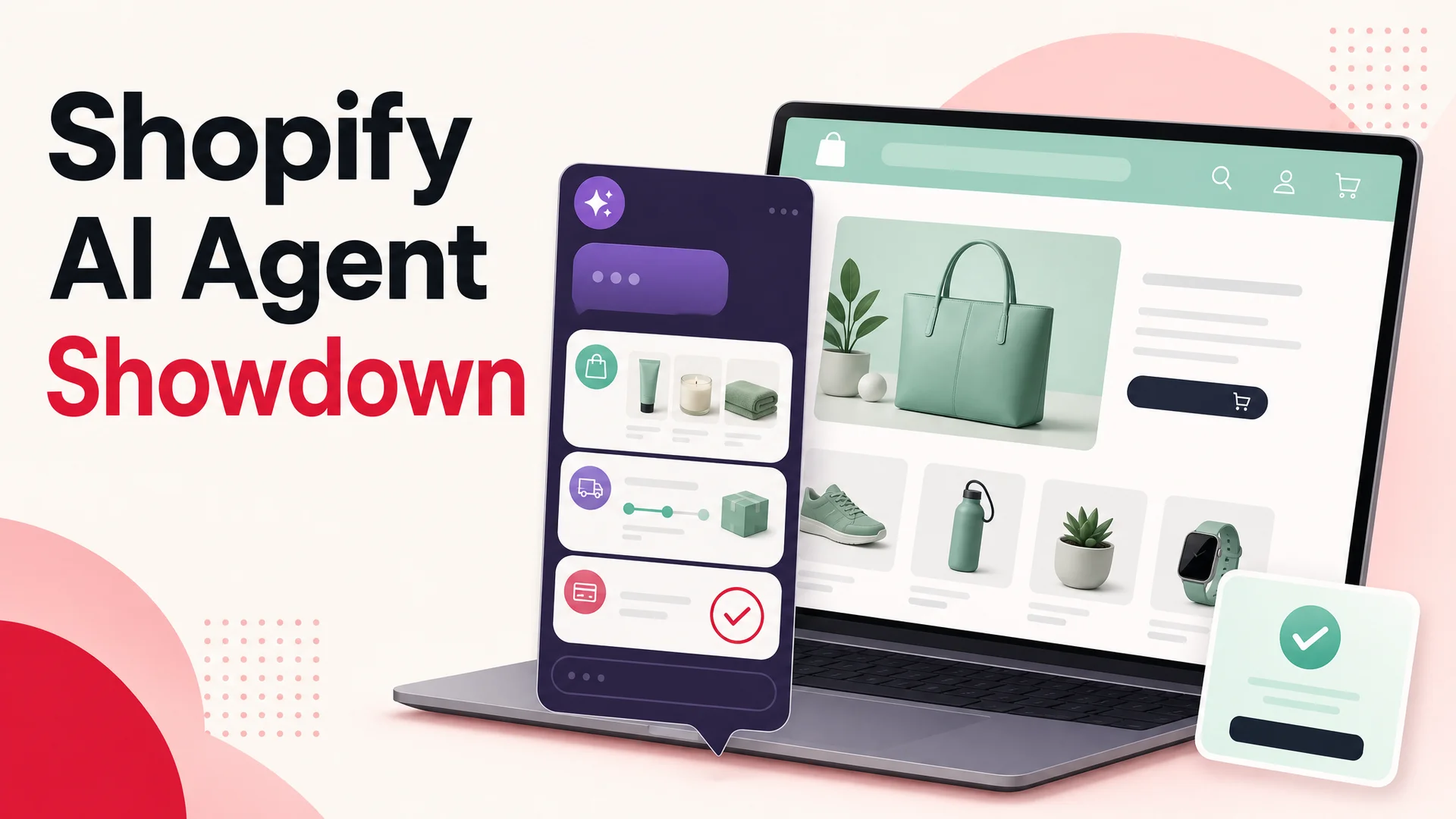
If you sell on Shopify, the chatbot conversation has shifted in the last twelve months. The old framing - a widget that greets visitors and deflects FAQs - is barely worth installing in 2026. What works now is something much closer to a junior support rep that lives inside the storefront: it reads your live product data, looks up orders, runs returns, books appointments, and quietly closes carts at 2 a.m. while you sleep.
That shift is mostly because the underlying models got dramatically better in late 2025 and early 2026. Claude Opus 4.7, GPT-5.5, and Gemini 3.1 Ultra now handle multi-step reasoning that used to break older bots, while open-weight models like DeepSeek V4 Flash and MiniMax M2 dropped the per-conversation cost low enough that running an always-on agent across every channel is no longer a budget question for most stores. The result is a market where the gap between a "chatbot" and an "AI agent" has gotten very wide, and a lot of the tools you've been pitched are still on the wrong side of it.
This post walks through six platforms worth your attention if you're shopping for a Shopify AI agent in 2026 - what each does well, where each falls short, and which kind of store should pick which.
Berrydesk-powered Shopify stores resolve roughly four out of five tickets without a human and cut first-response times from hours to seconds. Setup takes one afternoon and zero developer time.
Six Shopify AI Agents Worth Considering in 2026
Not every Shopify chatbot is built for the kind of work modern stores need. Some are still glorified FAQ deflectors with a chat skin on top. Others have leveled up into proper AI agents that take real action in your store. Here are the six that consistently show up when ecommerce teams shortlist a platform.
1. Berrydesk
Berrydesk is purpose-built for the job most Shopify owners actually need done: a support agent that handles the messy middle of ecommerce - sizing questions, shipping ETAs, returns, refunds, payment edge cases - without bouncing every conversation to a human queue.
The setup philosophy is deliberately boring in a good way. Pick a model from a long shortlist (GPT-5.5, Claude Opus 4.7, Gemini 3.1 Ultra, plus the open-weight frontier - DeepSeek V4, Kimi K2.6, GLM-5.1, Qwen3.6, MiniMax M2.7), train it on your help docs, product pages, return policy, and any internal Notion or Google Drive material that explains how your store works. Brand the widget. Add AI Actions for the workflows you want the agent to actually run - book a fitting appointment, issue a partial refund, take payment for a back-in-stock item - and ship.
Where Berrydesk earns its keep on Shopify specifically is the live-data layer. The agent can search your live product catalog from inside the chat, surface product cards with images and prices, look up an order by email or order number, check stock at a particular variant, and update the customer's cart without them ever leaving the conversation. When a return is in scope, the agent walks the customer through it and triggers it. When it isn't, the agent escalates with the full conversation context already attached so a human picks up at the right moment instead of starting over.
The model-routing piece matters more than it sounds. Most stores don't want to pay frontier-model prices for "where's my order?" but they very much want the smart model on a complex returns dispute or a multi-product upsell. Berrydesk lets you route routine traffic to a cheap fast model - DeepSeek V4 Flash at roughly $0.14 / $0.28 per million input/output tokens, or MiniMax M2 at around 8% the cost of Claude Sonnet at twice the speed - and reserve Claude Opus 4.7 or GPT-5.5 Pro for the harder escalations. The savings on a high-volume store are meaningful, and customers don't notice a thing.
Deployment surface is broad: the embedded widget on your Shopify storefront, plus Slack for the internal team, WhatsApp and Instagram for social-first shoppers, Discord for community-driven brands, and a clean API if you want to wire it into something custom. Stripe is a first-class integration for in-chat payments and invoice generation.
Try Berrydesk on your Shopify store →
Berrydesk plugs into your Shopify catalog, order system, and returns flow on day one. Train it once, and the same agent answers your storefront, your Slack escalations, and your WhatsApp DMs.
2. Tidio
Tidio positions itself as an all-in-one customer service platform - live chat, automation, ticketing, and a chatbot layer on top. For a Shopify store that wants one tool to cover live agents and basic automation, it's a reasonable starting point.
The Shopify integration handles the obvious tasks: visitor tracking, automated greetings based on the page someone is browsing, abandoned cart recovery flows, and discount-code triggers. It also covers the social channels you'd expect - Instagram, Facebook Messenger, WhatsApp - which matters if your audience lives on those surfaces more than on your storefront.
The trade-off is configuration depth. Tidio gives you a lot of knobs, and that surface area can swallow a small team's first week. The free trial is only seven days, which is barely enough to build out one workflow and watch it run, let alone evaluate the platform end-to-end. Pricing also climbs aggressively at the top end, with the most loaded tier reaching the high three figures per month - fine for a mid-market store, expensive for a scrappy one. Tidio's chatbot reasoning is also more rules-and-templates than true agentic AI, so the messier the question, the more you'll feel the difference compared to a model-first platform.
3. GoBot
GoBot's calling card is its AI-powered product quizzes. If your catalog is in a category where customers genuinely don't know what they want - skincare, supplements, mattresses, fragrance - a guided quiz is a real conversion lift, and GoBot does it well. The recommendations are accurate without being magical.
Outside the quiz feature, GoBot is fairly standard. Setup is easy and the learning curve is gentle, which is the main pitch for solo founders. There's a free tier covering the first 5,000 engagements, which is generous enough to validate whether guided selling actually moves the needle for your products before you commit to a paid plan. If you're past that test and your store doesn't lean on guided discovery, you'll likely outgrow GoBot in favor of something more agentic.
4. Re:amaze
Re:amaze is the no-frills option. It builds chatbots from templates, plugs into Shopify cleanly, and gets out of the way. There's nothing particularly novel here - no AI agent in the modern sense, no live data orchestration, no payment-taking inside chat - but the pieces it does ship are stable.
Customization is intentionally limited, which is a feature for some teams and a problem for others. If you've used a platform with deep prompt and behavior controls, Re:amaze will feel constrained. If you just want a tidy chatbot that handles common questions and escalates the rest to a human inbox, it does that without drama. Pricing is straightforward - three tiers, mid-double-digits per month - and stays predictable as you scale.
5. Gorgias
Gorgias is best understood as a support helpdesk first and a chatbot second. The ticketing layer is the strong part: a unified inbox, customer history, segmentation, intent and sentiment detection, and roughly thirty integrations across the ecommerce stack. For mid-sized brands that have outgrown a shared Gmail and need a real ticketing workflow with chatbot deflection bolted on, Gorgias is a strong fit.
The chatbot itself is more about deflecting tier-one tickets than running multi-step agentic workflows. You won't get the same "agent does the whole thing inside the chat" experience as a model-first platform. Pricing starts around $60/month and scales steeply for the higher tiers; enterprise plans are quote-only. Pick Gorgias if your bottleneck is ticket triage and your support team is already five-plus people. Skip it if you're trying to delete tickets entirely instead of route them faster.
6. Maisie AI
Maisie AI is built for small Shopify stores that want a clean, approachable chatbot without committing to an enterprise platform. Templates cover the common ecommerce scripts - abandoned cart, return triage, product recommendation - and the builder is straightforward enough that a non-technical founder can get something live the same day.
Pricing starts around $9/month for the first 1,000 unique visitors, which is the cheapest entry point on this list for an actual paid product. Lost-sale recovery, return processing, and human handoff are all in the box. The ceiling is lower than the model-first platforms - you won't get sophisticated agent reasoning or live order orchestration - but for a store doing a few hundred conversations a month, it's a sensible fit and a kind starting price.
How to Connect a Chatbot to Your Shopify Store
Three integration paths cover essentially every Shopify chatbot on the market, and the one you pick puts a hard ceiling on what your bot can actually do.
The Shopify App Store path. Tidio, Gorgias, and several others offer one-click installs from the Shopify App Store. You grant permissions, pick a theme, and the widget appears on your storefront. Speed is the win - you can be live in fifteen minutes. The cost is configuration depth: you only get whatever the app exposes through its UI, and if you need behavior the developer didn't build, you're stuck. Berrydesk also installs natively on Shopify, but pairs the easy install with a deeper data layer underneath.
The embed-code path. Most platforms, including Berrydesk, give you a small JavaScript snippet you paste into your theme. In your Shopify admin, open Online Store → Themes → Edit Code, then drop the snippet just before the closing </body> tag in theme.liquid. This works on any Shopify theme - including custom Hydrogen builds - and gives you control over placement, timing, and visibility rules. Use this when the App Store version doesn't quite match how you want the widget to behave.
The API path. This is what separates a chat widget from an actual AI agent. An API connection lets the bot read your live order data, check inventory at the variant level, retrieve tracking info, update customer records, and trigger workflows inside Shopify in real time. Berrydesk uses Shopify's API plus a layer of AI Actions so the agent can do things like "find this customer's last three orders, identify which one had the delayed delivery, and offer a 10% credit toward their next purchase" inside a single conversation.
The integration tier you choose is the integration tier the customer experiences. A storefront install gets you a friendly widget. An API integration with AI Actions gets you a support agent that operates as an extension of your team - and on a 2026 model stack with 1M-token context windows, the agent can hold your entire help center, return policy, and a customer's full order history in working memory at once instead of round-tripping through brittle retrieval steps.
The Best Free Options for Testing on Shopify in 2026
Before committing to a paid plan, most stores want to test whether the math works on their conversation volume and product mix. A few free tiers are worth using.
Berrydesk offers a free plan that lets you build, train, and deploy a real AI agent - same model selection, same AI Actions, same channel coverage - capped at a fixed number of message credits per month. It's enough to wire up your catalog, configure tone, run a couple of dozen real conversations, and decide whether the resolution quality is what you need. Paid plans start when you need higher volume, advanced analytics, or premium model routing.
GoBot covers the first 5,000 engagements free, which is the most generous threshold on this list. If your hypothesis is "a quiz will lift conversion on my catalog," that's plenty of runway to test it before paying.
Tidio offers a 7-day trial of the full platform with no permanent free tier. The window is short and the platform is broad, so you'll need a clear evaluation plan walking in or you'll burn the trial just clicking around.
Maisie AI isn't free but starts at $9/month for a small store, which is effectively a low-risk trial.
The honest read: free tiers exist to validate fit, not to run a real store on. Any Shopify business doing more than a handful of daily conversations will outgrow them inside a quarter. The right question isn't "can I run on free forever?" - it's "does the platform I'm validating on free still feel like the right tool when I'm paying for 50,000 conversations a month?"
How AI Agents Actually Move Revenue on Shopify
Roughly seventy percent of online carts get abandoned, and the most common reasons are the kind of small frictions a fast, knowledgeable agent can resolve in seconds: shipping cost surprise, return policy uncertainty, product fit doubt, payment failure. An always-on agent that addresses those frictions in the moment is, mathematically, a revenue tool - not just a support tool.
Recovering abandoned carts. When a customer adds a $200 jacket to their cart and then sits on the page for three minutes, a generic exit-intent popup is noise. A contextual agent message - "Free returns within 30 days on this jacket, and right now we'd ship by Tuesday - anything I can answer about sizing?" - is a different conversation. It addresses the actual hesitation, in the actual customer's language, with information pulled from your live product and shipping data.
Personalized product recommendations. Long-context models in 2026 can hold your entire catalog and the customer's session history in working memory at once. That changes recommendations from "people who bought X also bought Y" to "based on the three products you've looked at, the size question you just asked, and the fact that you bought a complementary item six months ago, here's the one I'd actually pick." For stores with sprawling catalogs, this replicates the in-store associate experience that ecommerce historically couldn't deliver.
Automating post-purchase support. Order tracking, return initiation, and exchange handling are the highest-volume tickets in ecommerce. They're also the easiest to automate well, because the data is structured and the workflows are repeatable. An AI agent connected to Shopify's API answers "where's my order?" instantly and accurately, runs the return workflow end-to-end, and only loops a human in when the situation is genuinely ambiguous.
Capturing the after-hours window. A real share of ecommerce purchase intent shows up between 9 p.m. and 1 a.m. local time, when most support teams are offline. An agent that handles a sizing question, a payment retry, or a "do you ship to my country?" question at 11 p.m. on a Sunday isn't replacing a human - it's capturing revenue that would otherwise have evaporated by Monday morning.
One quiet thing to watch out for. The single most common failure mode we see on Shopify is a chatbot that's confidently wrong about live data - wrong stock level, stale order status, an outdated shipping ETA. Older retrieval-only bots produce this constantly. The fix is the API integration: an agent that reads from Shopify directly, in real time, instead of from a snapshot of your catalog from last week. It's also the dividing line between a tool you can trust on returns and refunds and a tool you can't.
The stores that get the strongest ROI from AI agents treat them as part of the conversion funnel, not as a deflection layer downstream of it. Every conversation is a chance to close a doubt that would otherwise close a tab.
Putting an AI Agent on Your Shopify Store
Plenty of brands didn't make this list, and most of the ones that didn't share a common shortcoming: they were built for the 2023 chatbot world and never quite caught up to what 2026 models can do. The six platforms above each fit a clear niche - Tidio for all-in-one teams, Gorgias for mid-market support ops, Re:amaze for no-frills, GoBot for guided selling, Maisie AI for very small stores.
For a Shopify store that wants the modern thing - an AI agent that reads live data, takes action inside the chat, routes between models for cost and quality, and ships across web, WhatsApp, Slack, and Instagram from one dashboard - Berrydesk is the most direct fit. The model selection is wide enough that you can right-size cost vs. capability per channel. The AI Actions layer is what turns the agent from a Q&A bot into something that actually moves the support and sales numbers. And the install is short enough that you can test the whole thing on a real customer load this week, not next quarter.
If you're ready to put a proper support agent on your storefront, you can build one for free at berrydesk.com - train it on your catalog and policies, brand the widget, wire up the AI Actions you care about, and have it live before your next promo cycle.
 Berrydesk
Launch a Shopify support agent in an afternoon
- Trains on your catalog, policies, and Notion docs in minutes
- Looks up orders, processes returns, and takes payments inside chat
Set up in minutes

Chirag Asarpota is the founder of Strawberry Labs, the team behind Berrydesk - the AI agent platform that helps businesses deploy intelligent customer support, sales and operations agents across web, WhatsApp, Slack, Instagram, Discord and more. Chirag writes about agentic AI, frontier model selection, retrieval and 1M-token context strategy, AI Actions, and the engineering it takes to ship production-grade conversational AI that customers actually trust.