For most subscription businesses, the single largest bucket of inbound support traffic is billing. Failed cards, prorated upgrades, "why was I charged twice," "send me a VAT-compliant invoice," "cancel and refund the last month" - these are the tickets that crush small support teams and burn out senior agents who would rather be working on edge cases. They are also the tickets most likely to escalate into a chargeback, a Trustpilot rant, or a churn event when they sit in a queue for two days.
The frustrating part is that almost none of those tickets actually require human judgment. They require access - read access to a subscription record, write access to a refund endpoint, the ability to push a new invoice. For years, the standard "AI chatbot" sitting on a SaaS marketing site could read a help center article about billing and paraphrase it back. It could not actually do the billing.
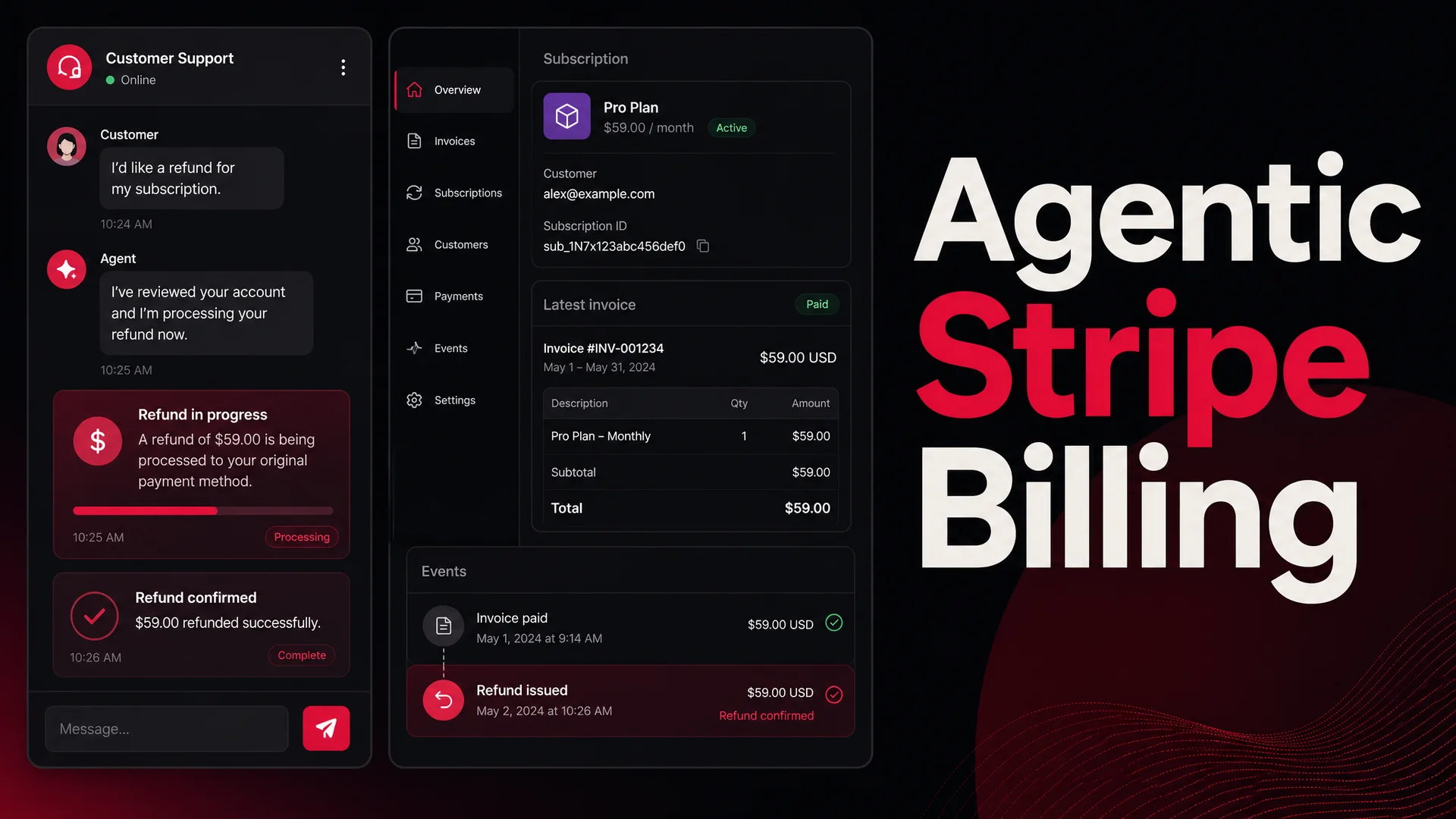
That gap is what Berrydesk's AI Actions are built to close. Connect Stripe (or your payment processor of choice), wire up the actions you want the agent to take, and your support agent stops being a glorified FAQ and starts being a teammate who can actually resolve the ticket while the customer is still in the chat window.
Why billing is the ideal first agentic workflow
If you are introducing AI Actions for the first time, billing is almost always the right place to start. The reason is structural, not stylistic.
Billing tickets have a small, well-defined surface area. A handful of operations - fetch subscription, fetch invoice, issue refund, update plan, retry payment, swap payment method - cover the overwhelming majority of inbound volume. That bounded API surface makes it tractable to test, sandbox, and add guardrails to. Compare that with, say, "diagnose a hardware failure" or "advise on which feature to use," where the action space is open-ended.
Billing tickets also have unambiguous success criteria. Either the refund hit Stripe, or it did not. Either the plan changed, or it did not. There is a webhook event you can audit. That auditability is exactly what compliance and finance teams want before they sign off on letting an AI touch money.
And finally, the customer outcome from automation is dramatic. A two-day wait for a $14 refund is the kind of micro-frustration that pushes people to cancel. A six-second resolution inside the chat changes the emotional valence of the entire interaction.
What changed in 2026 to make this finally work
Agentic tool-use sounds like a 2024 idea, but in practice the early generation of "function calling" was brittle. Models would invent fields, skip required parameters, hallucinate currencies, or get confused on multi-step flows like "find the latest invoice, prorate the difference, then refund."
The current model generation is genuinely different. Claude Opus 4.7 leads SWE-bench Pro at 64.3% and is exceptionally reliable at structured tool-calling chains. Moonshot's Kimi K2.6, an open-weight 1T-parameter MoE released in April 2026, was designed agentic-first - it can run autonomous coding sessions for twelve hours and coordinate up to 300 sub-agents across 4,000 steps, which is dramatic overkill for a refund workflow but tells you everything about how robust the underlying tool-use has become. Z.ai's GLM-5.1, MIT-licensed and trained entirely on Huawei Ascend hardware, scores 58.4 on SWE-Bench Pro and runs eight-hour autonomous plan-execute-test-fix loops. Alibaba's Qwen 3.6 family and Xiaomi's MiMo-V2-Pro are tuned in the same direction.
For a Berrydesk deployment, the practical implication is that the choice of model is now a cost and latency decision more than a capability decision. You can route the bulk of your billing traffic to DeepSeek V4 Flash at $0.14 / $0.28 per million tokens, or to MiniMax M2 at roughly 8% the price of Claude Sonnet at twice the speed, and reserve Claude Opus 4.7 or GPT-5.5 Pro for the rare ambiguous case that needs deeper reasoning. The 1M–2M-token context windows on Claude Sonnet 4.6, DeepSeek V4, and Gemini 3.1 Ultra mean the agent can hold your entire billing policy, the customer's full history, and the relevant Stripe objects in a single prompt, which is what makes the multi-step flows actually reliable.
What a Berrydesk agent can do once it's wired into Stripe
The set of actions you expose to the agent should be deliberate, not maximalist. A typical first deployment looks like this:
- Look up subscription state. The agent can pull the customer's current plan, billing interval, next invoice date, payment method status, and any past-due balance. This alone resolves a large fraction of "what's my plan" and "when is my next charge" tickets without any write operations.
- Send invoices and receipts. Customers asking for a tax-compliant invoice or a duplicate receipt for expenses can get the document emailed inside the chat, with the right billing address and VAT field already on file.
- Issue refunds within policy. This is where guardrails earn their keep. The agent should be allowed to refund up to a defined amount (say, one billing cycle), within a defined window (say, the last 30 days), without escalation. Anything outside the envelope routes to a human.
- Change plans and seats. Upgrades, downgrades, seat additions, and prorated swaps all become single-turn interactions. The agent confirms the change, runs the action, and reads back the new invoice total.
- Handle dunning and recovery. When a card fails, the agent can proactively reach out, walk the customer through updating the payment method, and retry the charge. This recovers revenue that would otherwise silently leak through involuntary churn.
- Cancel and pause. The agent can offer a pause as a save attempt, accept the cancellation if the customer insists, and confirm the effective date in writing. The transcript itself becomes the audit trail.
Each of these maps cleanly to a Stripe API call, and each one can be sandboxed in a Stripe test mode environment until your team is comfortable letting it run in production.
Setting it up in Berrydesk
The deployment loop is intentionally short. Inside the Berrydesk dashboard, point the agent at your knowledge base - your billing policy, your refund rules, your dunning cadence, your terms of service. Connect Stripe through the AI Actions panel and pick which actions the agent is allowed to perform, with optional spend caps and approval rules. Brand the chat widget so it lives on your site, in Slack, in Discord, on WhatsApp, or wherever your customers already are. Pick the model that fits the work - Claude Opus 4.7 if you want maximum reasoning, DeepSeek V4 Flash if you want maximum margin, Gemini 3.1 Ultra if you want long-context multimodal handling for screenshots of failed payments.
A small team can typically have a working billing agent in production in a single afternoon. Most of the time goes into writing tight, honest policy text - the agent will only be as principled as the documents it learns from.
Common pitfalls to avoid
A few patterns we see new teams fall into:
Letting the agent write before it's ready to read well. If your knowledge base is out of date, the agent will confidently misquote your refund policy and then act on it. Audit your billing docs before you turn on write actions.
Skipping the spend cap. Every refund action should have an upper bound. The cap protects you from prompt injection, from edge-case hallucination, and from the rare customer who tries to talk the agent into something generous. Anything beyond the cap should require a human signoff that the agent surfaces in the same conversation.
Treating it as a single-model decision forever. Re-evaluate quarterly. The open-weight frontier is moving fast - DeepSeek V4, Kimi K2.6, GLM-5.1, Qwen 3.6, MiMo-V2-Pro, and MiniMax M2.7 all shipped within a six-week window in March and April 2026, and each has shifted the price-performance frontier. A routing layer that lets you swap in a cheaper or stronger model without rewriting your prompts is worth building from day one.
Forgetting the human handoff. The agent should know when to stop. Disputed charges, suspected fraud, anything that requires reading between the lines of an angry message - these are signals to escalate, not to keep going. A clean handoff with the full context already summarized is more valuable than a forced resolution.
Where this leads
Billing is the wedge, not the destination. Once your support team trusts the agent to move money correctly, the same pattern extends to bookings, account provisioning, shipping changes, return labels, and every other operational task that today routes through a human queue. The shift is not from chatbot to better chatbot - it is from a layer that talks about your business to a layer that runs parts of it.
If you're ready to put a billing agent in front of real customers, start building with Berrydesk. You can connect Stripe, pick your model, and have a working agent live on your site in less time than it takes to clear today's billing queue by hand.
 Berrydesk
Turn billing tickets into instant resolutions
- Wire your AI agent into Stripe in minutes - refunds, plans, invoices, all from chat
- Pick the model that fits your margins: Claude Opus 4.7 for nuance, DeepSeek V4 Flash for scale
Set up in minutes

Chirag Asarpota is the founder of Strawberry Labs, the team behind Berrydesk - the AI agent platform that helps businesses deploy intelligent customer support, sales and operations agents across web, WhatsApp, Slack, Instagram, Discord and more. Chirag writes about agentic AI, frontier model selection, retrieval and 1M-token context strategy, AI Actions, and the engineering it takes to ship production-grade conversational AI that customers actually trust.