AI agents now sit behind the recommendation rail you scroll on a Friday night, the lane-keeping that nudges your car back into position on the highway, and the support reply that lands in a customer's inbox at 3 a.m. while your team is asleep. They are not a single category of software. They are a family of approaches with very different appetites for memory, planning, and learning.
That family is wider than most buyers realize. A keyword-matching FAQ widget and a Claude Opus 4.7 agent that books a meeting, processes a refund, and writes back a personalized message are technically both "AI agents" - but they share almost nothing under the hood. Treating them as interchangeable is how teams end up paying frontier-model prices for problems a rule engine could solve, or pinning regulated workflows on a thin script that breaks the moment a customer phrases something sideways.
This guide walks through the five canonical types of AI agents, what each one is actually doing, where each shines, and where each falls over. We will use real-world examples - including how each maps onto a modern customer support stack - and weave in the 2026 model landscape so the recommendations are current, not three product cycles stale. By the end you should have a clean mental model for matching agent type to problem, and a sense for which categories are now the default choice for support, ops, and revenue work.
What actually makes something an AI agent
An AI agent is software that perceives its environment, decides what to do next, and acts on that decision - usually in pursuit of some goal. The line between "agent" and "ordinary program" sits at autonomy. A spreadsheet waits for you to type a formula. A spam filter watches your inbox, decides which messages are junk, and quarantines them without asking. The first is a tool. The second is acting on your behalf.
A few traits show up across every flavor of agent. Autonomy means the agent operates without constant human prompting; the recommendation system on your streaming service does not ask permission before queuing the next show. Reactivity means the agent senses changes in its environment and responds; a trading bot detects a price drop and executes a buy. Proactivity means the agent moves toward goals on its own; a chess engine does not wait for you to suggest the next move. The more sophisticated the agent, the more weight it puts on proactivity over pure reaction.
The interesting thing about 2026 is how dramatically the floor and ceiling of "agent" have moved. The floor still includes if-then automations that look indistinguishable from the ones we shipped in 2010. The ceiling now includes models like Moonshot's Kimi K2.6, which can run a 12-hour autonomous coding session, coordinate up to 300 sub-agents across 4,000 steps, and never check in with a human until it is done. Both are agents. The taxonomy below explains why that range exists and how to navigate it.
The five types of AI agents at a glance
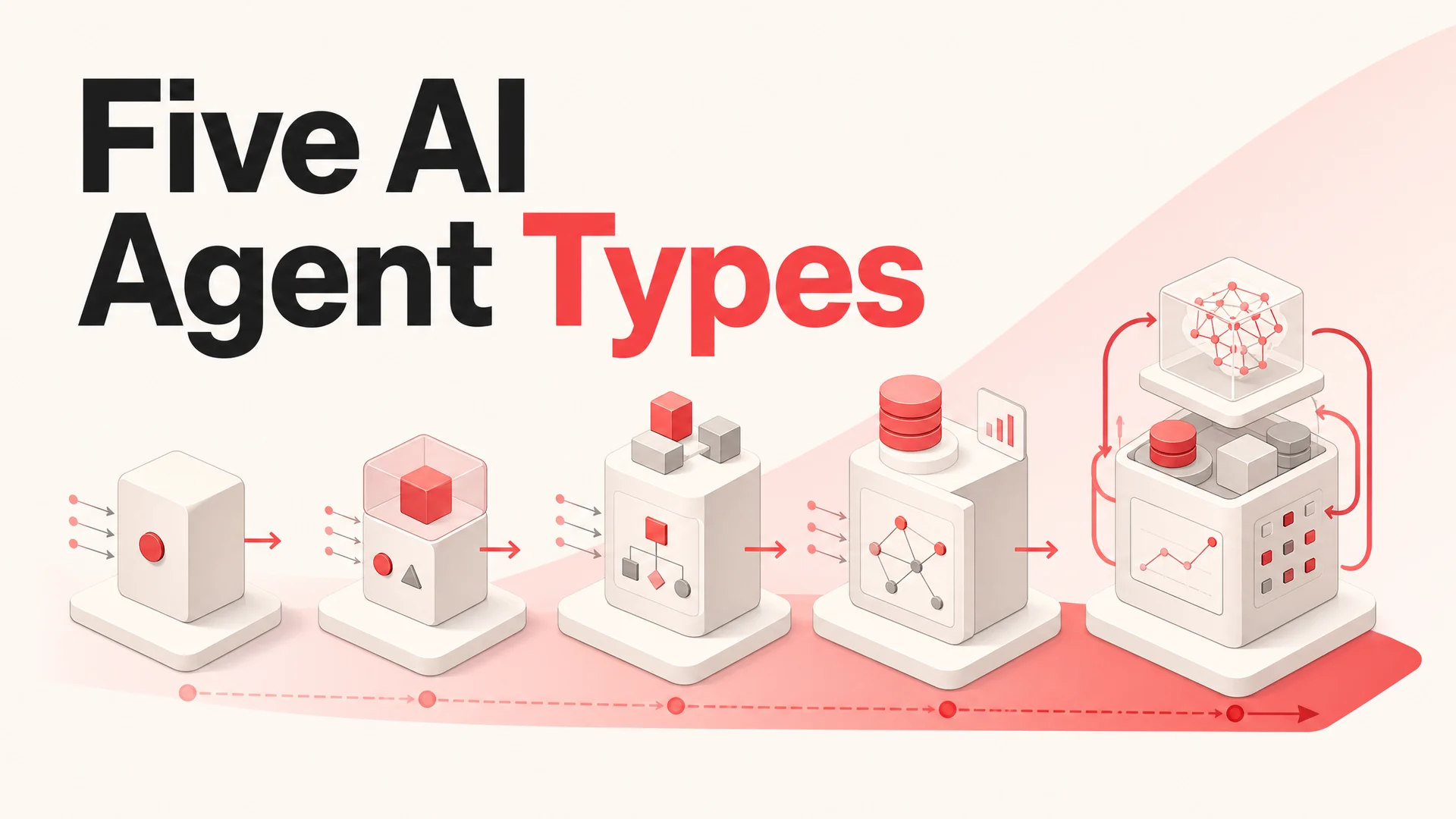
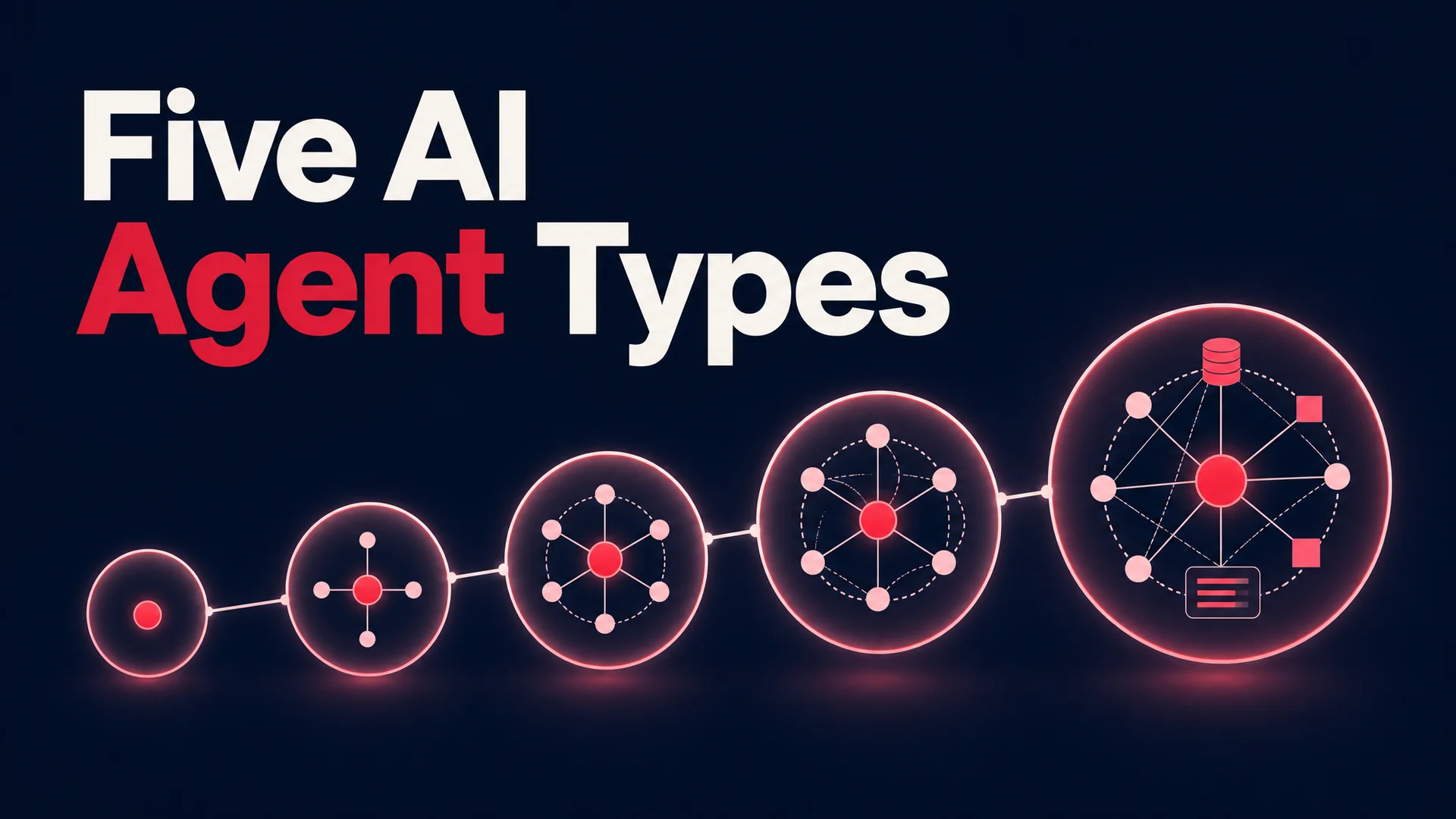
Researchers usually classify agents by how they make decisions and what they keep track of between decisions. The five-type framework - simple reflex, model-based reflex, goal-based, utility-based, and learning - has held up because it captures real architectural differences, not surface details. As you read each section, hold in mind the question the agent is implicitly answering:
- Simple reflex: "What rule fires right now?"
- Model-based reflex: "Given what I remember about the world, what rule fires now?"
- Goal-based: "Which action moves me closer to my goal?"
- Utility-based: "Which action gives me the highest-value outcome?"
- Learning: "Given what I just observed, how should I change my behavior?"
Each step up adds capability and cost. Each step up also adds new failure modes. Picking the right rung is the entire game.
1. Simple reflex agents
Simple reflex agents are pure stimulus-response. They look at the current input, match it against a table of condition-action rules, and fire the matching action. There is no memory of what came before and no model of what might come next. If the rule is not in the table, the agent either does nothing or does something wrong.
Mechanically, the loop is: sensor reads the environment, rule engine checks if X then do Y, actuator does Y. That is the whole story. No probability, no inference, no planning.
Where you actually see them
Automatic doors and motion-triggered lights are the textbook case. A sensor detects movement, a relay opens the door or flips the switch. The system has no concept of who is approaching or whether anyone walked through five minutes ago.
Keyword-routing chatbots are the support world's version. Type "refund" and you get the refund script. Type "refund" again and you get the same script, because the bot has no memory that you already saw it. Most pre-LLM "chatbots" sold to support teams between roughly 2016 and 2022 were simple reflex agents in a friendly UI.
Bang-bang thermostats and circuit breakers sit in the same family. If temperature drops below 68°F, turn the heater on. If current exceeds 20 amps, trip the breaker. There is no learning, no schedule, no context - just the rule.
Strengths and limitations
The case for simple reflex agents is speed, cost, and predictability. They respond in microseconds, run on hardware a wristwatch could spare, and behave identically every time. In a stable environment with a small, well-understood set of inputs, they are still the right answer.
The limitations show up the moment the environment is not stable. They cannot handle ambiguity, cannot recover from the unexpected, and have no way to escape loops - the canonical example is a vacuum that keeps bumping the same wall because nothing in its rule set tells it the wall is still there. In a support context, they collapse the moment a customer asks anything nuanced; the cost is not that they answer wrong, it is that they erode trust before a human ever sees the conversation.
When to use them in support and ops
Reserve simple reflex agents for narrow, deterministic jobs: routing intents to queues, blocking known spam phrases, triggering an escalation when a message contains certain compliance-sensitive terms. They are infrastructure, not the conversation itself. If your bot's main job is talking to customers, a reflex agent is the wrong shape.
2. Model-based reflex agents
Model-based reflex agents add a single, transformative ingredient: an internal state. They keep a running model of how the world is laid out and how it changes over time, including parts of the world they cannot currently see. This lets them reason about partial information instead of pretending nothing exists outside the immediate sensor reading.
The decision loop now has four steps: read the sensor, update the internal model, check the rules against the model, act. The leap from one to the other is bigger than it sounds - the agent now has continuity. It knows what it did a minute ago, what changed because of that action, and what is probably true even when its sensors are blocked.
Where you actually see them
Robot vacuums like the modern Roomba family map your floor as they clean. They remember which rooms they have finished, which corner the dock is in, and where the staircase is, even when none of those are visible. When the bot ducks under a couch and loses the WiFi signal, its internal map keeps it oriented.
Smart home and security systems track baselines for normal activity - when doors open, when motion happens, when lights go on. A 3 a.m. window event reads as anomalous because the system has a model of what 3 a.m. usually looks like in your house.
Conveyor-belt sorters in fulfillment centers scan a barcode at one end of the line, predict where the package will arrive based on belt speed, and time the diverter arm without re-scanning. The model substitutes for continuous perception.
In support, model-based agents show up wherever conversation state matters: tracking which questions a customer has already asked, which articles they have already been pointed at, what page of the funnel they are on, whether they are a paying customer or a trial user. A bot that remembers "you already asked about refunds two messages ago" is doing model-based reasoning even if it dresses it up as a chat reply.
Strengths and limitations
The strength is graceful handling of partial information. Sensors fail, signals drop, customers reload the page mid-conversation - a model-based agent keeps going because its picture of the world is not solely a function of right-now. It also avoids redundant work; the vacuum will not re-clean the kitchen because it remembers it just did.
The limitation is that the model can drift away from reality. Move the furniture without telling the vacuum and it will try to drive through a chair. Update your refund policy without rebuilding the bot's internal state and it will quote the old one with full confidence. Maintaining the model takes more compute and more careful design than a pure reflex agent, and the cost of a stale model is silent rather than loud.
When to use them in support and ops
Anything that needs context across turns or sessions wants a model-based component: conversation memory, customer state, ticket history, "you asked about this two weeks ago" follow-ups. Modern support agents on Berrydesk lean heavily on this - the agent does not just answer the current message, it answers the current message in the context of the customer's last seven interactions and their current account state.
3. Goal-based agents
Goal-based agents add planning. Instead of asking "what rule fires," they ask "what sequence of actions gets me from here to there." They use their model of the world to simulate possible futures, evaluate which paths reach the goal, and choose the best route. Change the goal and you do not have to rewrite the agent - the same planning machinery will figure out a new route.
The structural shift is from rules to search. A goal-based agent has a description of the desired end state and a way to imagine the consequences of candidate actions. It explores those consequences, often quite deeply, before committing.
Where you actually see them
Routing software in self-driving stacks and logistics platforms takes a destination and continuously re-plans around traffic, weather, road closures, and battery state. It is not following a fixed rule; it is solving a fresh shortest-path problem every few seconds.
Game-playing systems like AlphaZero or top-tier chess engines look ahead through millions of candidate move sequences, each scored against the goal of winning. The "rule" is to win; the planning is everything else.
Personal task and project tools that take a goal - "ship the v2 launch by July" or "lose 10 pounds by August" - and decompose it into concrete steps are doing goal-based reasoning.
In customer support, goal-based agents are what the 2026 generation of large models has unlocked at scale. When a customer says "I'd like to reschedule my Tuesday appointment to sometime next week, ideally morning," a modern agent built on Claude Opus 4.7, GPT-5.5, or Kimi K2.6 does not pattern-match a script. It treats "reschedule appointment" as a goal, queries the calendar via an AI Action, finds available morning slots, proposes one, confirms with the customer, and writes the change back. That whole loop is goal-based planning over tool calls - and it works reliably in production now in a way it simply did not eighteen months ago, because models like Kimi K2.6, GLM-5.1, Qwen3.6, and MiMo-V2 have crossed the threshold where multi-step tool use stops fumbling.
Strengths and limitations
Goal-based agents are flexible. Swap the goal and the same agent solves a different problem. They handle obstacles by re-planning rather than failing. And they are explainable - you can ask "why did you do that" and trace the answer through the plan.
The cost is compute and latency. Searching through possible action sequences is not free, especially when each step involves a tool call that takes hundreds of milliseconds. They are also harder to design well; the quality of the agent depends on how accurately it can predict the consequences of its actions, and that prediction quality is where most goal-based systems quietly fail.
When to use them in support and ops
Use goal-based agents anywhere the customer's request maps to a clear outcome with multiple possible paths: bookings, rescheduling, refunds, order modifications, multi-step troubleshooting, account changes. The 2026 rule of thumb is that if you find yourself writing a long decision tree to handle "what if the customer says X then Y then Z," you have outgrown reflex agents and want a goal-based one.
4. Utility-based agents
Utility-based agents are goal-based agents with a richer success criterion. A goal-based agent is satisfied with any path that reaches the goal. A utility-based agent ranks paths by a numerical utility function and picks the one with the highest score. That distinction matters when there are trade-offs - when "succeeding" is really a question of which kind of success you want.
Mathematically, the agent assigns each candidate outcome a number representing how desirable it is, then chooses the action with the highest expected utility. The hard work is designing a utility function that actually reflects what you care about, including the things that are hard to quantify.
Where you actually see them
Flight and travel booking systems weigh price against duration against layovers against departure time against airline preference. Two flights might both "get you to Lisbon," but one is better on the utility curve.
Surge and dynamic pricing engines at rideshare and delivery platforms balance driver earnings, customer wait time, conversion rate, and competitor pricing. They are not picking the highest price or the lowest price; they are picking the price with the best expected value across the whole system.
Portfolio managers and recommendation systems trade off return against risk, novelty against familiarity, short-term against long-term. The agent's value is in the trade-off, not in any single optimization.
In support, utility-based reasoning shows up when you start routing model traffic intelligently. A typical Berrydesk deployment might score every incoming message on complexity and risk, then route accordingly: high-volume, low-stakes intents go to DeepSeek V4 Flash at $0.14 per million input tokens; nuanced policy questions go to Claude Opus 4.7; multimodal tickets with screenshots and short videos go to Gemini 3.1 Ultra; agentic tasks that need long autonomous tool-calling sessions go to Kimi K2.6 or GLM-5.1. The router itself is a utility-based agent, balancing answer quality, latency, cost, and confidence on every request. That kind of model routing is one of the highest-ROI patterns in production support today, and it is utility-based agency end to end.
Strengths and limitations
The strength is nuance. Utility-based agents are the right tool whenever "good enough" leaves money or quality on the table, and whenever the right answer depends on weighing several conflicting things at once. They also handle uncertainty gracefully - when outcomes are probabilistic, expected utility gives you a principled way to choose.
The limitations are upstream of the agent itself. The whole system is only as good as the utility function, and writing a utility function that accurately captures things like "customer satisfaction," "brand safety," or "compliance risk" is genuinely hard. Computation costs grow as the agent considers more options. And debugging a poorly performing utility-based agent often means debugging the scoring function, not the agent's logic.
When to use them in support and ops
Use utility-based agents whenever you face explicit trade-offs at scale: model routing across a portfolio of LLMs, dynamic deflection thresholds, escalation logic that weighs cost against CSAT, prioritization across a queue of tickets with different SLA, customer tier, and content complexity. If your team is making the same trade-off thousands of times a day, a utility-based agent will make it more consistently than humans can.
5. Learning agents
Learning agents change their own behavior based on experience. Every other type on this list is fixed at deploy time - the rules, the model, the goals, the utility function are all written down by humans and stay that way until humans rewrite them. A learning agent rewrites itself.
The classical architecture has four parts. The performance element picks actions, like any other agent. The critic evaluates how well those actions worked, against some external feedback signal. The learning element updates the agent based on what the critic said. The problem generator suggests novel actions or situations to explore, so the agent does not just optimize over what it already knows. The four pieces are how an agent improves over time without a human in the loop.
Where you actually see them
Autopilot systems in modern cars are learning agents in the strict sense. When a human takes over or corrects the car's intended path, that disagreement becomes training data. The fleet collectively improves. Tesla's stack is the famous example, but the same architecture now runs across most major OEMs.
Frontier LLMs like Claude Opus 4.7, GPT-5.5 Pro, Gemini 3.1 Ultra, DeepSeek V4 Pro, and Kimi K2.6 are learning agents at training time. Reinforcement Learning from Human Feedback, constitutional AI, and the newer self-play and self-evolving methods used by models like MiniMax M2 are all variations on the same loop: the model acts, a critic evaluates, the model updates, the cycle repeats. Within a single conversation, today's deployed models do not learn - but the version you are talking to was shaped by billions of these loops, and the next version is being shaped by yours right now.
Recommendation systems at every major streaming, retail, and feed product are learning agents wrapped around utility functions. Each click is a critic signal. The model adjusts.
Support agents with feedback loops are the everyday version. When your agent asks "did this answer your question," tracks which articles led to resolution versus escalation, and uses those signals to fine-tune retrieval, ranking, and response generation, you have a learning agent in production. Berrydesk's analytics layer is built around making these signals available so you can close the loop without writing the training infrastructure yourself.
Strengths and limitations
The strength is adaptation. Learning agents handle situations their designers did not anticipate, discover strategies humans did not think of, and improve continuously without code changes. In any environment that drifts - customer language, product features, the competitive landscape - a learning agent ages much better than a static one.
The limitations are real. Learning agents are data-hungry; they need volume and quality of feedback to improve. They are expensive to train and re-train, though the open-weight frontier from DeepSeek, Z.ai, Moonshot, MiniMax, Alibaba, and Xiaomi has compressed those costs dramatically - GLM-5.1 trained entirely on Huawei Ascend chips with no Nvidia in the loop, and the MIT-licensed weights mean a regulated enterprise can run, fine-tune, and air-gap-deploy a frontier-grade model on their own hardware. That said, learning agents can also learn the wrong things. If your feedback signal is biased, the agent inherits the bias; if customers thumbs-up confidently wrong answers, the agent gets confidently more wrong over time. They need ongoing evaluation, guardrails, and human review.
When to use them in support and ops
Use learning agents whenever the underlying problem shifts faster than you can re-author rules. New products, new policies, new customer cohorts, new edge cases - these all reward an agent that gets better over time without a redeploy. The 2026 default for serious support deployments is a learning loop wrapped around a goal- or utility-based agent: the agent plans and acts, the system collects outcomes, and the model improves on the next training cycle.
How to choose the right type for your problem
Almost every team gets this wrong in the same direction: they reach for the most sophisticated agent type available, because it sounds impressive, and end up paying for capabilities they do not use. The discipline is to start at the bottom of the ladder and only climb when the rung you are on actually breaks.
Start with the environment, not the model. Stable, narrow, predictable problems want simple reflex or model-based reflex agents. Dynamic, ambiguous, high-variance problems want goal-based, utility-based, or learning agents. A status-page bot does not need GPT-5.5 Pro. A negotiation flow probably does.
Match cost to value, not to ambition. A typical Berrydesk customer running 50,000 tickets a month does not run them all on Claude Opus 4.7. The economics work because the bulk of routine traffic gets handled by DeepSeek V4 Flash or MiniMax M2 - both open-weight, both pricing fractions of a cent per resolution - with the heavy frontier models reserved for the 5–10% of conversations that actually need them. That routing decision is a utility-based agent in front of a portfolio of learning-trained models. Build the cost story into the architecture from day one.
Think long-term, not just launch. Reflex and model-based agents are cheap to ship and cheap to run, but they ossify. Learning agents cost more upfront and more to operate, but they bend with the business. If your domain is moving fast - new products quarterly, new policies monthly, new customer segments weekly - pay the upfront cost.
Plan for failure modes, not just happy paths. Each agent type fails in characteristic ways. Reflex agents repeat themselves. Model-based agents drift when reality changes faster than their model. Goal-based agents pursue goals literally and miss the point. Utility-based agents optimize the wrong number when the utility function is poorly specified. Learning agents inherit the biases of their feedback. Knowing what your agent will do when it is wrong is at least as important as knowing what it will do when it is right.
Common pitfalls to avoid
A few patterns burn teams repeatedly. Building a learning agent for a problem a rule could solve is the most common - six months of MLOps to replace a fifty-line decision tree. Skipping the model-based step and trying to get a stateless reflex agent to handle multi-turn conversation, then blaming the LLM when it forgets context. Routing everything to the most expensive model because it is "the best one," then watching unit economics implode. Trusting a learning loop without guardrails, and finding out three weeks later that the agent has quietly trained itself to confidently agree with whatever the customer said. Designing utility functions in a vacuum, optimizing for handle time when the business actually cares about resolution rate. None of these are technical failures. They are alignment failures between the type of agent and the shape of the problem.
Open-weight vs. closed-frontier in agent design
A 2026-specific decision worth flagging: when you build a goal-based, utility-based, or learning agent on top of LLMs, you now have a real choice between closed frontier (GPT-5.5, Claude Opus 4.7, Gemini 3.1) and open-weight frontier (DeepSeek V4, Kimi K2.6, GLM-5.1, Qwen3.6, MiniMax M2, MiMo-V2). The closed models still lead on the hardest reasoning and the most sensitive judgment; Claude Opus 4.7's 64.3% on SWE-Bench Pro and Gemini 3.1 Pro's 94.3% on GPQA Diamond are not numbers the open weights have closed all the way to. But for the bulk of agentic support work - tool use, multi-step planning, knowledge retrieval at 1M-token context - the open-weight tier is now genuinely competitive, with MIT- and Apache-licensed weights that you can deploy on-prem, fine-tune freely, and run at a fraction of frontier pricing. The right architecture for most teams in 2026 is a routed mix, not a religion.
The bottom line
The five-type taxonomy is not academic. It is the cleanest mental model for matching the right amount of intelligence to the actual shape of your problem. Simple reflex for the truly deterministic. Model-based reflex for the partially observable. Goal-based for the planful. Utility-based for the trade-off-heavy. Learning for the ever-changing. Most production systems end up as composites - a learning-trained, utility-routed, goal-based agent with reflex guardrails on top - and that composition is itself the design work.
The era of treating "AI agent" as a single thing is over. The teams that win in 2026 are the ones who can name what kind of agent they are building, why that type fits the problem, and what the next type up the ladder would buy them if they ever needed it.
If you want to skip straight to building one for customer support - pick the model that fits the workload, train it on your knowledge, wire up AI Actions for the operations that matter, and ship to wherever your customers already are - start with Berrydesk. The taxonomy above is the theory. The platform is the shortest path from theory to a live agent your customers can talk to today.
 Berrydesk
Launch a support agent built on the model that fits your problem
- Pick from GPT-5.5, Claude Opus 4.7, Gemini 3.1, DeepSeek V4, Kimi K2.6, GLM-5.1, Qwen3.6, MiniMax M2 and more
- Train on your docs, ship to web, Slack, WhatsApp, Discord - wire AI Actions for bookings, refunds, and lookups
Set up in minutes

Chirag Asarpota is the founder of Strawberry Labs, the team behind Berrydesk - the AI agent platform that helps businesses deploy intelligent customer support, sales and operations agents across web, WhatsApp, Slack, Instagram, Discord and more. Chirag writes about agentic AI, frontier model selection, retrieval and 1M-token context strategy, AI Actions, and the engineering it takes to ship production-grade conversational AI that customers actually trust.